South Dakota Quitclaim Deed (Corrective)
County Specific Legal Forms Validated as recently as October 23, 2026 by our Forms Development Team
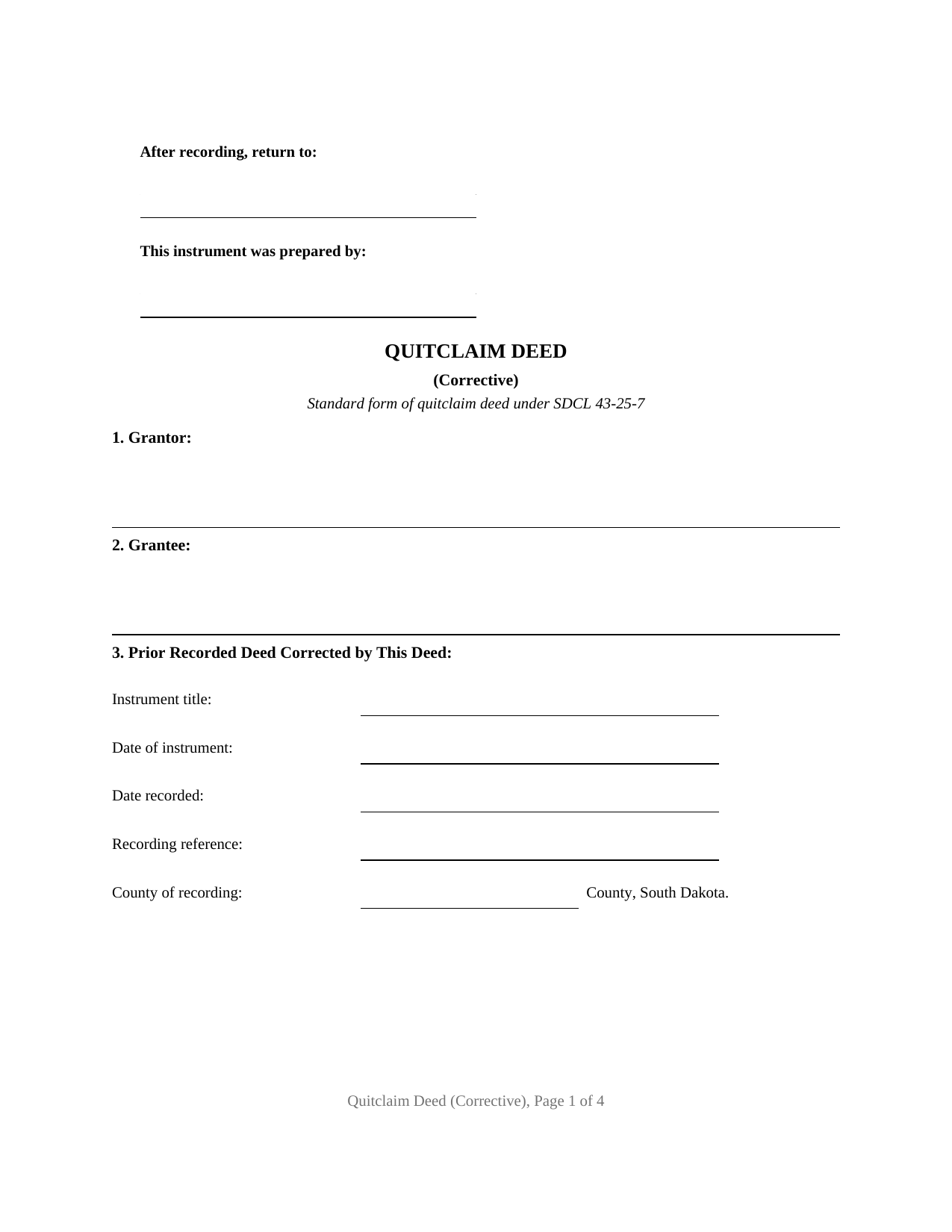
About the South Dakota Quitclaim Deed (Corrective)
How to Use This Form
- Select your county from the list
- Download the county-specific form
- Fill in the required information
- Have the document notarized if required
- Record with your county recorder's office
What Others Like You Are Saying
"Very pleased with the ease of this deed form. Completing the deed form to make sure everything was i…"
"Great forms! No issues at all at the recorder office. Will be back for sure if needed."
"I am an attorney assisting my son with some simple legal docs & this service saved me a lot of t…"
"It was easy to find what I was looking for. The instructions were easy to follow. The example given …"
"Easy process as I had an example of my other property deeds to work from plus my most current Real E…"
4.8/5 from 4,832 reviews. Read all
Most deeds move property. This one repairs a record. A corrective quitclaim deed points at an instrument already sitting in the register of deeds record, states what that instrument got wrong, states what it was meant to say, and quitclaims the grantor's interest once more against the description as corrected. The fillable form prepares that second deed on the standard quitclaim pattern South Dakota enacted in 1911 and carries today at SDCL 43-25-7.
Three sections carry the correction
The variant lives in Sections 3, 4, and 5. Section 3 identifies the earlier instrument the way a title examiner searches for it: title, signing date, recording date, document number or book and page, and the county that recorded it. Section 4 states the error. Section 5 states the corrected information and the source behind it, a recorded plat, a survey, or the vesting deed ahead of the one being fixed. Both instruments stay in the chain and are read together, which is why the deed spells the variance out rather than leaving two disagreeing descriptions to be reconciled by inference.
South Dakota names this deed in the fee statute
No SDCL section enacts a correction deed form or a scrivener's error affidavit for deeds, and none was located in this build. Recognition of the category arrives where money changes hands instead: SDCL 43-4-22(4) exempts a transfer of title which confirms or corrects a deed previously executed and recorded from the realty transfer fee, and SDCL 43-4-23 has the claim marked on the instrument, so Section 9 receives the exemption with its subdivision in parentheses. A false claim is a misdemeanor under SDCL 43-4-26. The Department of Revenue's certificate of real estate value still crosses the counter as its own filing under SDCL 7-9-7, carrying that exemption number.
Interest passes again, with no promises attached
Section 11 performs the act in the statutory pair of words, conveys and quitclaims. SDCL 43-25-8 sets the reach of an instrument in that form at the interest the grantor holds when the deed is made, leaving later-arriving title behind unless words claiming it are added, and this deed adds none. South Dakota also reads two covenants into quitclaim words unless a conveyance restricts them by express terms, one denying an earlier conveyance of the same estate, one denying encumbrances the grantor made, did, or suffered; the operative section restricts both in capitals. The same section states the boundary that makes this a correction: the deed restates the earlier conveyance with corrected information and passes no interest beyond what that deed was given to pass.
One grantor, the same two parties
The form recites the grantor who signed the earlier deed, with name, marital status, and mailing address, and the grantee who took under it, with the address SDCL 43-28-23 makes recording content. One signature block with a printed-name line and one notary certificate follow; the grantee signs nothing. Patterns appearing in the South Dakota record include a platted description whose subdivision or lot designation was typed wrong, a grantee surname misspelled at closing, and a reference to the wrong prior instrument. This deed does not print two owners who signed the original together, an entity or trustee that executed it in a representative capacity, an agent signing under a power of attorney, or a homestead conveyance, where SDCL 43-31-17 has both spouses concur in and sign.
Where a correction ends and a new deed begins
A corrective deed answers to mistakes in the writing. Moving title to a different parcel, adding or dropping a party, or changing the bargain is a fresh conveyance signed by whoever holds record title then. Revision of an instrument for fraud or mistake belongs to a court under SDCL chapter 21-11, and a bare variance in a name has its own route, since the State Bar of South Dakota Title Standards treat a recorded affidavit as curative evidence for name discrepancies; such an affidavit is prepared and recorded on its own and is not part of this package. Recording happens where the land lies, for thirty dollars under SDCL 7-9-15.
Three files ship with this correction deed: the blank quit claim deed as a fillable PDF, a completed example worked through on a Clay County description error, and a plain-language guide to the twelve numbered sections, the signing formalities, and what the register of deeds collects. The materials are informational and are not legal advice.
Important: County-Specific Forms
Our quitclaim deed (corrective) forms are specifically formatted for each of the 66 counties in South Dakota.
After selecting your county, you'll receive forms that meet all local recording requirements, ensuring your documents will be accepted without delays or rejection fees.