South Dakota Quitclaim Deed
County Specific Legal Forms Validated as recently as October 6, 2026 by our Forms Development Team
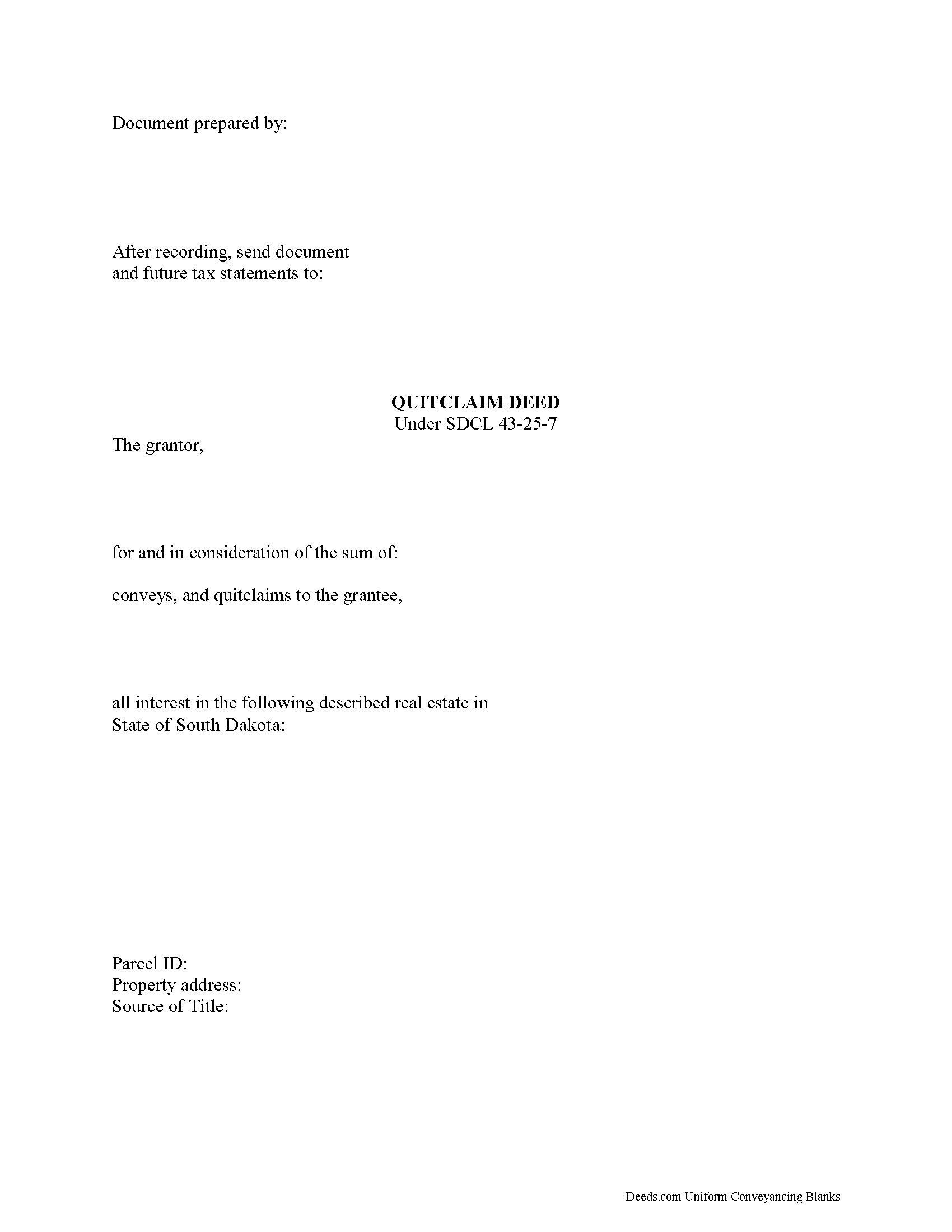
About the South Dakota Quitclaim Deed
How to Use This Form
- Select your county from the list
- Download the county-specific form
- Fill in the required information
- Have the document notarized if required
- Record with your county recorder's office
What Others Like You Are Saying
"This site was a great help to us. It was worth the money to get it right!"
"Easy to set up and fast service."
"Your site was so easy to use. And I got the form and instructions I needed."
"Big savings and easy to use. Thanks so much."
"Easy-peasy to find, download and use the forms!"
4.8/5 from 4,828 reviews. Read all
A South Dakota quitclaim deed that assumes nothing about the people signing it. The grantor block on this fillable form takes one name or two, in whatever words describe the signers, and the grantee block does the same, so marital status recitals and any co-ownership designation are entered by the parties instead of preprinted by the form. The conveyance itself runs on the two words the 1911 standard form put into the code at SDCL 43-25-7, conveys and quitclaims.
The quirk that separates a South Dakota quitclaim from the common-law one
Elsewhere a quitclaim grantee often struggles to claim the recording act's protection, on the theory that the deed's own form warns that the title is doubtful. South Dakota wrote the opposite rule. Under SDCL 43-25-12, a person holding real estate under a quitclaim deed is deemed a purchaser in good faith and for valuable consideration unless that person had actual notice or knowledge of a prior unrecorded conveyance when the deed was executed and delivered. The recording statutes then work normally: SDCL 43-28-15 through 43-28-17 give a recorded conveyance priority against a later good-faith purchaser for value, while an unrecorded deed stays good between the parties and anyone with notice under SDCL 43-28-14.
Interest at the date of the conveyance, and no promises with it
SDCL 43-25-8 fixes what moves: all right, title, and interest of the grantor in the premises described, measured when the deed is made, with title arriving later left behind unless words expressing that intention are added. This deed adds none and says so. South Dakota then reads two covenants into quitclaim words unless a conveyance restricts them by express terms, one denying an earlier conveyance of the same estate, the other denying encumbrances the grantor made, did, or suffered, so Section 9 restricts and excludes both in capital letters. What the grantee receives is interest, whatever it turns out to be.
One quit claim deed, four count patterns
The instrument carries a Grantor block and a Grantee block, each sized for one or two people signing in their own names, two signature blocks headed GRANTOR and SECOND GRANTOR (if applicable), and an acknowledgment certificate for each; the second block and its certificate stay blank where one person conveys. That architecture prints one grantor to one grantee, one to two, two to one, and two to two. Where the land is the homestead of a married owner, SDCL 43-31-17 has both spouses concur in and sign the conveyance, and the second block takes that signature, whichever spouse holds record title; outside the homestead, SDCL 25-2-4 leaves separate property conveyable by one spouse alone. Two grantees fall to the interest-in-common default of SDCL 43-2-17 unless the grantee clause expressly declares a joint tenancy in the words SDCL 43-2-12 calls for. Entity, trustee, and attorney-in-fact signers, and three or more owners on either side, each print a different configuration than this form recites.
Three charges, and a sheet the statute measures
The signed instrument goes to the register of deeds for the county in which the parcel sits, where SDCL 7-9-15 prices a deed of fifty pages or fewer at thirty dollars statewide. SDCL 43-4-21 puts the realty transfer fee on the grantor at fifty cents for each five hundred dollars of value or fraction of it, turning the example's $214,500.00 of consideration into $214.50 collected before the deed goes on record; a transfer within one of the SDCL 43-4-22 categories instead marks the instrument under SDCL 43-4-23 with the words the statute names and the subdivision claimed, which Section 7 receives. Separately, SDCL 7-9-7 sends a completed certificate of real estate value across the same counter on the Department of Revenue's own form. SDCL 43-28-23 then measures the sheet, and the deed is built to it: ten point type at the smallest, three inches of blank space at the head of page one, an inch of margin elsewhere, the grantee's mailing address, and each signer's name printed beneath the signature. A page that misses a measurement is surcharged under SDCL 43-28-24 rather than refused.
The package is three files. The blank quit claim deed arrives as a fillable PDF; the completed example fills every blank on a Lawrence County sale by two record owners to a couple taking with survivorship; and the guide walks the ten numbered sections, the ownership forms open to grantees, the signing mechanics, and the recording package. The materials are informational and are not legal advice.
Important: County-Specific Forms
Our quitclaim deed forms are specifically formatted for each of the 66 counties in South Dakota.
After selecting your county, you'll receive forms that meet all local recording requirements, ensuring your documents will be accepted without delays or rejection fees.