South Dakota Quitclaim Deed (Divorce)
County Specific Legal Forms Validated as recently as October 5, 2026 by our Forms Development Team
About the South Dakota Quitclaim Deed (Divorce)
How to Use This Form
- Select your county from the list
- Download the county-specific form
- Fill in the required information
- Have the document notarized if required
- Record with your county recorder's office
What Others Like You Are Saying
"good place to get documents and it seems like a sound place to get forms. Self explainitory and help…"
"Wow! Deeds.com provided proficient eRecording with great response time and great service... and it w…"
"Exceptionally easy site to navigate. Forms and related documents downloaded quickly and were helpful…"
"Couldn't be more simple. Good product"
"I found the information easy to understand, and the forms to be correct for my needs."
4.8/5 from 4,815 reviews. Read all
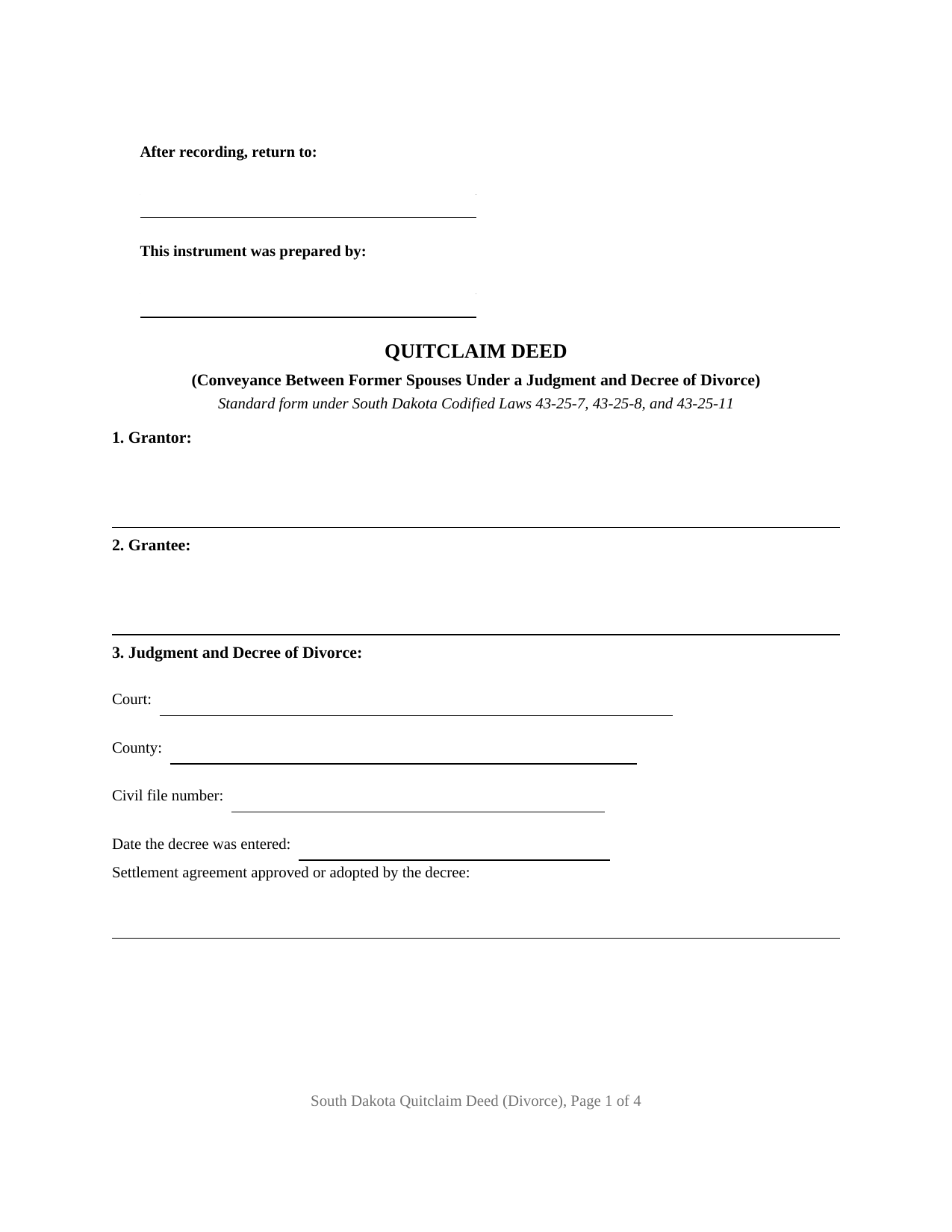
A South Dakota divorce decree can carry title on its own, but only if it says two specific things. Under Standard 12-02 of the State Bar of South Dakota Title Standards, carried in SDCL chapter 43-30S, a divorce judgment is sufficient to vest title where it contains a legal description of the property and a statement by the court that the judgment acts in lieu of a conveyance if the party fails to execute one. A decree carrying neither leaves the transfer to a deed. This fillable quitclaim deed is the appropriate instrument of conveyance that standard points at: one former spouse signs, the decree is named on the face of the instrument, and the division reaches the land records.
The decree sits on the face of the deed
Section 3 identifies the judgment and decree the way a searcher hunts for it: the court, the county, the civil file number, the date of entry, and any stipulation and settlement agreement the decree approved or adopted. Section 11 ties the conveyance to that decree, stating that the deed is made in performance of the division of property the decree states. SDCL 25-4-44 is where the division comes from, letting the court divide property belonging to either or both parties whatever the source of title.
What the divorce already did to the title
Some of the work happens before anyone signs. SDCL 29A-2-804 severs a joint tenancy between spouses when the marriage ends, converting the survivorship interests into a tenancy in common, subject to the exceptions that section carries. A couple who bought a house as joint tenants hold it as tenants in common once the decree is entered. This deed does the remaining work, moving the divested party's undivided interest to the party the decree names, so one name stands in the chain of title where two stood before.
Interest passes, with South Dakota's implied covenants shut off
The operative words come from the standard form of SDCL 43-25-7: conveys and quitclaims. SDCL 43-25-8 measures their reach at the date of the conveyance and leaves later-arriving title behind unless words claiming it are added, which this instrument does not add. Quitclaim words otherwise carry two covenants under SDCL 43-25-11 unless a conveyance restricts them by express terms. Section 11 restricts both in capital letters, so what reaches the receiving former spouse is interest, with no title promises riding along.
One signature, and the reason the homestead statute stays quiet
The form recites one Grantor, one Grantee, one signature block, and one acknowledgment certificate; the Grantee signs nothing. Section 11 recites that the marriage was dissolved by the decree identified in Section 3 and that the two parties are not married to each other on the date of the conveyance. That recital carries weight: SDCL 43-31-17 conditions a homestead conveyance on both spouses concurring and signing, and its predicate is an owner who is married, so the section states no rule for a deed executed after the decree. Patterns appearing in the South Dakota record with this architecture include a decree awarding the marital home to one party while record title stands in both names, and a decree confirming a parcel to the party who brought it into the marriage. A deed prepared before any decree is entered, a conveyance to an outside buyer, and trustee, entity, or agent signers each print a different configuration than this quit claim deed recites.
The line written for divorce in the exemption list
The SDCL 43-4-21 realty transfer fee is collected before recording unless an exemption is claimed, and subdivision (17) of SDCL 43-4-22 is written for this exact transfer: one made pursuant to a decree of divorce, annulment, or separate maintenance, or pursuant to a settlement agreement approved or adopted by such a decree. SDCL 43-4-23 has the claim marked on the instrument, which Section 9 receives. One distinction meets filers at the counter: Department of Revenue guidance lists a divorce decree among the documents needing no certificate of real estate value, but a divorce deed is a deed, and the SDCL 7-9-7 certificate crosses the counter with it carrying the exemption number.
Three files come with the purchase: this divorce quitclaim deed as a blank fillable PDF, a completed example worked through on a Pennington County conveyance following a Rapid City decree, and a plain-language guide to the twelve numbered sections, the signing formalities, and the recording package. The materials are informational and are not legal advice.
Important: County-Specific Forms
Our quitclaim deed (divorce) forms are specifically formatted for each of the 66 counties in South Dakota.
After selecting your county, you'll receive forms that meet all local recording requirements, ensuring your documents will be accepted without delays or rejection fees.