Texas Easement Deed (Ingress and Egress)
County Specific Legal Forms Validated as recently as September 11, 2026 by our Forms Development Team
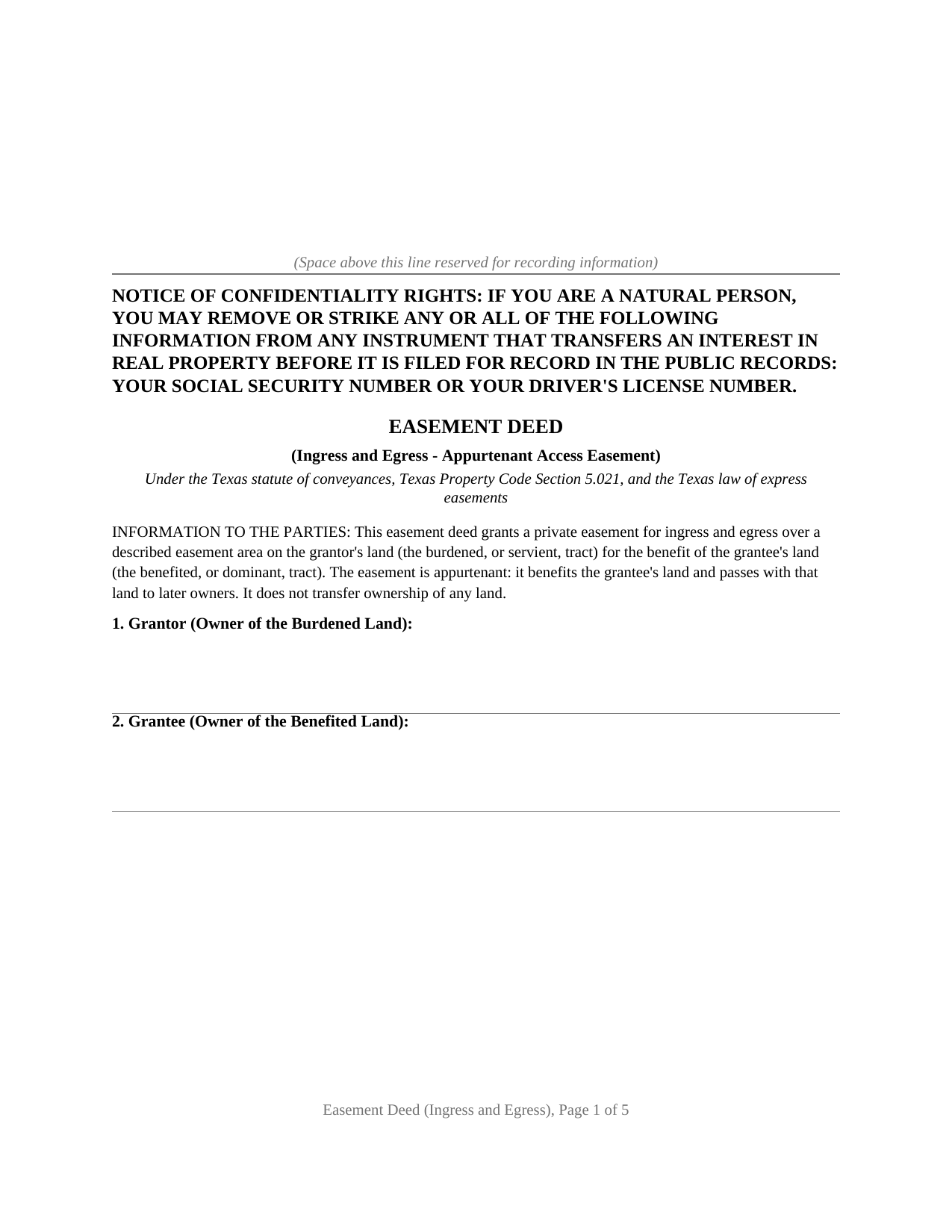
About the Texas Easement Deed (Ingress and Egress)
How to Use This Form
- Select your county from the list
- Download the county-specific form
- Fill in the required information
- Have the document notarized if required
- Record with your county recorder's office
What Others Like You Are Saying
"Found correct form right away, easy to download and print. Thank you!"
"Awesome same-day service!"
"My E-deed was not excepted by the county, so I had to snail mail the documents to the recorders offi…"
"Very easy to download and appreciated the other information and affidavits."
"As advertised. Thanks."
4.8/5 from 4,818 reviews. Read all
A Texas easement deed for ingress and egress grants a recorded right to cross one owner's land so that a neighboring owner can reach a road. It does not hand over ownership of the strip that gets crossed; it grants a right of passage that attaches to the benefited land and travels with it to every later owner. This form prepares that grant as an appurtenant easement, the kind that ties access to a parcel rather than to a person.
A Right of Passage, Not a Transfer of Land
An easement is a nonpossessory interest: the owner of the burdened land keeps the land and every use of it that does not unreasonably interfere with the right granted. The grantee gets the right to enter, leave, and pass over a defined area, on foot and by vehicle, and nothing more unless the deed says so. Texas courts read ingress and egress narrowly as the right to pass; a right to park or to build has to be spelled out, and this form sets that out in its terms section rather than leaving it to argument later.
Appurtenant: The Access Runs With the Land
The form grants an easement appurtenant, which means it benefits a particular tract, the dominant estate, by burdening another tract, the servient estate. An appurtenant easement attaches to the benefited land and passes automatically when that land is sold, so a buyer of the rear lot inherits the recorded right to cross the front lot. The deed names both tracts for exactly this reason, which also removes any question of whether the access is merely personal.
The Description Has to Locate the Easement
The detail that most often decides whether an access easement holds up is the description of the easement area. Texas courts require that an easement be described with enough certainty that a surveyor can go on the ground and locate it; an easement whose writing gives no way to fix the area is void under the statute of frauds, the rule stated in Pick v. Bartel and applied to strike down vague access easements. The form gives the easement area its own section, separate from the descriptions of the two whole tracts, and the guide explains how a strip is fixed by width, course, and length or by an attached easement plat.
Signing, Homestead, and Co-Owners
The owner of the burdened land signs as grantor, because a grant of an easement is a conveyance under Texas Property Code Section 5.021, which calls for a writing signed and delivered by the grantor. Where the burdened land is the homestead of a married grantor, both spouses sign: Texas Family Code Section 5.001 calls for both spouses to join in an encumbrance of the homestead, and an easement is an encumbrance. The form carries a joining-spouse signature block for that situation and leaves it blank otherwise. Where more than one owner holds the burdened tract, all of them sign.
The completed deed is recorded with the county clerk of the county where the burdened land is located, which protects the easement against a later purchaser of that land who pays value without notice. The package includes the fillable easement deed, a completed example built on a realistic Travis County access arrangement, and a plain-language guide that walks every section. The materials are informational and are not legal advice.
Important: County-Specific Forms
Our easement deed (ingress and egress) forms are specifically formatted for each of the 254 counties in Texas.
After selecting your county, you'll receive forms that meet all local recording requirements, ensuring your documents will be accepted without delays or rejection fees.