Texas Grant Deed (Joint Grantors)
County Specific Legal Forms Validated as recently as September 30, 2026 by our Forms Development Team
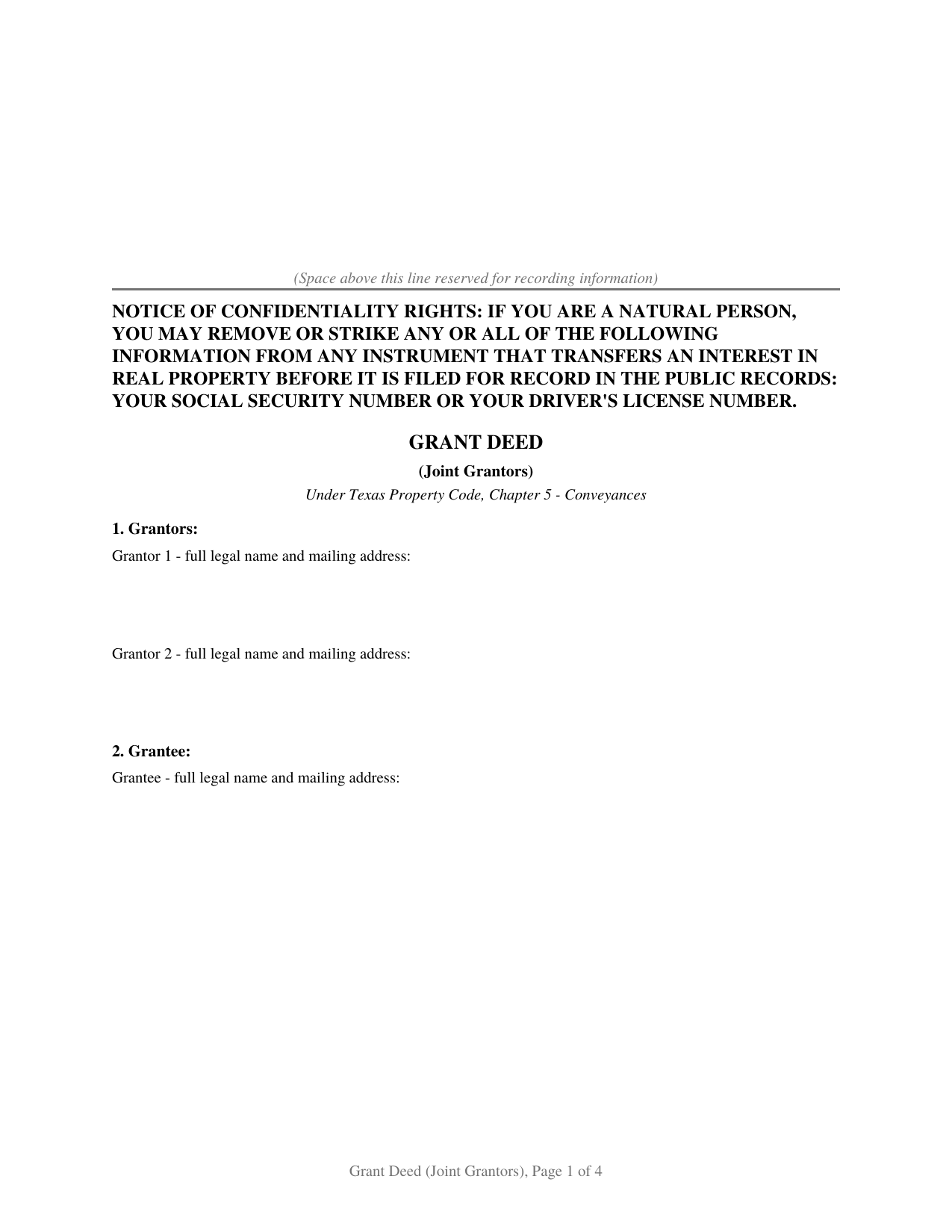
About the Texas Grant Deed (Joint Grantors)
How to Use This Form
- Select your county from the list
- Download the county-specific form
- Fill in the required information
- Have the document notarized if required
- Record with your county recorder's office
What Others Like You Are Saying
"Thank you for offering this service. We were getting several different answers on how to solve our p…"
"Disclaimer letter was just what I needed. Download worked without a hitch."
"It was very easy to navigate and find what I needed. Very happy with the app."
"Thank for you guidance to amend & correct & recover my home with evidence you provide in Dea…"
"I got what I needed and did exactly what I needed. All legal and no hassle. Thanks Deeds.com, you ma…"
4.8/5 from 4,828 reviews. Read all
When two owners transfer Texas real estate together, the deed they sign sets how much each promises about the title. A grant deed has them convey the property with two specific covenants and nothing beyond them. This form prepares a grant deed for two grantors under Chapter 5 of the Texas Property Code.
Two Owners Conveying Together
Both owners on the current deed sign as grantors and convey the property to the grantee. How they hold title between themselves, as tenants in common, joint tenants, or community property, does not change the deed: each signs, and each conveys the property described in it. A separate notary certificate for each grantor lets the two acknowledge on different days or before different notaries, even in different states.
What the Words Grant and Convey Promise
A grant deed takes its character from Section 5.023 of the Property Code. Unless a deed provides otherwise, the words grant and convey carry two covenants: that the signer has not previously conveyed the property to anyone else, and that the signer placed no encumbrance on it. The deed adds no general or special warranty, so it makes no broader promise to defend the title. The covenants are narrow by design, reaching a grantor's own conduct rather than the full history of the title or problems that predate the grantor's ownership.
Each Grantor Answers Only for Their Own Acts
With two grantors, the Section 5.023 covenants run separately. Each grantor promises only about what that grantor did: that this signer made no earlier conveyance and placed no encumbrance. One grantor does not insure the other's conduct, and neither answers for the chain of title that came before. That per-grantor structure is the practical point of a two-owner deed, and the form states the covenant for each grantor rather than as one joint promise.
When the Two Grantors Are a Married Couple
The most common pair of grantors is a married couple selling property they own together. When the property is their homestead, Texas Family Code Section 5.001 calls for both spouses to join in the conveyance, and here both already sign as grantors, so the deed meets that rule on its face. Where a grantor's spouse is not a co-owner and the property is that grantor's homestead, the non-owner spouse signs too; the individual grantor form carries a joinder line for that signature.
Recording in Texas
A grant deed is recorded with the county clerk where the property sits. Recording does not make the deed good between the parties, a delivered deed already does that, but under Property Code Section 13.001 an unrecorded deed is void against a later buyer or creditor without notice. Texas charges no transfer tax on a deed, and since December 4, 2025, a person filing one in person shows a government photo identification under Senate Bill 16.
Related Texas Forms
The Texas Grant Deed (Individual Grantor) makes the same two covenants for a single owner and adds a joinder line for a non-owner spouse. The Texas Deed Without Warranty uses the Section 5.023 exclusion this form omits, leaving its grantee with no covenant of title. The Texas Quitclaim Deed passes only whatever interest the grantors hold, if any. The Texas Gift Deed records a transfer made for no consideration.
Important: County-Specific Forms
Our grant deed (joint grantors) forms are specifically formatted for each of the 254 counties in Texas.
After selecting your county, you'll receive forms that meet all local recording requirements, ensuring your documents will be accepted without delays or rejection fees.