Vermont Administrator Deed (Entity)
County Specific Legal Forms Validated as recently as September 9, 2026 by our Forms Development Team
About the Vermont Administrator Deed (Entity)
How to Use This Form
- Select your county from the list
- Download the county-specific form
- Fill in the required information
- Have the document notarized if required
- Record with your county recorder's office
What Others Like You Are Saying
"Really a great service for a reasonable price. Will definitely use again."
"No Brainer. Easy to use. Good service. I recommend this."
"Outstanding. There is nothing worse than finding the correct forms or having to hire an atty to do w…"
"Awesome. Quick informative and very easy. I made a mistake the first time, emailed you and was able …"
"Very easy. Worked well. Will be glad to use the service again."
4.8/5 from 4,815 reviews. Read all
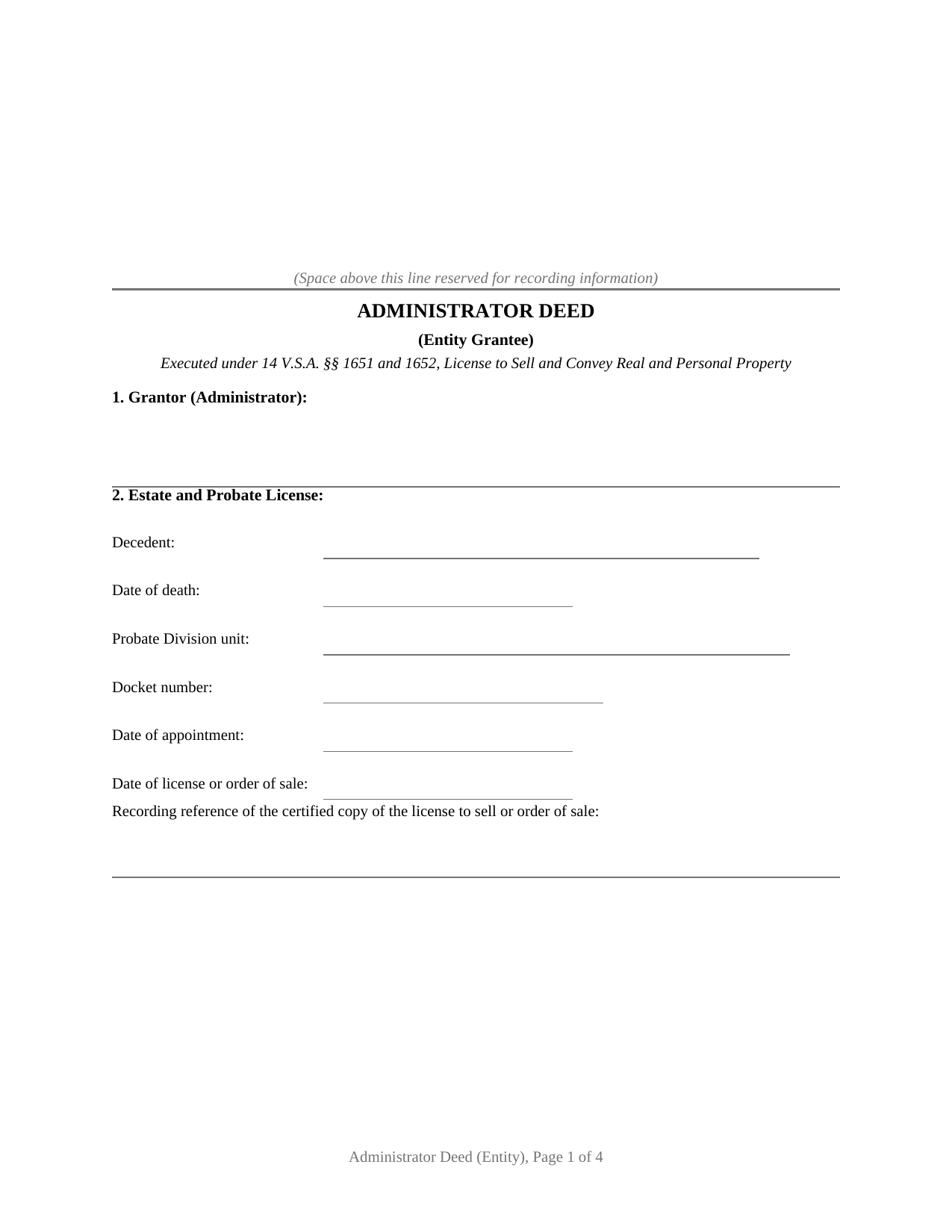
This fill-in-the-blank administrator deed conveys Vermont real property out of a deceased owner's estate to a single entity grantee: a limited liability company, corporation, partnership, or nonprofit organization taking title in its exact registered name. The form is configured for one court-appointed administrator signing in a fiduciary capacity under a license to sell or order of sale issued by the Probate Division of the Vermont Superior Court, with one organization named as grantee.
A deed that runs on the probate license
Vermont estates sell real property through 14 V.S.A. chapter 75. Under section 1651, the Probate Division may license a sale it finds necessary or beneficial, on a motion by the fiduciary, with written consents of interested persons where required, notice and hearing where consent cannot be obtained, and a bond where the court directs one. Section 1652 then gives the deed its force: the deed of an administrator who has obtained a certified copy of the order of sale or license to sell is valid to convey the real estate authorized to be sold. The form carries that machinery on its face. Its estate section collects the decedent's name and date of death, the Probate Division unit and docket number, the dates of appointment and license, and the recording reference for the certified copy of the license, which section 1651(8) sends to the same municipal land records that receive the deed.
An entity grantee, named the way the registry names it
The grantee section recites one organization in three entries: the exact legal name as it appears in the formation record or business registry, the entity type and state of organization, and the mailing address. The completed example shows a Vermont limited liability company taking the whole interest in its registered name, the sole-ownership vesting a single-grantee deed states. An estate selling a house to a local investment company, a farm parcel passing to an agricultural LLC, and a village lot bought by a nonprofit housing organization all present the single-entity pattern this deed recites. The form is set up for exactly one entity grantee; a sale to individual purchasers, or to two or more buyers taking in a co-ownership form, presents a different grantee pattern than this configuration carries.
One fiduciary signature, one representative-capacity certificate
The administrator signs alone, and the form carries one acknowledgment certificate in the statutory short form for a representative capacity under 26 V.S.A. section 5368(2), with the statute's labeled blanks printed on the certificate: the name of the individual signing, the type of authority, and the estate on whose behalf the deed is executed. No witnesses are required on a Vermont deed, and no spouse signs; the grantor is the estate's fiduciary, and the protections for heirs and creditors live in the license procedure itself. The operative section conveys all right, title, and interest of the decedent and the estate, with a covenant limited to the administrator's appointment and the court's license rather than a general warranty, so the grantee takes subject to matters of record.
Recorded with the town clerk, taxed on the transfer
Vermont records land instruments by municipality. The deed goes to the clerk of the town or city where the land lies, at the statewide fee of $15.00 per page under 32 V.S.A. section 1671. A Vermont Property Transfer Tax Return accompanies the deed; under 32 V.S.A. section 9608 the clerk cannot record without a complete return and the required Act 250 certificate. The transferee is liable for the transfer tax, and an ordinary estate sale to an entity falls in the general bracket: 1.25 percent of value plus the 0.22 percent clean water surcharge, 1.47 percent combined.
The download includes the blank fillable administrator deed formatted for Vermont municipal recording, a completed example showing a licensed estate sale to an entity grantee, and a guide that walks through each section of the form, the license requirement, and the recording process. The materials are informational and are not legal advice.
Important: County-Specific Forms
Our administrator deed (entity) forms are specifically formatted for each of the 14 counties in Vermont.
After selecting your county, you'll receive forms that meet all local recording requirements, ensuring your documents will be accepted without delays or rejection fees.