Vermont Administrator Deed
County Specific Legal Forms Validated as recently as October 16, 2026 by our Forms Development Team
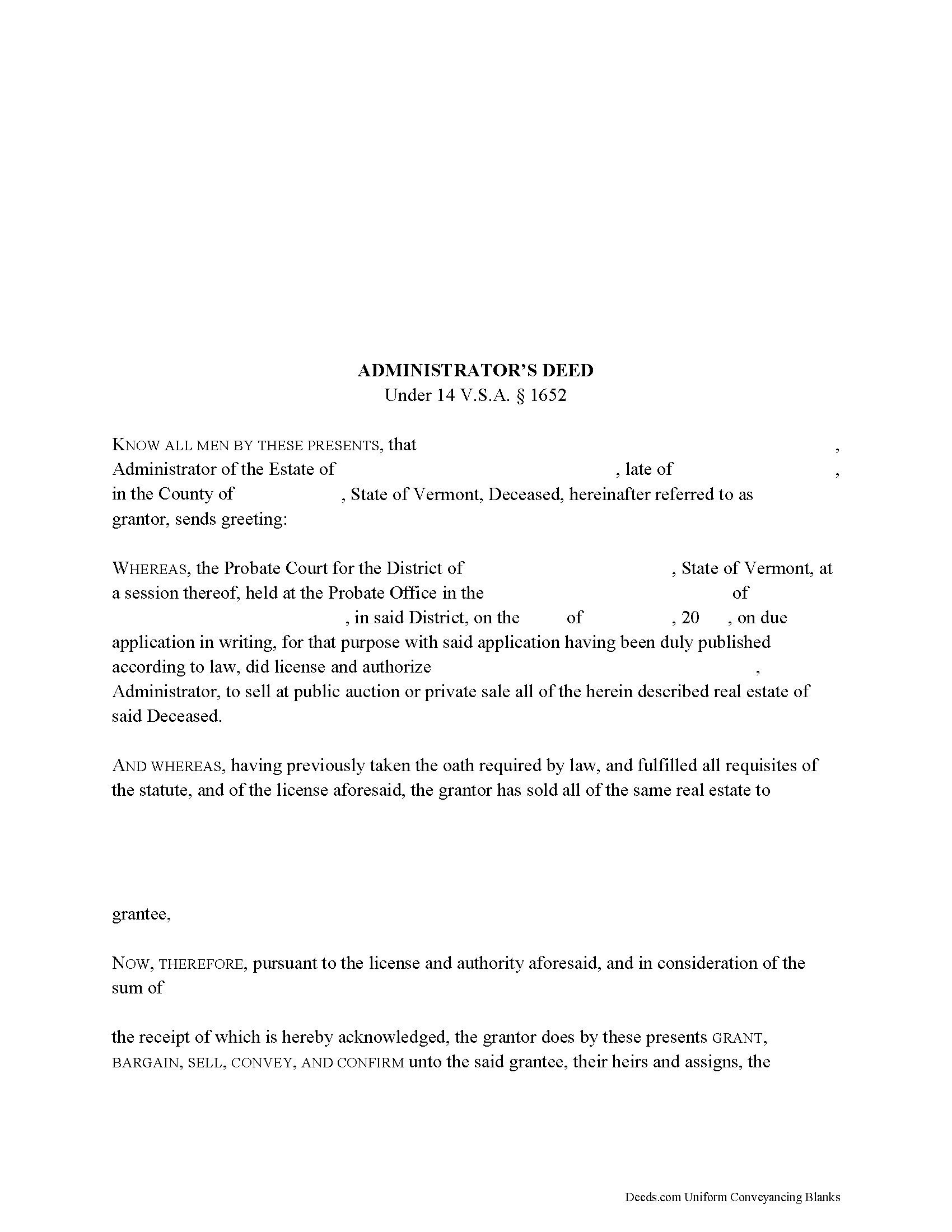
About the Vermont Administrator Deed
How to Use This Form
- Select your county from the list
- Download the county-specific form
- Fill in the required information
- Have the document notarized if required
- Record with your county recorder's office
What Others Like You Are Saying
"Very pleased with deeds.com. I highly recommend them to anyone, from clueless beginners like myself …"
"This is so much easier than going downtown to file paperwork! Thanks deeds.com!"
"Very easy. Very helpful."
"It was easy to use and clear directions."
"Thank-you for your excellent services"
4.8/5 from 4,836 reviews. Read all
This fillable Vermont administrator's deed carries a single configuration: one court-appointed administrator, signing in a fiduciary capacity, conveys real property of a deceased person's estate. The form recites one administrator, one estate, and one fiduciary signature block with one acknowledgment certificate, the pattern that appears when an intestate estate sells a parcel through its personal representative.
One signature, one fiduciary capacity
Everything on this deed runs through the administrator's representative capacity. The signature area carries a single signature line with a printed-name entry, the acknowledgment certificate's name line carries the signer's name together with the capacity, in the style of the included example, and the operative section states expressly that the administrator signs solely as administrator of the estate and not individually. Estates with two co-administrators, and executors acting under a proved will, present different signing and capacity patterns; this form recites exactly one administrator of an estate under administration.
A deed that points back to its license
Vermont ties the validity of a personal representative's conveyance to court authority. Under 14 V.S.A. 1652, the deed of an executor or administrator who has obtained a certified copy of an order of sale or license to sell real estate from the Probate Division of the Superior Court is valid to convey the real estate of a deceased person authorized to be sold, and 14 V.S.A. 1651 directs that a certified copy of the license or order be recorded in the same office where the deed is recorded. This administrator deed is built around that structure: a section identifies the estate by decedent, Probate Division unit, and docket number, and a dedicated license section carries the date of the license or order of sale and the book and page where the certified copy sits in the town land records. The probate deed and the recorded license read together in the chain of title.
A fiduciary covenant that stops at the estate
The deed's granting clause gives, grants, sells, conveys, and confirms the property to the grantee, and its covenants are fiduciary in scope: the administrator covenants due appointment and authority under the license, and warrants the property against the lawful claims of persons claiming by, through, or under the decedent or the estate, but against no other claims. The instrument states that the administrator makes no personal covenant or warranty, which keeps the fiduciary's exposure inside the estate rather than personal. Sections for the legal description, the property address, the decedent's source of title, and the encumbrances the conveyance remains subject to complete the picture a title examiner reads.
Recording with the town clerk, not a county recorder
Vermont records land instruments by town and city. The completed deed is acknowledged before a notary public under 27 V.S.A. 341 and recorded with the clerk of the town or city where the land lies, at the statewide fee of $15.00 per page under 32 V.S.A. 1671. A Vermont Property Transfer Tax Return accompanies the deed; under 32 V.S.A. 9608 the town clerk does not record a deed evidencing a transfer of title without a complete return and the required Act 250 certificate, and the transfer tax return is prepared separately and not included in this package. The included guide walks through the return, the tax rates, and the license recording step in full.
What the download contains
The package contains the fillable administrator deed form, a completed example showing a licensed estate sale filled in from start to finish, and a guide that explains each section, the signing and notarization formalities, and the recording process with the town clerk. The materials are informational and are not legal advice; a Vermont attorney can address how the probate and conveyancing statutes operate on a specific estate.
Important: County-Specific Forms
Our administrator deed forms are specifically formatted for each of the 14 counties in Vermont.
After selecting your county, you'll receive forms that meet all local recording requirements, ensuring your documents will be accepted without delays or rejection fees.