Vermont Administrator Deed (Two Individuals)
County Specific Legal Forms Validated as recently as September 23, 2026 by our Forms Development Team
About the Vermont Administrator Deed (Two Individuals)
How to Use This Form
- Select your county from the list
- Download the county-specific form
- Fill in the required information
- Have the document notarized if required
- Record with your county recorder's office
What Others Like You Are Saying
"Great process and very easy to complete"
"I found everything I needed. Very easy to use. I am very satisfied."
"Lots of Info. Forms seem straightforward. Easy to Fill out."
"I love this tool and it is easy to work with. The interface is straight forward and notifications ar…"
"I downloaded the gift deed and I can not type my info onto it what am I doing wrong. Please advise"
4.8/5 from 4,823 reviews. Read all
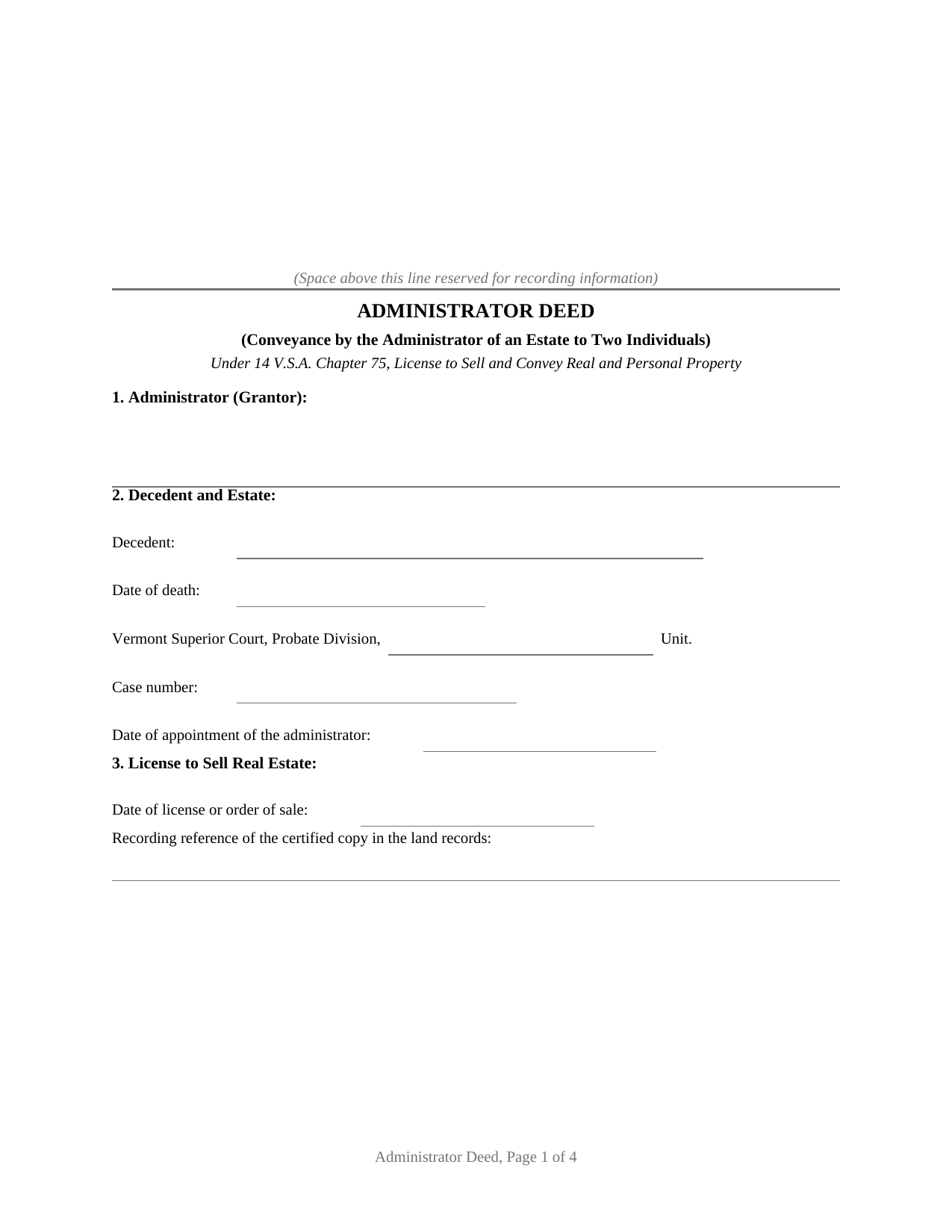
A Vermont administrator deed moves a decedent's real estate out of probate administration and into the hands of its new owners, and this version of the form recites exactly two individual grantees. On its face the deed identifies the administrator appointed by the Probate Division of the Vermont Superior Court, the estate, the license to sell real estate issued under 14 V.S.A. Chapter 75, the two people who take title, and the form of co-ownership in which they take it.
A deed that carries its court authority on its face
Vermont routes fiduciary sales of estate land through the Probate Division. Under 14 V.S.A. Section 1651, the court grants a license when a sale of estate property appears necessary or beneficial, and a certified copy of the license to sell or order of sale is recorded in the same land records where the deed itself will be recorded. Section 1652 then does the heavy lifting: the deed of an administrator who has obtained that certified copy is valid to convey the real estate the license authorized to be sold. This form is built around that pairing. A dedicated section of the deed records the license date and the book and page where the certified copy appears in the town records, so the deed and its authority read together in the chain of title, and the operative clause conveys under that stated license in the administrator's fiduciary capacity alone.
Two grantees and the words that set their co-ownership
The grantee section carries three blanks: one for each of the two individual grantees, with mailing addresses, and one for the form of co-ownership. Vermont law makes that last entry meaningful. Under 27 V.S.A. Section 2, a conveyance to two or more persons creates a tenancy in common unless the deed expresses joint tenancy, with survivorship arising only from express words such as as joint tenants or to them and the survivors of them, and a conveyance to spouses sits outside the default entirely. The completed example shows two unmarried buyers taking as tenants in common in equal undivided halves; the guide walks through each form Vermont recognizes and the exact words that create it, so the entry can match what the buyers agreed to. The form recites two individual grantees taking in their own right; a sole purchaser, an entity, a trustee, or a group of three or more presents a different grantee pattern than this deed recites.
Covenants scaled to a fiduciary
An administrator does not warrant a dead person's title history, and this deed does not pretend otherwise. It conveys all of the right, title, and interest the decedent had at death and the estate holds at delivery, with covenants limited to what the fiduciary actually controls: the appointment, the license, and the administrator's own acts. The deed states expressly that no other covenant or warranty is made or implied, and a numbered section collects the encumbrances the title remains subject to. Where the licensed property carries a mortgage or other lien, 14 V.S.A. Section 1662 sends the net sale proceeds to the lien first, and the closing produces the discharges that clear the record.
Signing and recording in the town land records
The administrator is the only signer and acknowledges the deed before a notary public, in the representative capacity the certificate recites. Vermont records land instruments town by town rather than by county, so the deed goes to the clerk of the town or city where the land lies, at the statewide fee of $15.00 per page. The clerk cannot record the deed unless a completed Vermont Property Transfer Tax Return accompanies it along with the certificate required by 32 V.S.A. Section 9608, and the buyers, as transferees, bear the transfer tax. The guide's recording section describes the return, the current rates and surcharge, and the Act 250 certificate in order.
The download contains this administrator deed as a fillable PDF, a completed example showing every entry made for a realistic Washington County estate sale, and a plain-language guide that walks through each numbered section, the notarization, and the recording package. The materials are informational and are not legal advice; a Vermont attorney can apply Chapter 75 to a particular estate.
Important: County-Specific Forms
Our administrator deed (two individuals) forms are specifically formatted for each of the 14 counties in Vermont.
After selecting your county, you'll receive forms that meet all local recording requirements, ensuring your documents will be accepted without delays or rejection fees.