Vermont Disclaimer of Interest (Entity)
County Specific Legal Forms Validated as recently as September 25, 2026 by our Forms Development Team
About the Vermont Disclaimer of Interest (Entity)
How to Use This Form
- Select your county from the list
- Download the county-specific form
- Fill in the required information
- Have the document notarized if required
- Record with your county recorder's office
What Others Like You Are Saying
"Love this site. The form directions are easy and I finished in less than an hour! Totally recommend …"
"So far it has been a good experience. I am working on getting a beneficiary deed."
"Very fast and easy! Thanks!!"
"I was happy with the way this worked and the quick responses. Unfortunately, my documents could not …"
"ive been looking for this information thank you ."
4.8/5 from 4,819 reviews. Read all
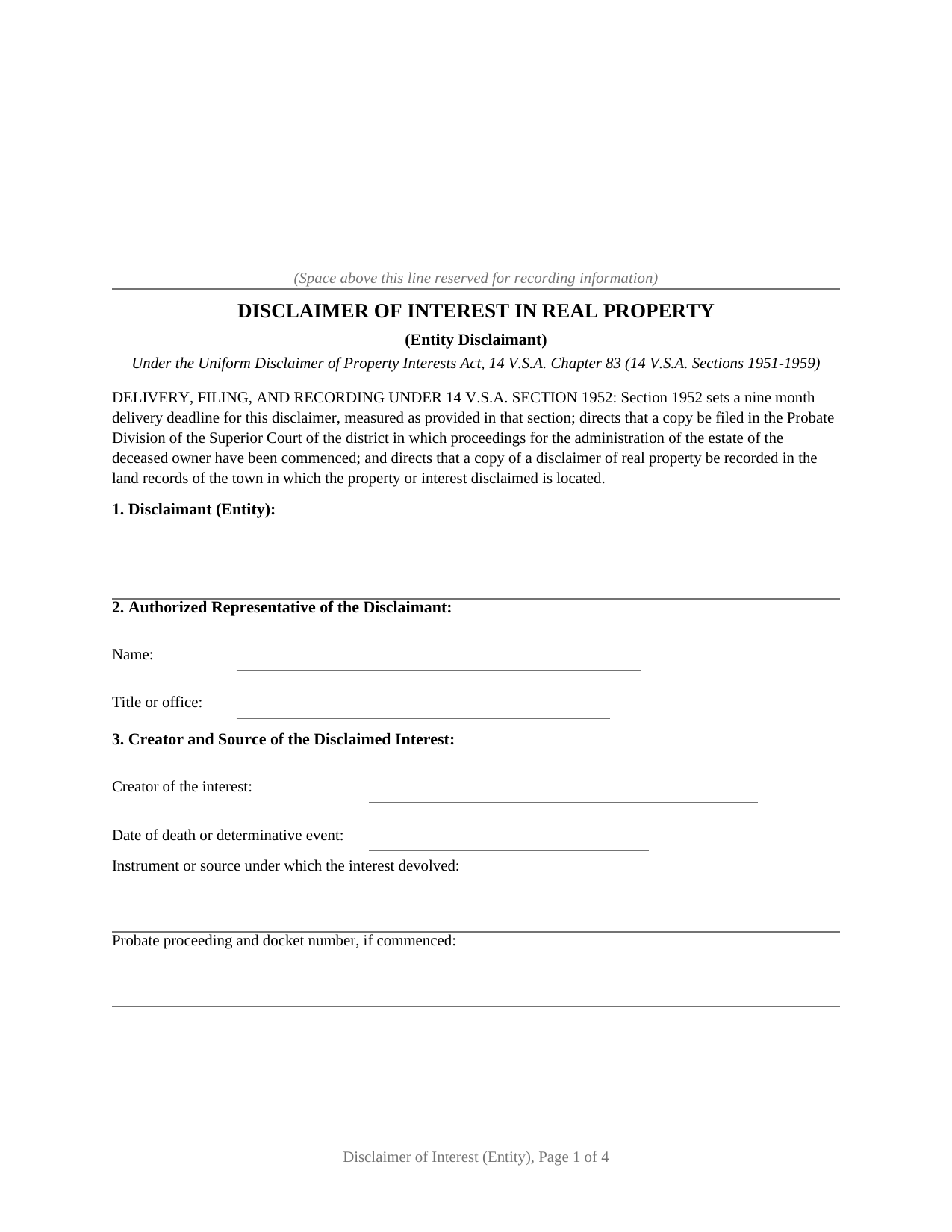
When a Vermont will, trust, or intestacy leaves real property to an organization, the organization does not have to take it. This Vermont Disclaimer of Interest is set up for an entity disclaimant, a corporation, limited liability company, partnership, association, or other legal entity, acting through one authorized representative who signs on the entity's behalf and acknowledges the record in a representative capacity. The form is a fill-in-the-blank renunciation of inheritance under the Uniform Disclaimer of Property Interests Act, 14 V.S.A. Chapter 83.
A refusal that speaks for an organization
Vermont's disclaimer statute lets a person to whom property devolves, by whatever means, disclaim it in whole or in part by delivering a written disclaimer (14 V.S.A. Section 1951), and Vermont law defines person to include corporations, partnerships, unincorporated associations, and other legal entities (1 V.S.A. Section 128). The pattern appears in the record more often than expected: a nonprofit devised land it cannot put to its exempt purpose, a land trust named for a parcel outside its service area, a company left a remainder interest that carries more liability than value. In each case the entity refuses, and the property passes as though the entity had predeceased the person who left it (14 V.S.A. Section 1954).
What the form recites
The form collects the entity's legal name and formation details, the representative's name and title, the creator of the interest and its source (the will, trust, intestacy, or other instrument), a description of the interest disclaimed, the declaration of extent, and the property's town, county, and legal description. Those entries track 14 V.S.A. Section 1953, which requires a disclaimer to describe the interest, declare the disclaimer and its extent, and carry the disclaimant's signature. An optional section holds the statement that Section 1952(c) requires when the disclaimer is intended as a federal qualified disclaimer under the Internal Revenue Code. The operative section then performs the refusal in full statutory terms, and the signature block pairs the entity name with the representative's signature, printed name, title, and date. The acknowledgment certificate follows the representative-capacity short form of 26 V.S.A. Section 5368(2), so the notarial record names the individual, the type of authority, and the entity on whose behalf the record was acknowledged.
Nine months, three destinations
Timing drives this instrument. Under 14 V.S.A. Section 1952, a disclaimer of a present interest that devolved by will or intestacy is delivered not later than nine months after the death, in person or by registered or certified mail, to the estate's personal representative or another statutory recipient. A copy is filed in the Probate Division of the Superior Court where the estate proceeding is pending, and because real property is involved, a copy is recorded in the land records of the Vermont town where the land lies. Vermont records land instruments by town and city rather than by county, and the statewide recording fee is fifteen dollars per page under 32 V.S.A. Section 1671. The recorded copy puts the refusal in the chain of title, so a later examiner sees why title passed around the named devisee.
Final when delivered
A Vermont disclaimer is binding on the disclaimant and everyone claiming through it (14 V.S.A. Section 1954), and the Vermont Supreme Court has described delivered disclaimers as revocable only in limited circumstances. The statute also bars the disclaimer after a written waiver or after acts indicating acceptance of the interest (14 V.S.A. Section 1955), so an organization that has taken possession of the property or collected its income presents a different case than one that has simply been named. The relation-back rule rewards a clean, timely record: the refusal takes effect as of the date of death, before the interest ever vested in the entity.
The download contains the blank fillable disclaimer form, a completed example showing a Vermont nonprofit's total disclaimer of a devised parcel, and a guide that walks through each section, the statutory deadlines, and the probate filing and town recording steps. The materials are informational and are not legal advice; a Vermont attorney can speak to how the statute operates on a particular estate or entity.
Important: County-Specific Forms
Our disclaimer of interest (entity) forms are specifically formatted for each of the 14 counties in Vermont.
After selecting your county, you'll receive forms that meet all local recording requirements, ensuring your documents will be accepted without delays or rejection fees.