Vermont Disclaimer of Interest (Surviving Joint Owner)
County Specific Legal Forms Validated as recently as October 5, 2026 by our Forms Development Team
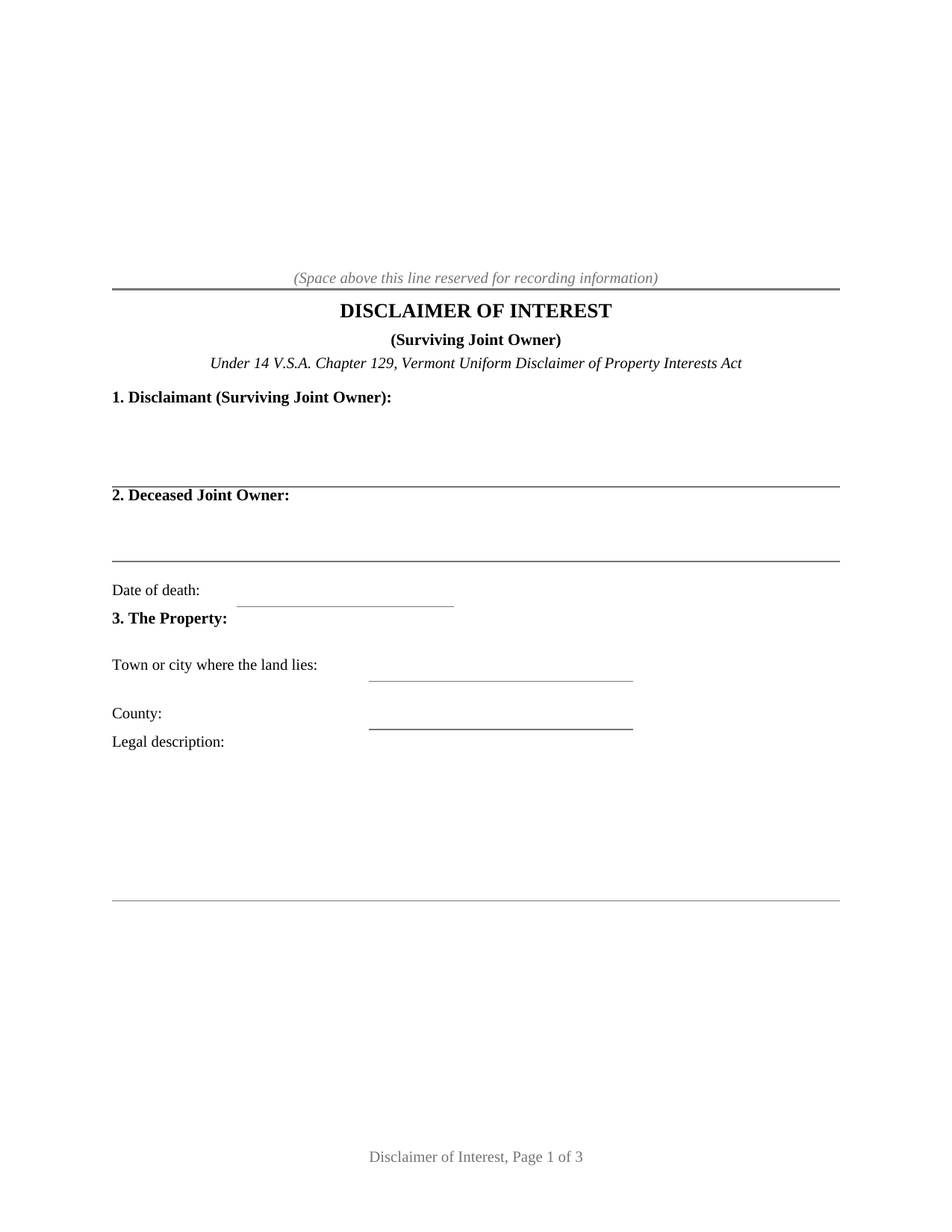
About the Vermont Disclaimer of Interest (Surviving Joint Owner)
How to Use This Form
- Select your county from the list
- Download the county-specific form
- Fill in the required information
- Have the document notarized if required
- Record with your county recorder's office
What Others Like You Are Saying
"used before awesome forms"
"The site was easy to use and find what I needed. The purchase and download were very easy."
"I was very pleased with the quick turn around on a response to my inquiry. Further guidance was dire…"
"Love the service !!"
"Spot on, lets do that again now! Thanks."
4.8/5 from 4,818 reviews. Read all
When one of two Vermont co-owners holding with a right of survivorship dies, the deceased owner's share passes to the survivor automatically, by operation of law. Not every survivor wants it. This form is a Vermont Disclaimer of Interest for a surviving joint owner: the instrument by which a surviving joint tenant, or a surviving spouse who held as a tenant by the entirety, refuses all or part of the interest that arrives by right of survivorship, under 14 V.S.A. Chapter 129, the Vermont Uniform Disclaimer of Property Interests Act.
A refusal, not a transfer
Vermont rewrote its disclaimer law in 2026. S.179, signed June 8, 2026 and effective on passage, repealed the 1985 statute at 14 V.S.A. Chapter 83 and enacted Chapter 129, Vermont's version of the national uniform act. Under the new chapter, a disclaimer is the refusal to accept an interest in property, and a disclaimer made under the chapter is not a transfer, assignment, or release. Section 4107 speaks directly to survivorship: upon the death of a holder of jointly held property, a surviving holder may disclaim, in whole or part, and the disclaimer takes effect as of the death of the co-owner. The disclaimed interest then devolves as the statute provides, as though the survivor had died first, which ordinarily sends it through the deceased owner's estate to the persons named in the will or taking under the intestacy statutes. The survivor's own preexisting share stays put; only the survivorship accretion is refused.
What the surviving joint owner form recites
The form recites one disclaimant, the surviving joint owner. Its numbered sections identify the deceased joint owner and the date of death, the town or city where the land lies, the legal description, the vesting deed that created the co-ownership with its book and page in the town land records, and the extent of the disclaimer, whole or partial; Chapter 129 permits a partial disclaimer expressed as a fraction, percentage, or other interest in the property. The operative section then performs the act in prose, irrevocably disclaiming, renouncing, and refusing to accept the survivorship interest, and states the disclaimant's position that none of the statutory barring events has occurred. One signature line and one Vermont statutory short form acknowledgment certificate complete the instrument. A surviving sibling co-owner passing an inherited half interest onward through the deceased owner's estate, and a surviving spouse declining a survivorship share for estate planning or federal tax reasons, present the pattern this instrument recites; a renunciation of an inheritance under a will follows a different section of the same chapter and a different pattern.
Timing, delivery, and the town land records
Chapter 129 sets no fixed state deadline of its own, but it bars a disclaimer once the interest has been accepted, assigned, conveyed, encumbered, pledged, or transferred, and federal law keeps its own clock: a disclaimer intended as a qualified disclaimer under 26 U.S.C. Section 2518 carries a nine month federal time limit measured from the death. Delivery matters too. An effective disclaimer under Section 4105 is delivered or filed as Section 4112 provides, and the form states that condition on its face in capital letters. For the title record, Section 4115 makes the disclaimer recordable, and Vermont recording is municipal: the instrument goes to the clerk of the town or city where the land lies, at the statewide fee of 15 dollars per page, where it takes its place in the chain of title beside the vesting deed it responds to. Because the statute states that a disclaimer is not a transfer, it sits outside the deed transfers that carry Vermont's property transfer tax return requirement, a point the guide treats in detail.
Prepared for the moment it is needed
A disclaimer is usually prepared once, on a deadline, in an unfamiliar corner of the law. The download includes the disclaimer of interest as a fillable PDF, a completed example showing the instrument prepared end to end for a realistic Chittenden County fact pattern, and a plain language guide that walks through every numbered section, the delivery step under Section 4112, and recording with the town clerk. The materials are informational and are not legal advice.
Important: County-Specific Forms
Our disclaimer of interest (surviving joint owner) forms are specifically formatted for each of the 14 counties in Vermont.
After selecting your county, you'll receive forms that meet all local recording requirements, ensuring your documents will be accepted without delays or rejection fees.