Vermont Executor Deed (Two Co-Executors)
County Specific Legal Forms Validated as recently as August 5, 2026 by our Forms Development Team
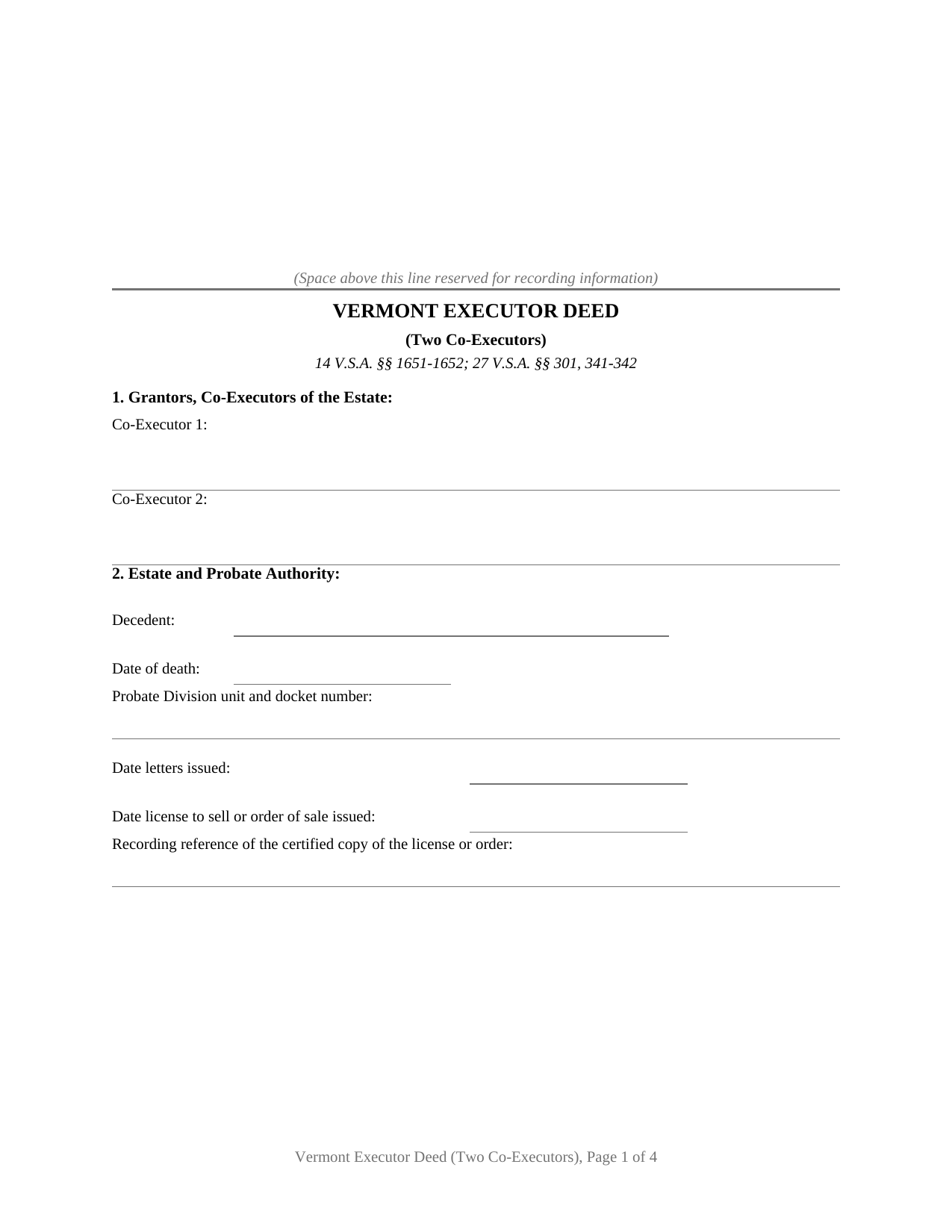
About the Vermont Executor Deed (Two Co-Executors)
How to Use This Form
- Select your county from the list
- Download the county-specific form
- Fill in the required information
- Have the document notarized if required
- Record with your county recorder's office
What Others Like You Are Saying
"Just perfect for what I needed. Made the property transfer very easy."
"The forms were easy to request. I'm assuming that the download will be as well. Im so glad that I ca…"
"Easy to set up account. If I am presented with a chance to review the service, I will do that after …"
"Quick and easy process to get the documents, and helpful to see the example filled out."
"Our firm is working remotely and a lot of court services are limited with the corona-virus shutdowns…"
4.8/5 from 4,817 reviews. Read all
When a Vermont will names two personal representatives, the estate's real property leaves the record over two signatures: each co-executor signs the deed, and each acknowledges it on a separate notarial certificate. This form prepares that instrument, a Vermont executor deed configured for exactly two co-executors of one testate estate, conveying under a license to sell or order of sale issued by the Probate Division of the Superior Court.
A deed that leans on the probate license
Vermont gives the executor deed its force through the license. Under 14 V.S.A. § 1652, the deed of an executor who has obtained a certified copy of a license to sell or an order of sale is valid to convey the real estate authorized to be sold, and under § 1651(8) the certified copy is recorded in the same land records office where the deed is recorded. The form is drafted around that structure. A dedicated section ties the conveyance to the probate record: the decedent and date of death, the Probate Division unit and docket number, the dates the letters and the license issued, and the recording reference of the certified copy, so the deed and its authority read together in the chain of title. Where the will expressly confers a power of sale, § 1651(10) directs the court to issue the license without requiring notice or hearing for property subject to the power, except a dwelling house in which the surviving spouse or an heir, devisee, or legatee is residing.
Two co-executors, two certificates
The deed recites two co-executors as grantors, each acting solely in a fiduciary capacity, and states on its face that both join in the execution. Each co-executor has a separate signature block with a printed-name line, and each has a separate acknowledgment certificate in the representative-capacity short form of 26 V.S.A. § 5368(2), reciting that the record was acknowledged by the named individual as co-executor of the named estate. Because the certificates are separate, the two fiduciaries may acknowledge on different dates, before different notaries, or in different states; the completed example shows acknowledgments taken in two Vermont counties on two different dates. Two siblings appointed under a parent's will, or a family member serving alongside a professional fiduciary, present the two-grantor pattern this deed recites. A sole executor, or the administrator of an intestate estate, presents a different recital and signature configuration than the one this form carries. Instruments in this family are also searched as an executor's deed, a fiduciary deed, or a probate deed; in Vermont the operative structure is the same licensed conveyance.
A covenant sized to the fiduciary role
The conveyance section grants, sells, and conveys the decedent's and the estate's interest, and its covenant is deliberately narrow: the co-executors covenant, in their fiduciary capacity only and not individually, that they are duly appointed and qualified, that the license or order issued, and that they have not themselves encumbered the property except as the deed states. The deed carries no other covenant or warranty of title, so the grantee takes subject to the encumbrance section's contents and to matters arising before the decedent's ownership. That posture matches the statute: 14 V.S.A. § 1652 makes the licensed deed valid to convey what the estate holds, and the fiduciaries do not personally guarantee the whole chain of title.
Recording in the town, not the county
Vermont records deeds with the clerk of the town or city where the land lies; there is no county recording office. The statewide fee is $15.00 per page under 32 V.S.A. § 1671, and the certified copy of the license records at the same rate. Recording is gated by the tax filing: under 32 V.S.A. § 9608, the town clerk cannot record the deed unless a completed Vermont Property Transfer Tax Return and the required Act 250 certificate accompany it. A licensed sale for a purchase price is taxable at the general 1.25 percent rate plus the 0.22 percent clean water surcharge, with reduced brackets for a buyer's principal residence, while a distribution from the estate to a closely related beneficiary without consideration can qualify for exemption on the same return. The license to sell and the transfer tax return are court and tax filings prepared separately and are not included in this package.
The download includes the executor deed as a fillable PDF, a completed example documenting a realistic Addison County estate sale from docket number to recording reference, and a plain-language guide that walks through every numbered section, the notarization, and the recording package. The materials are informational and are not legal advice.
Important: County-Specific Forms
Our executor deed (two co-executors) forms are specifically formatted for each of the 14 counties in Vermont.
After selecting your county, you'll receive forms that meet all local recording requirements, ensuring your documents will be accepted without delays or rejection fees.