Vermont Executor Deed (Individual Executor)
County Specific Legal Forms Validated as recently as September 16, 2026 by our Forms Development Team
About the Vermont Executor Deed (Individual Executor)
How to Use This Form
- Select your county from the list
- Download the county-specific form
- Fill in the required information
- Have the document notarized if required
- Record with your county recorder's office
What Others Like You Are Saying
"Easy to access and good instructions. Where to mail would be the only thing I would add."
"It was fast and easy to use."
"Your instructions and sample are geared towards businesses. It would have been helpful to have inclu…"
"Got the forms I needed after getting forms for the wrong county and paying twice. My bad!"
"So happy to be able to track down where I purchased TODD forms and be able to sign in and find the f…"
4.8/5 from 4,815 reviews. Read all
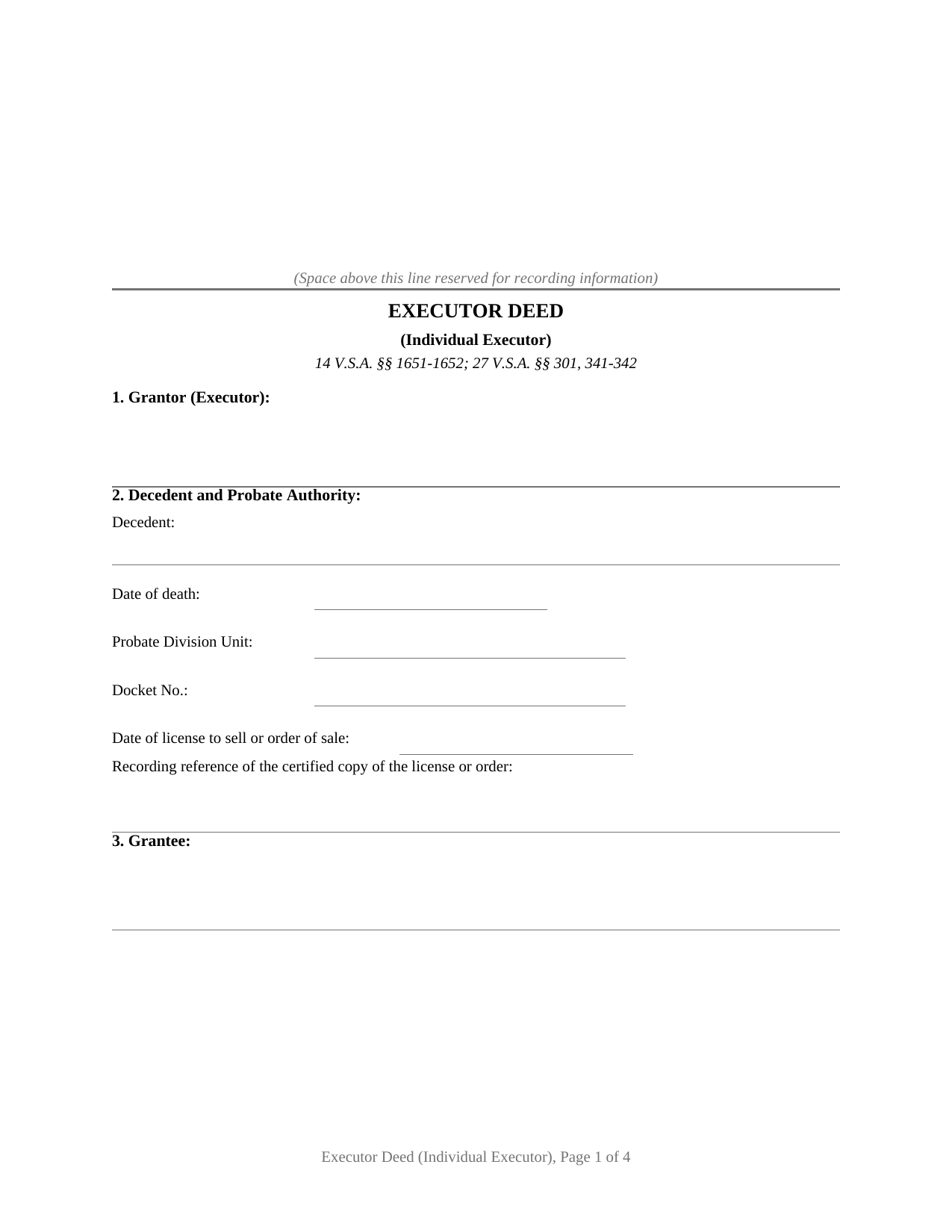
A Vermont executor deed is signed by one person in one capacity: the executor of a deceased owner's estate, conveying under a license to sell or order of sale issued by the Vermont Superior Court, Probate Division. This fillable form prepares that deed for an individual executor serving alone, transferring Vermont real property out of a testate estate to a purchaser, with a completed example and a full guide alongside it.
A deed that carries its probate authority on its face
Vermont's probate sale statutes put the court at the center. Under 14 V.S.A. § 1651, the Probate Division may license an executor to sell estate real property when the sale appears necessary or beneficial, and a certified copy of the license to sell or order of sale is recorded in the same land records office where the deed is recorded. Where the will expressly confers a power of sale, the statute directs the court to issue the license without notice or hearing for property subject to that power, with a carve-out for a dwelling house in which the surviving spouse or an heir, devisee, or legatee is residing. The payoff arrives in 14 V.S.A. § 1652: the deed of an executor who has obtained a certified copy of the license or order is valid to convey the real estate authorized to be sold.
This form is built around that record trail. Its probate authority section identifies the decedent, the Probate Division unit and docket number, the date of the license or order, and the book and page where the certified copy is recorded, so the deed and its authority read together in the town land records. The license and the certified copy are court documents, obtained and recorded separately and not included in this package.
One executor, one signature, a representative acknowledgment
The form recites exactly one signing fiduciary who holds the office of executor. The operative section states the capacity in words, acting solely as executor of the estate and not individually, and the single signature line is matched by a notary certificate in the representative-capacity short form of 26 V.S.A. § 5368(2), printing the statute's own labeled blanks for the signer's name, the type of authority, and the estate on whose behalf the deed is executed. A sole executor selling a decedent's house to pay debts and administration expenses, and an executor exercising a will's power of sale under a court-issued license, present the pattern this deed recites. An estate with two co-executors presents a two-signer pattern with a second certificate, and an intestate administration carries the administrator title rather than the executor title; the form is not set up as either of those.
Covenants scaled to the fiduciary office
An executor sells what the estate holds, so this deed does not promise what a general warranty deed promises. Its covenant is limited to the fiduciary's own position: that the executor holds the license or order identified in the deed and has not personally encumbered the property. The deed states that it carries no other covenant or warranty of title, and the purchaser takes subject to easements, restrictions, and other matters of record. Vermont has no general statutory deed form with implied covenants, so the form spells its covenant out in express words, alongside the statutory validity language of 14 V.S.A. § 1652.
Recording with the town clerk, not a county recorder
Vermont records deeds by town or city, and this executor's deed goes to the clerk of the municipality where the land lies, at the statewide fee of 15 dollars per page under 32 V.S.A. § 1671. The Vermont Property Transfer Tax Return, Form PTT-172, filed separately with the clerk and not included in this package, travels with the deed: under 32 V.S.A. § 9608 the clerk cannot record a transfer deed without a complete return and the required Act 250 certificate. The guide walks through the return, the current transfer tax and clean water surcharge rates, and the survey citation rule for descriptions that reference a recorded plat.
The download contains the blank executor deed as a fillable PDF, a completed example showing every entry for a realistic Washington County estate sale, and a plain language guide that covers each numbered section, the representative-capacity acknowledgment, and the recording steps. The materials are informational and are not legal advice.
Important: County-Specific Forms
Our executor deed (individual executor) forms are specifically formatted for each of the 14 counties in Vermont.
After selecting your county, you'll receive forms that meet all local recording requirements, ensuring your documents will be accepted without delays or rejection fees.