Vermont Executor Deed (Corporate Executor)
County Specific Legal Forms Validated as recently as September 23, 2026 by our Forms Development Team
About the Vermont Executor Deed (Corporate Executor)
How to Use This Form
- Select your county from the list
- Download the county-specific form
- Fill in the required information
- Have the document notarized if required
- Record with your county recorder's office
What Others Like You Are Saying
"Excellent and Helpful as well as patient. Great Service."
"I ordered the wrong forms because I didn't do enough research to understand what I needed. Their cus…"
"Easy to understand and use. However, need to add line for phone number for preparer - Thanks"
"Great site, user friendly. Exactly what we needed and the detailed instructions/completed sample wer…"
"worked great!!!"
4.8/5 from 4,815 reviews. Read all
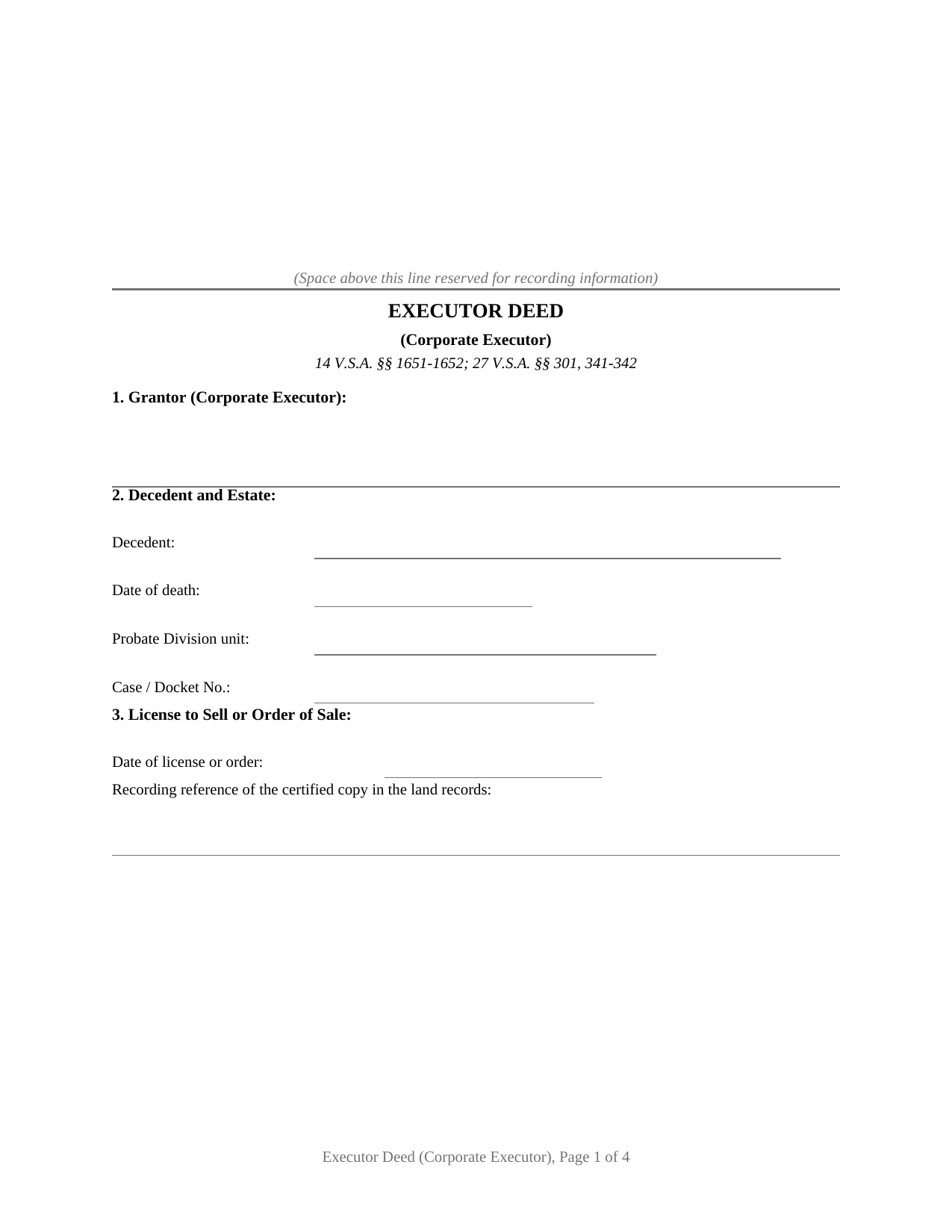
When a Vermont will names a bank or trust company as executor, the deed that carries out a probate sale takes a corporate shape: the grantor is the corporation itself, acting solely as executor of the estate, one authorized officer signs on its behalf, and the notary certificate records two layers of representation in a single acknowledgment. This Vermont executor deed form recites exactly that configuration, a corporate executor conveying estate real property under a license to sell from the Probate Division of the Superior Court. Deeds of this kind are often searched as a fiduciary deed, an estate deed, or an executor's deed.
A deed that runs on probate authority
Vermont channels an executor's sale of real estate through the Probate Division. Under 14 V.S.A. § 1651, the court grants a license to sell when a sale appears necessary or beneficial, and a certified copy of the license or order of sale is recorded in the land records of the town or city where the property lies. A will that expressly grants a power of sale feeds the same channel: section 1651(10) directs the court to issue the license without notice or hearing for property subject to the testamentary power, with an exception for a dwelling house in which the surviving spouse or an heir, devisee, or legatee is residing. The deed then draws its force from 14 V.S.A. § 1652, which makes the deed of an executor holding a certified copy of the license or order valid to convey the real estate authorized to be sold. The form's third section cites the license by date and by its land-records recording reference, so the deed and its authority read together in the record.
One officer signature, two layers of representation
The form recites one corporate executor as grantor: the corporation's name, organizational character, and principal office address, followed by its capacity as executor of the named estate. The operative section states that the corporation acts solely in its fiduciary capacity and not in its individual corporate capacity. The signature block carries the corporation's name and a single signature line for the authorized officer, with printed name, title, and date beneath, and the certificate that follows is the representative-capacity acknowledgment short form of 26 V.S.A. § 5368(2), printed with the statute's own captions for the officer's name, the type of authority, and the party on whose behalf the record was executed. The certificate also carries the printed-name and commission-number lines that 26 V.S.A. § 5367 describes for a paper certificate completed without an official stamp. An estate administered by an individual executor or by an administrator presents a different signature and recital pattern than the corporate configuration this form recites.
A covenant sized to the fiduciary's role
A corporate executor sells property it never owned in its own right, so the deed carries a limited fiduciary covenant rather than general warranty covenants. The grantor covenants that it holds the probate authority recited in the deed and that it has neither done nor suffered any act to encumber the property while serving as executor, and it warrants title only against claims arising by, through, or under the executor. The deed conveys the estate and interest the decedent held at death, subject to the matters listed in its encumbrances section.
Recording at the town clerk's counter
Vermont records land instruments municipally, so the completed deed goes to the clerk of the town or city where the property is located, at $15.00 per page under 32 V.S.A. § 1671, together with the recorded certified copy of the probate license. Under 32 V.S.A. § 9608, the clerk cannot record a deed evidencing a transfer of title unless a completed Vermont Property Transfer Tax Return, Form PTT-172, and the Act 250 certificate accompany it. The transfer tax falls on the transferee at 1.25 percent of value, plus the 0.22 percent clean water surcharge of 32 V.S.A. § 9602a, with a reduced rate on the first $200,000 of a principal-residence purchase.
The download prepares one complete recording-ready instrument and contains the fillable executor deed form, a completed example showing the document filled in for a realistic Washington County estate sale, and a plain-language guide that walks through every numbered section, the probate license requirement, the representative-capacity acknowledgment, and the recording package. The materials are informational and are not legal advice; a Vermont attorney can address how these rules operate on a specific estate.
Important: County-Specific Forms
Our executor deed (corporate executor) forms are specifically formatted for each of the 14 counties in Vermont.
After selecting your county, you'll receive forms that meet all local recording requirements, ensuring your documents will be accepted without delays or rejection fees.