Vermont Gift Deed (Charitable Organization Grantee)
County Specific Legal Forms Validated as recently as October 26, 2026 by our Forms Development Team
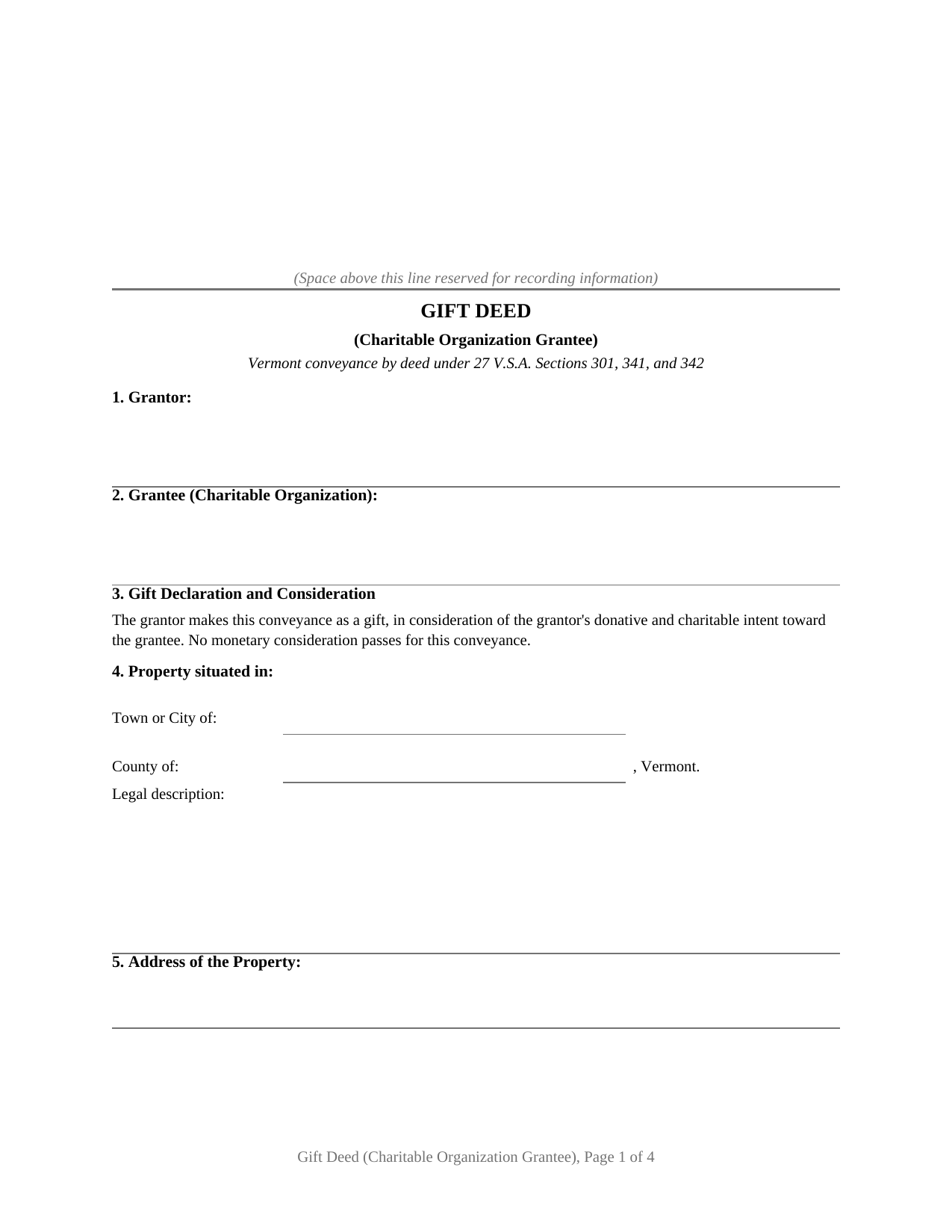
About the Vermont Gift Deed (Charitable Organization Grantee)
How to Use This Form
- Select your county from the list
- Download the county-specific form
- Fill in the required information
- Have the document notarized if required
- Record with your county recorder's office
What Others Like You Are Saying
"Working with one document at a time every thing was great, but the program will not let multiple doc…"
"Thank you for the excellent and complete layout of all forms needed to complete the Affidavit of Dea…"
"Deeds.com has become a great assistant to our firm! The service is of highest quality and consistent…"
"A great help! Thank you."
"Great system"
4.8/5 from 4,836 reviews. Read all
A Vermont gift deed with a charitable organization grantee names a nonprofit, rather than a relative, on the receiving side: one owner conveys Vermont real property to a nonprofit corporation, religious society, school, or land trust, without monetary consideration, and the deed states the gift character of the transfer on its face. This form prepares that conveyance, sometimes searched as a deed of gift or a deed to donate property, under Chapter 5 of Title 27 of the Vermont Statutes, with a grantee block written for an organization, a gift declaration in place of a purchase price, and Vermont's traditional express covenants of title.
A donation that still files a transfer tax return
Vermont taxes transfers by deed under 32 V.S.A. Chapter 231 and values a gift, or a transfer for nominal or no consideration, at the fair market value of the property transferred. The town clerk is barred by Section 9608 from recording a deed evidencing a transfer without a complete Vermont Property Transfer Tax Return, so the return travels with this deed even though no money changes hands. Two exemptions in Section 9603 reach organizations qualifying under Section 501(c)(3) of the Internal Revenue Code, both conditioned on stated purposes centered on preserving farmland or open space land; a charitable gift outside those conditions is taxed on fair market value at the general combined rate of 1.47 percent. The return, a Vermont Department of Taxes form prepared separately and not included in this package, is filed either way, with any exemption number entered on it.
The organization in the grantee block
The form recites exactly one individual grantor and one organization grantee. The grantee section identifies the organization by its registered legal name, its entity type and state of formation, and its mailing address, with room for a federal tax status description where the parties include one. An owner donating a wooded parcel to a land trust, a parishioner deeding a lot to a religious society, and a family placing open land with a conservation nonprofit present the single grantor, organization grantee pattern this deed recites. Property held by two owners, by spouses as tenants by the entirety, or by a trustee presents a different grantor configuration than the one this form is set up to carry.
Covenants that travel with a gift
Vermont has no statutory short form deed with implied covenants, so a Vermont deed warrants only what it says. This form carries the traditional Vermont warranty covenants in express words: that the grantor is the sole owner with good right and title to convey, that the property is free from every encumbrance except as stated in the deed, and that the grantor will warrant and defend the property against the lawful claims of all persons. The encumbrance section defines the exceptions, listing the recorded easements, restrictions, and other matters the covenants do not reach.
One grantor, with a joinder block for a spouse
Vermont's homestead statute, 27 V.S.A. Section 141, leaves a married owner's deed inoperative as to the homestead when the owner's spouse does not join in executing and acknowledging it. The form carries a dedicated joinder signature block and a second acknowledgment certificate for that spouse; where no spouse joins, the blocks remain blank. Each certificate carries the notary's printed name and commission number lines that 26 V.S.A. Section 5367 describes for paper records, and the acknowledgment before a notary public is the execution formality Vermont requires, with no witness signatures on an ordinary deed.
Recording with the town clerk
Vermont records deeds with the clerk of the town or city where the land lies, not at a county office, at $15.00 per page plus $15.00 for the transfer tax return. A deed that refers to a survey prepared or revised after July 1, 1988 is recorded only with the survey attached or a citation to the volume and page where the survey is recorded. Once acknowledged and recorded, the deed holds the estate against the world under 27 V.S.A. Section 342.
The package contains the gift deed as a fillable PDF, a completed example showing the entire document filled in for a realistic Stowe, Vermont fact pattern, and a plain language guide that describes every numbered section, the signing formalities, and the recording process. The materials describe Vermont law in general terms and are not legal advice.
Important: County-Specific Forms
Our gift deed (charitable organization grantee) forms are specifically formatted for each of the 14 counties in Vermont.
After selecting your county, you'll receive forms that meet all local recording requirements, ensuring your documents will be accepted without delays or rejection fees.