Vermont Gift Deed (Two Grantors)
County Specific Legal Forms Validated as recently as September 2, 2026 by our Forms Development Team
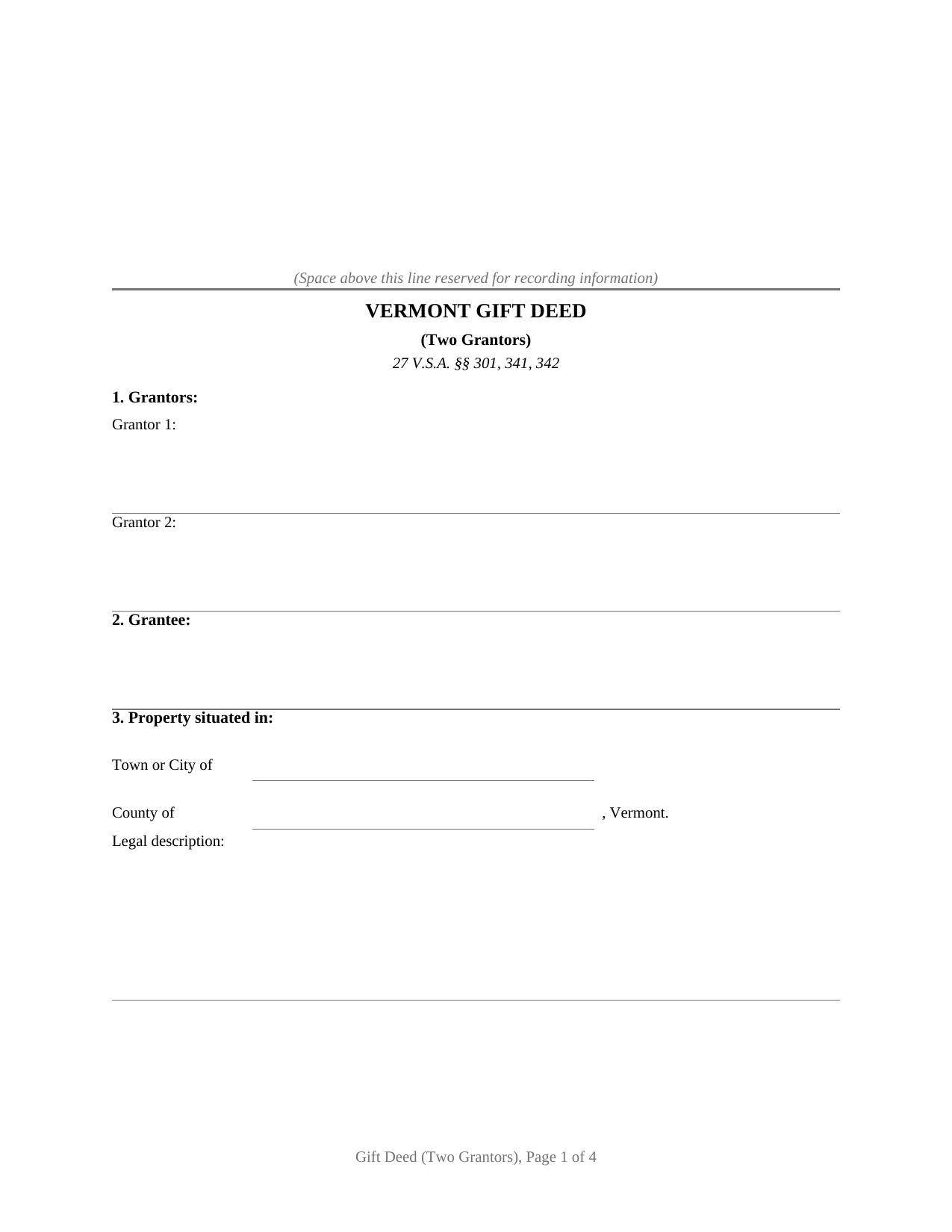
About the Vermont Gift Deed (Two Grantors)
How to Use This Form
- Select your county from the list
- Download the county-specific form
- Fill in the required information
- Have the document notarized if required
- Record with your county recorder's office
What Others Like You Are Saying
"The forms, instructions and example of the completed Interspousal Transfer Deed was very helpful. I …"
"Finding current forms in one place helps simplify the process. Thank you."
"My county accessors office recommended this site. My Uncle passed away and did not leave a will and …"
"This was an excellent service to amend a deed. It was a little frustrating at first, but well worth …"
"The guide I needed was very easy to understand and the template was easy to complete. I had a proper…"
4.8/5 from 4,836 reviews. Read all
Two record owners give Vermont real estate away with a single deed on this form. This Vermont gift deed is set up for exactly two grantors: two signature lines, a separate acknowledgment certificate for each signer, and a granting clause that conveys all of each grantor's right, title, and interest for love and affection rather than for a price.
A deed that recites love and affection instead of a price
Vermont has no separate gift deed statute. A gift deed, sometimes called a deed of gift, is an ordinary Vermont conveyance under 27 V.S.A. Section 301, signed by the grantors, acknowledged before a notary public, and recorded where the land lies. What makes it a gift deed is its own text: this form states that the conveyance is a gift, that the consideration is the love and affection the grantors hold for the grantee, and that no monetary consideration passes.
Vermont law attaches no implied covenant package to a deed label, so the covenants here are express. The grantors covenant that they are the sole owners of the property, that they have good right and title to convey it, that the property is free from every encumbrance except as stated in the deed, and that they will warrant and defend the property to the grantee. A family member receiving land by gift takes it with the same warranty-style protection a buyer receives under a Vermont warranty deed, less whatever exceptions the deed lists.
Two grantors, two acknowledgment certificates
The form recites exactly two grantors, and each grantor executes and acknowledges the deed. It carries a separate acknowledgment certificate for each signer, so the two grantors may acknowledge on different dates, before different notaries, in different states. Two ownership patterns present this configuration again and again in the land records: a married couple giving a home or acreage to a child or other relative, and two siblings passing inherited fractional interests to one family member. Two unmarried co-owners consolidating title in a single name by gift present the same two-signer pattern. A sole owner's gift presents a different signing pattern than this deed recites; this form is not set up as a single-grantor instrument.
Where the two grantors are spouses conveying their own homestead, both signatures and both certificates place on the face of the record the spousal joinder that 27 V.S.A. Section 141 describes for a married owner's homestead conveyance.
The transfer tax return that travels with a Vermont gift
A gift is not paperwork-free in Vermont. Form PTT-172, the Vermont Property Transfer Tax Return, accompanies every deed transferring title, and under 32 V.S.A. Section 9608 the town clerk cannot record the deed without a completed return and its Act 250 certificate. For a gift, the statute measures the tax by the fair market value of the property transferred, at a combined general rate of 1.47 percent, and the exemptions in 32 V.S.A. Section 9603 are specific rather than a blanket family-gift exemption. The return also reports the family relationship between the parties. The guide walks through the return, the rates, the exemption list, and where payment goes.
Recorded in the town, not the county
Vermont keeps land records at the municipal level, so this deed goes to the clerk of the town or city where the land lies, at the statewide fee of 15 dollars per page plus 15 dollars for the transfer tax return. The form carries a survey reference section satisfying 27 V.S.A. Section 341(b) where the deed refers to a recorded survey, printed name lines under the signatures satisfying 32 V.S.A. Section 1405, and reserved space at the top of the first page for the clerk's recording information. Once recorded, the deed holds the estate against third persons under 27 V.S.A. Section 342.
The download contains three pieces: this gift deed as a fillable PDF for exactly two grantors, a completed example showing the whole document filled in for a realistic Vermont fact pattern, and a plain language guide that explains every numbered section, the notarization, and the recording steps. The materials are informational and are not legal advice; a Vermont attorney can address how these rules operate on a specific title.
Important: County-Specific Forms
Our gift deed (two grantors) forms are specifically formatted for each of the 14 counties in Vermont.
After selecting your county, you'll receive forms that meet all local recording requirements, ensuring your documents will be accepted without delays or rejection fees.