Vermont Gift Deed (Trustee Grantor)
County Specific Legal Forms Validated as recently as October 5, 2026 by our Forms Development Team
About the Vermont Gift Deed (Trustee Grantor)
How to Use This Form
- Select your county from the list
- Download the county-specific form
- Fill in the required information
- Have the document notarized if required
- Record with your county recorder's office
What Others Like You Are Saying
"Very simple to use and everything included"
"Excellent service, easy to follow instructions."
"Thanks for making this process a seamless one! I love Deeds.com and will recommend it to others!"
"Deeds.com is very helpful when filling a Deed. I appreciate that. Thank you."
"Love the fact that you can buy a form instead of a subscription. I would highly recommend this site."
4.8/5 from 4,815 reviews. Read all
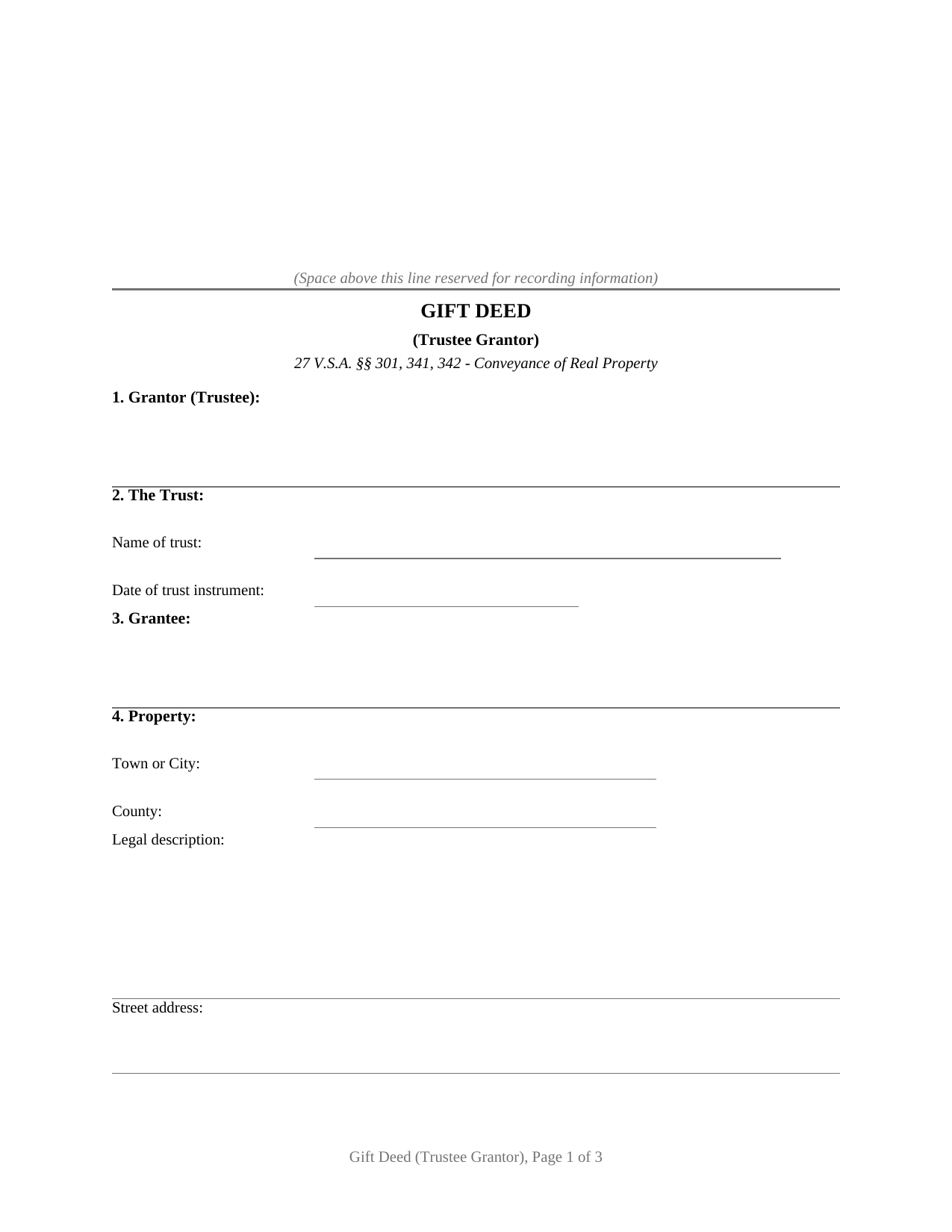
This Vermont gift deed is built for a conveyance signed in a fiduciary capacity: the grantor is a trustee, the property sits in a trust, and the deed passes it to the grantee as a gift, for no monetary consideration. The form recites one trustee grantor acting for an identified trust, one grantee entry, and a granting clause exercised solely in the trustee capacity under 27 V.S.A. 301 and the Vermont Trust Code.
A gift signed by the trustee, not an individual owner
The deed identifies the trust by its full name and the date of its instrument, and every operative element runs through that identification. The signature block carries one line, for the trustee; the single acknowledgment certificate names the signer together with the representative capacity, in the pattern of the statutory short form certificates of 26 V.S.A. 5368; and the granting clause states that the grantor acts not individually but solely as trustee, under the authority the trust instrument and 14A V.S.A. 815 and 816 confer. Two patterns present this configuration in Vermont land records: a family trust distributing real estate to a beneficiary of the settlor without payment, and a trustee winding up a trust and releasing the property free of trust to the person entitled to it. A gift of property titled in an owner's personal name follows a different pattern; this form's capacity recital, signature block, and certificate are all trustee-shaped.
A limited covenant instead of a full warranty
Vermont supplies no implied statutory covenants for ordinary deeds, so a Vermont deed warrants exactly what it says. This deed conveys with the words GIVES, GRANTS, CONVEYS, AND CONFIRMS and carries one express covenant: that the grantor, acting as trustee, has not encumbered the property except as the deed states. It disclaims every other covenant or warranty of title, so the donee takes subject to recorded easements, liens, and other matters of record, which is the conventional posture of a fiduciary conveying property the trustee did not originally acquire on personal account. The deed also collects the source of title, the formal legal description with its survey citation under 27 V.S.A. 341(b), and the encumbrances the conveyance remains subject to.
No purchase price, but a transfer tax return all the same
Vermont ties recording to its property transfer tax paperwork. Under 32 V.S.A. 9608, no town clerk records a deed evidencing a transfer of title unless a completed Property Transfer Tax Return, Form PTT-172, and the required Act 250 certificate are attached, and that rule applies to gifts. The tax itself, 1.25 percent of value plus a 0.22 percent clean water surcharge at the general rate, comes with statutory exemptions that reach donative trust transfers: 32 V.S.A. 9603(5) exempts no-consideration transfers between close family members and extends to transfers from a family trust releasing property free of trust among those relatives, and 9603(6) exempts transfers with no change in beneficial ownership. An exemption is claimed on the return, which is filed either way. The included guide walks through the return, the exemptions, and where a trustee documents authority of record with a separately prepared certification of trust under 14A V.S.A. 1013, which is not included in this package.
Recording in the town where the land lies
Vermont records land documents by municipality, not by county, so the completed deed goes to the clerk of the town or city where the property is located, acknowledged before a notary as 27 V.S.A. 341 requires. Recording runs fifteen dollars per page plus fifteen dollars for the transfer tax return under 32 V.S.A. 1671, and the deed holds the estate against third parties only once it is acknowledged and recorded.
The download includes the blank gift deed as a fillable PDF, a completed example showing the form filled in for a realistic Chittenden County trust fact pattern, and a plain language guide covering every section, the signing formalities, and the town recording process. The materials are informational and are not legal advice.
Important: County-Specific Forms
Our gift deed (trustee grantor) forms are specifically formatted for each of the 14 counties in Vermont.
After selecting your county, you'll receive forms that meet all local recording requirements, ensuring your documents will be accepted without delays or rejection fees.