Vermont Gift Deed (Reserving Life Estate)
County Specific Legal Forms Validated as recently as October 23, 2026 by our Forms Development Team
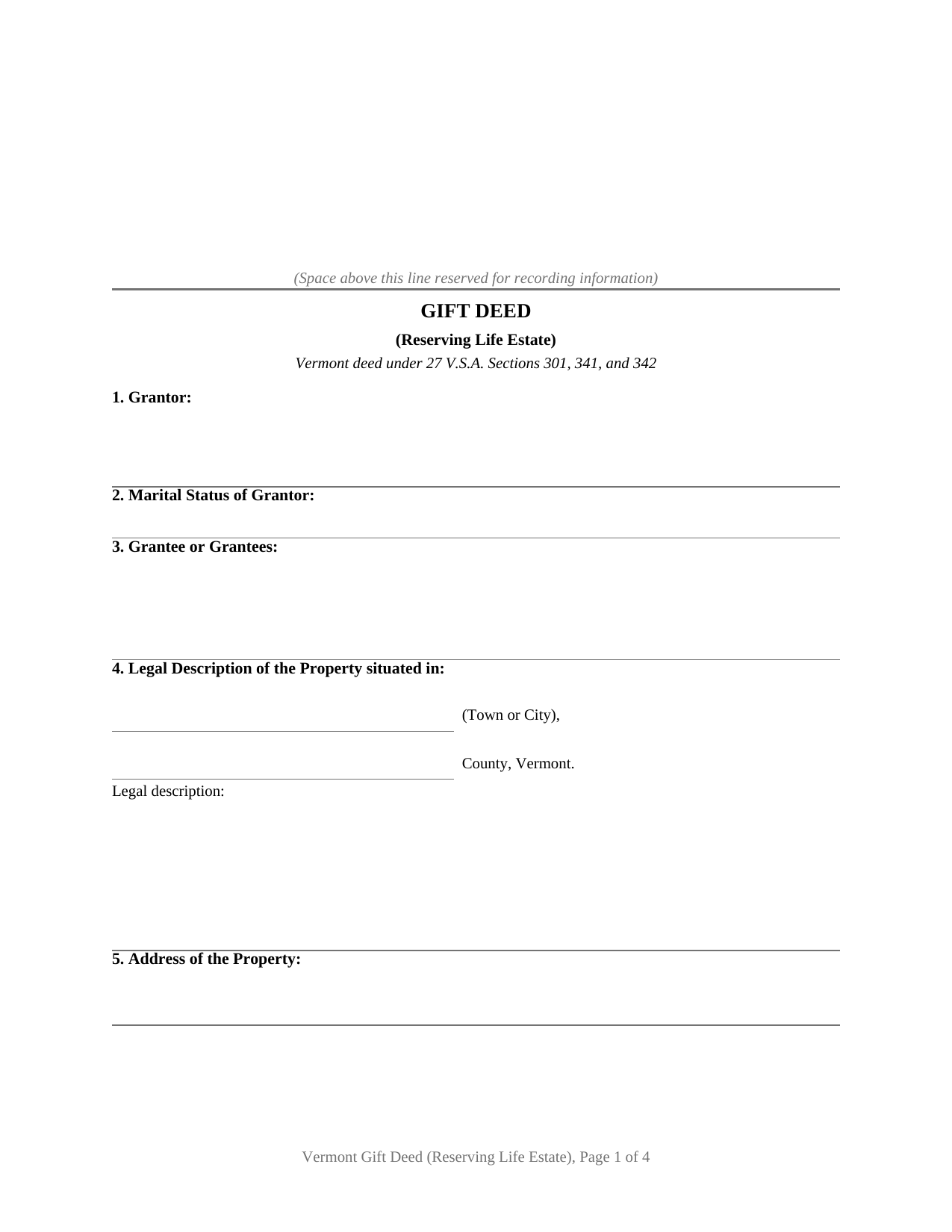
About the Vermont Gift Deed (Reserving Life Estate)
How to Use This Form
- Select your county from the list
- Download the county-specific form
- Fill in the required information
- Have the document notarized if required
- Record with your county recorder's office
What Others Like You Are Saying
"Excellent and Helpful as well as patient. Great Service."
"This platform made electronic filing of a lien easy and quick. I was able to accomplish everything f…"
"As always, amazing forms and information. A must have for anyone doing it themselves. Everything is …"
"Really fast turn around time, and was provided exactly what I was looking for this time. This is my …"
"Fantastic forms, thanks for making them available."
4.8/5 from 4,836 reviews. Read all
A Vermont gift deed reserving a life estate passes the family home, camp, or land to the next generation now, while the giver keeps the legal right to live there for life. This form prepares that deed for one Vermont owner: the grantor conveys the property as a gift, reserves a common-law life estate, and the named grantee takes a vested remainder that ripens into full ownership, outside probate, when the life estate ends at the grantor's death.
A gift now, possession later
The deed divides ownership along a timeline. From delivery, the grantor holds a life estate: the exclusive right to occupy and use the property, and to its rents and income, for the rest of the grantor's natural life. The grantee holds the remainder from the same moment, a present property interest that waits for possession. At the grantor's death the life estate simply ends, and the grantee holds the property outright without probate administration of the parcel. Because the transfer is donative, the deed recites love and affection rather than a purchase price, and it states that it conveys without covenant or warranty of title, the posture Vermont law leaves to the deed's own text since no statute implies covenants into a Vermont deed.
A vested remainder, not a revocable arrangement
The reservation here is the traditional common-law life estate, and the deed says so on its face: no power is reserved to sell, convey, or mortgage the property without the grantee's joinder, and the instrument is not an enhanced life estate deed under 27 V.S.A. chapter 6, Vermont's statute for reserved-power deeds. The certainty runs in both directions. The grantee's remainder is vested and safe from later changes of heart, and by the same token the grantor cannot take the gift back or deal with the full title alone; a later sale or mortgage of the whole property takes both signatures. The completed example shows the reservation, the gift conveyance, and the statutory references exactly as they read on a finished deed.
Who signs, and the homestead joinder
The form recites one grantor, who signs before a notary public; Vermont requires no witnesses on a deed, and 27 V.S.A. Section 341 makes the notarial acknowledgment and town recording the operative formalities. A parent conveying the home place to a child while continuing to live in it, or an owner passing a woodlot or camp to family with continued lifetime use, presents the single-owner pattern this deed recites. The grantee section accepts one or more grantees together with the co-ownership form they take, and the guide walks through Vermont's forms, from tenancy in common to joint tenancy and tenancy by the entirety. Because a married owner's homestead moves only with the spouse's joinder under 27 V.S.A. Section 141, the form carries a labeled spouse joinder signature block, and it carries a separate acknowledgment certificate for each signer on the Vermont statutory short form, so the grantor and a joining spouse may acknowledge on different dates or before different notaries.
Recording in the town, with the transfer tax return
Vermont records land instruments town by town, not by county, so the deed goes to the clerk of the town or city where the land lies, at fifteen dollars per page. Until recorded, a Vermont deed holds the estate only against the grantor and the grantor's heirs, so recording is what secures the gift against everyone else. One filing controls the counter: a completed Vermont Property Transfer Tax Return, Form PTT-172, accompanies the deed, and the town clerk cannot record without it. For a gift, the tax value is fair market value rather than the recited consideration, and Vermont exempts no-consideration transfers between spouses, parent and child or the child's spouse, and grandparent and grandchild or the grandchild's spouse; the exemption is claimed right on the return. The guide's recording section walks through the return, the Act 250 certificate that accompanies it, and the survey reference rule that reaches deeds citing a recorded plat.
The download includes the gift deed as a fillable blank PDF, a completed example that presents the whole deed prepared for a realistic Vermont fact pattern, and a plain-language guide explaining every numbered section, the signing formalities, and the recording steps. The materials are informational and are not legal advice; a Vermont attorney can apply these rules to a specific title or estate plan.
Important: County-Specific Forms
Our gift deed (reserving life estate) forms are specifically formatted for each of the 14 counties in Vermont.
After selecting your county, you'll receive forms that meet all local recording requirements, ensuring your documents will be accepted without delays or rejection fees.