Vermont Gift Deed (Interspousal)
County Specific Legal Forms Validated as recently as October 6, 2026 by our Forms Development Team
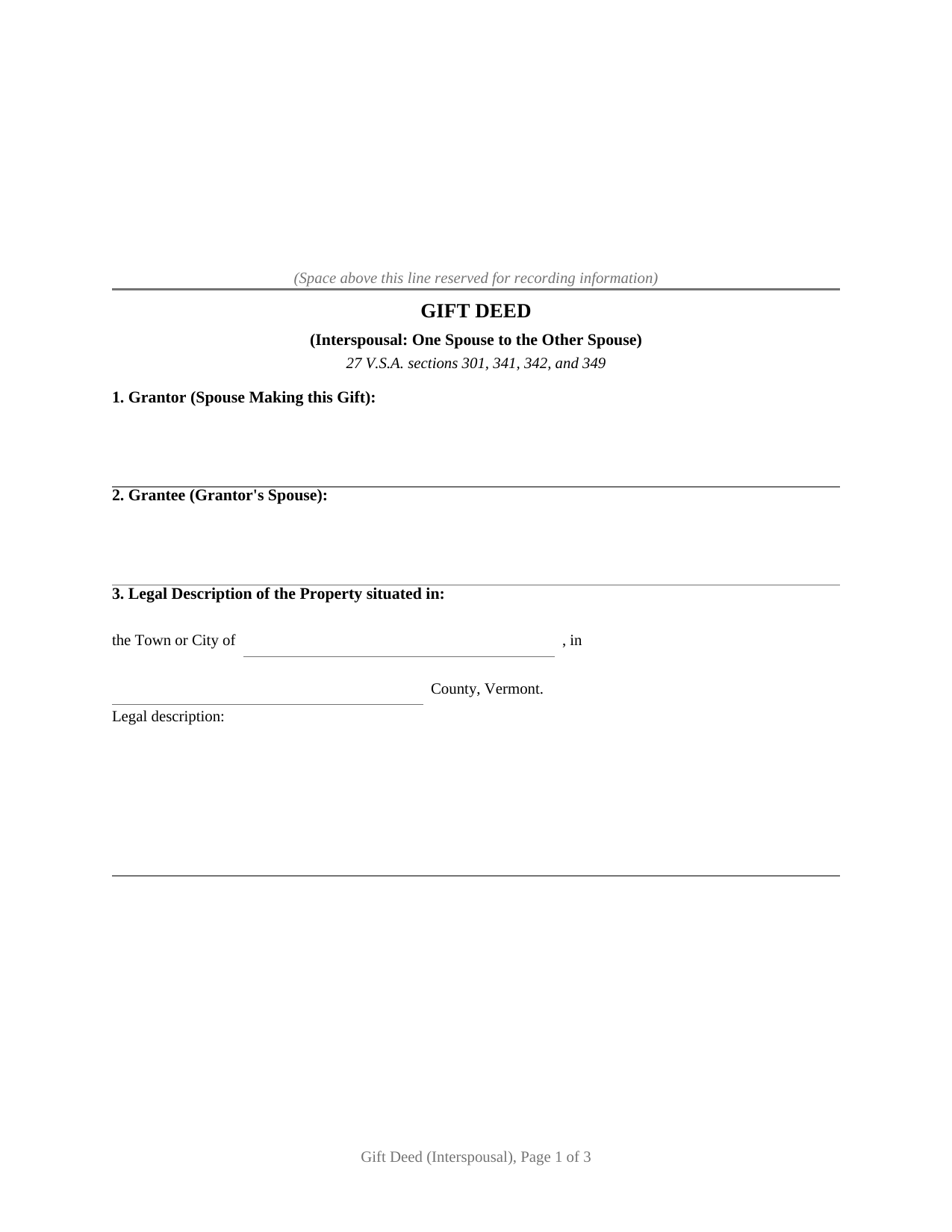
About the Vermont Gift Deed (Interspousal)
How to Use This Form
- Select your county from the list
- Download the county-specific form
- Fill in the required information
- Have the document notarized if required
- Record with your county recorder's office
What Others Like You Are Saying
"I am mostly satisfied with my Deeds.Com experience. Not sure if you can do anything about this, but …"
"Great source for forms acceptable to the county."
"I was trying to get a lien released for the last 3 month with Maricopa County and once I utilized yo…"
"Amazing from start to finish!"
"This site is awesome. It has everything I need to purchase and sell (transfer deed ownership) land a…"
4.8/5 from 4,823 reviews. Read all
One signature line carries this entire Vermont deed: it is a gift deed from one spouse to the other, and the grantee spouse signs nothing. The package prepares an interspousal gift deed for Vermont real property, moving the grantor's whole interest into the other spouse's name alone, without a price and without warranties.
A gift between spouses, stated on the face of the deed
The deed states that the grantor and the grantee are married to each other or joined in a civil union that Vermont law recognizes, and it conveys in consideration of love and affection, without actual consideration. Vermont law makes room for exactly this conveyance: 27 V.S.A. section 349(a) permits a person to convey real estate directly to the person's spouse, with no intermediate conveyance and no second grantor. And because Vermont has no statute that implies title covenants from a deed's operative words, the form says plainly what a gift deed is: a conveyance of whatever interest the grantor holds at delivery, with no covenant or warranty of title, stated in bold capitals in the operative section.
The homestead interest travels with the gift
Vermont's homestead statute ordinarily makes a married owner's conveyance of the homestead inoperative as to the homestead unless the other spouse joins in the deed. The interspousal direction is the exception written into the statute itself: under 27 V.S.A. section 141(d), a spouse or civil union partner may convey the homestead interest to the other spouse or civil union partner, and a conveyance of homestead property between spouses is deemed to include any homestead interest. The deed carries that statutory reference in its operative section, so the land record shows the homestead question answered on the face of the instrument. Spouses consolidating a home into one name after a marriage, and households where title practice places the non-titled spouse's homestead interest with the titled spouse, present the pattern this spouse-to-spouse deed carries.
Exempt from the transfer tax, never from the return
Vermont taxes transfers of real property by deed, and a transfer between two spouses without actual consideration is exempt under 32 V.S.A. section 9603(5). The exemption does not travel by itself: 32 V.S.A. section 9608 bars the town clerk from recording a deed unless a complete Vermont Property Transfer Tax Return accompanies it, so the return is prepared and the exemption is claimed on it even though no tax is due. Recording happens with the clerk of the town or city where the land lies, since Vermont keeps its land records by municipality rather than by county, at fifteen dollars per page plus fifteen dollars for the return filing. Under 27 V.S.A. section 342, recording is also what makes the deed effectual against anyone beyond the grantor and the grantor's heirs; between the spouses the gift operates on delivery, and the recorded deed protects the grantee against the rest of the world.
What this form is set up as
The form carries nine numbered sections: one grantor entry, one grantee entry, the property's town and formal legal description, the street address, the source of title, encumbrances of record, a survey reference blank serving 27 V.S.A. section 341(b), the gift conveyance, and a single signature block feeding one acknowledgment certificate in Vermont's statutory short form wording, with the commission number line the notary statutes describe for certificates completed without an official stamp. The grantor signs before a notary public, in Vermont or in any state where the grantor happens to be. The form is not set up as a two-grantor deed, and it is not set up to place both spouses on title together; the grantee entry names one person, the grantor's spouse, taking the entire interest in sole ownership. A deed signed by both spouses in favor of an outsider, and a deed adding a spouse alongside the grantor as co-owner, each follow a different architecture from the one this interspousal transfer document carries.
The package contains the gift deed as a fillable PDF, a completed example showing the form filled in for a Milton, Chittenden County fact pattern, and a plain language guide that walks through every numbered section, the notary certificate, and recording with the town clerk. The materials describe Vermont law in general terms and are not legal advice.
Important: County-Specific Forms
Our gift deed (interspousal) forms are specifically formatted for each of the 14 counties in Vermont.
After selecting your county, you'll receive forms that meet all local recording requirements, ensuring your documents will be accepted without delays or rejection fees.