Vermont Memorandum of Lease (Entity Lessor)
County Specific Legal Forms Validated as recently as September 23, 2026 by our Forms Development Team
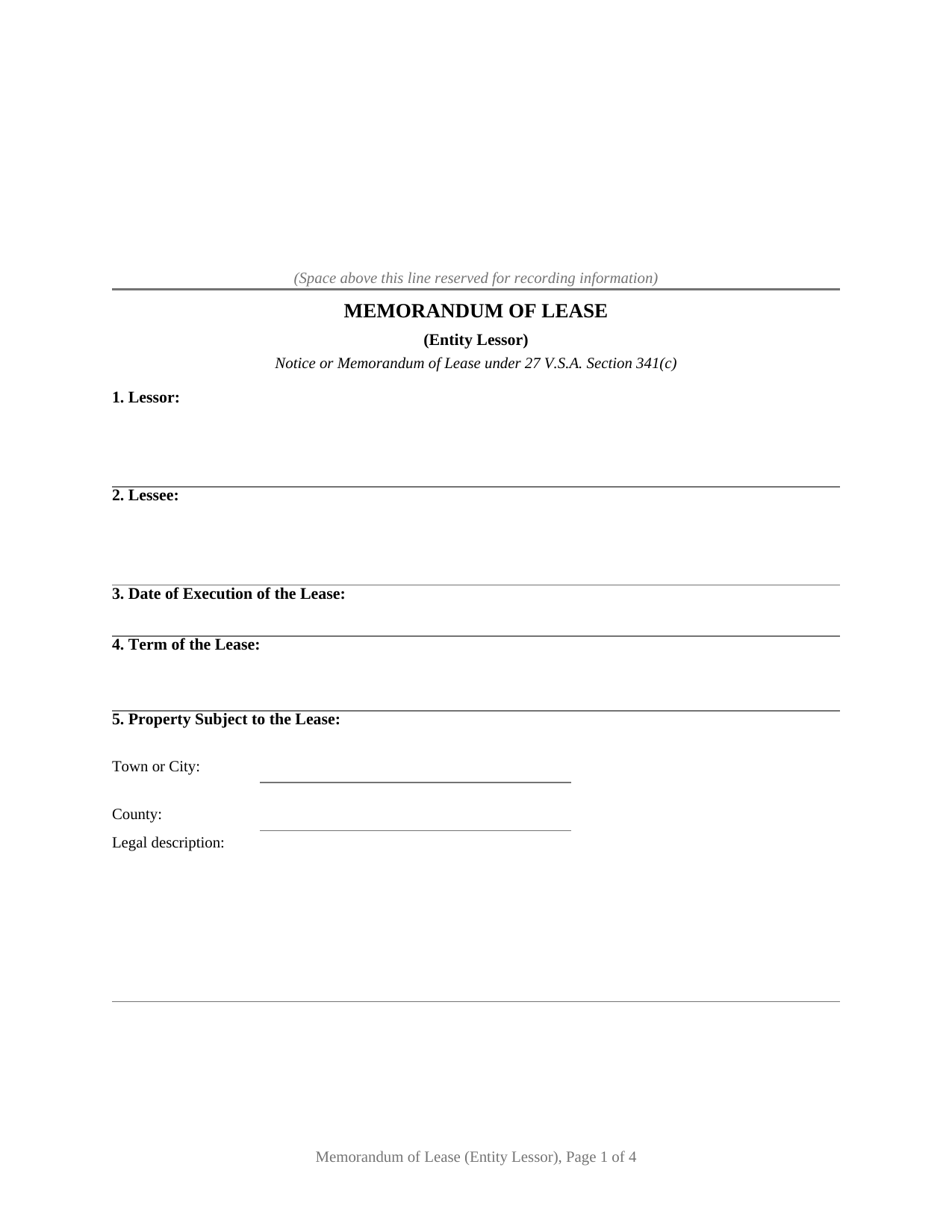
About the Vermont Memorandum of Lease (Entity Lessor)
How to Use This Form
- Select your county from the list
- Download the county-specific form
- Fill in the required information
- Have the document notarized if required
- Record with your county recorder's office
What Others Like You Are Saying
"So helpful and quick! The response time and kindness was amazing! The steps were easy to follow as w…"
"A little confusing to try to save your docouments and how to process them but once figured out easy …"
"Easy, Fast, Inexpensive and Responsive!"
"Nice work. Easy to use site for reasonable price. Thank you."
"make filing doc so simple and fast saves time and money"
4.8/5 from 4,817 reviews. Read all
A landlord that is a limited liability company or corporation signs nothing in its own hand: every signature comes from an authorized representative, and every recorded instrument carries that capacity on its face. This Vermont memorandum of lease is built around that fact. It gives record notice of a lease whose lessor is a business entity, under 27 V.S.A. Section 341(c), while the lease itself, with its rent and business covenants, stays off the public record.
Why a long Vermont lease goes on record
Under 27 V.S.A. Section 342, a lease for more than one year is not effectual to hold the estate against any person but the grantor and the grantor's heirs unless it is acknowledged and recorded. A ten-year storefront lease that never reaches the town land records binds its original parties, but the recording statute leaves later purchasers and lenders outside it. Recording the whole lease cures that and publishes every negotiated term along the way. Section 341(c) supplies the middle path: a recorded notice of lease, also called a memorandum of lease or short form of lease, executed and acknowledged by the parties, carrying the statutory content list and nothing more.
The statute names the items: the parties, the date of execution, the term of the lease, the property description, rights of extension or renewal, rights of purchase or first refusal, restrictions on assignment, the addresses set forth in the lease, and the location of the original lease. The form collects each item in its own numbered section, closes with notice language stating that the lease controls over any summary, and ends with signature blocks and an acknowledgment certificate for each signer.
Built for an entity landlord
The lessor section recites the entity's full name, its type and state of organization, and its address as set forth in the lease. The signature section carries a capacity statement, the representative's signature line with printed name and date, and a title line reading in the style of the completed example, Manager, Green Mountain Commons LLC. The representative acknowledges in a representative capacity, and the certificate's name line carries the signer and the entity in the style of 26 V.S.A. Section 5368(2): the signer as an officer, manager, or trustee of the named party.
An LLC that owns a mixed-use building and leases its ground floor, a corporation granting a ground lease for development, a family company renting farmland on a long term, and a solar or telecommunications site lease with an entity owner all present the pattern this form recites. The lessee entry takes the tenant exactly as the lease names it; the completed example shows an individual tenant, and the certificate by-lines accommodate a tenant entity's representative in the same style. A lease whose landlord signs personally presents a different signature and certificate pattern than the entity configuration this form recites.
Recording with the town clerk, and the transfer tax line
Vermont records land instruments by municipality, not by county, so the memorandum goes to the clerk of the town or city where the property is located, at the statewide fee of $15.00 per page under 32 V.S.A. Section 1671. One more statute matters before the counter: under 32 V.S.A. Section 9601, a memorandum of lease that evidences a transfer of title to property is a deed for property transfer tax purposes, and title to property includes a perpetual leasehold, a leasehold of 50 years or more, a shorter term that renewal rights may extend to 50 years or more, and a shorter lease granting both a right to purchase and rights to construct improvements. A memorandum of a lease within those classes records only with a completed Vermont Property Transfer Tax Return; a memorandum of a lease outside them sits outside that definition. The guide describes the statute so the classification question surfaces before the recording trip rather than at the counter.
The download includes the memorandum of lease as a fillable PDF, a completed example showing the form filled in for a realistic Vermont fact pattern, and a plain-language guide that describes every section, the signing formalities, and the recording steps. The materials are informational and are not legal advice; a Vermont attorney can apply these statutes to a particular lease.
Important: County-Specific Forms
Our memorandum of lease (entity lessor) forms are specifically formatted for each of the 14 counties in Vermont.
After selecting your county, you'll receive forms that meet all local recording requirements, ensuring your documents will be accepted without delays or rejection fees.