Vermont Memorandum of Lease (Individual Lessor by Attorney-in-Fact)
County Specific Legal Forms Validated as recently as September 29, 2026 by our Forms Development Team
About the Vermont Memorandum of Lease (Individual Lessor by Attorney-in-Fact)
How to Use This Form
- Select your county from the list
- Download the county-specific form
- Fill in the required information
- Have the document notarized if required
- Record with your county recorder's office
What Others Like You Are Saying
"Super easy and efficient. One time charge for the form with no commitment to a recurring charge for …"
"after a poor start was able to get to the forms page and find what I was looking for and every thing…"
"very quick and easy"
"Fabulous resource! They provide everything you need at an extremely reasonable price."
"Document site was very easy to access and pull up what I needed."
4.8/5 from 4,817 reviews. Read all
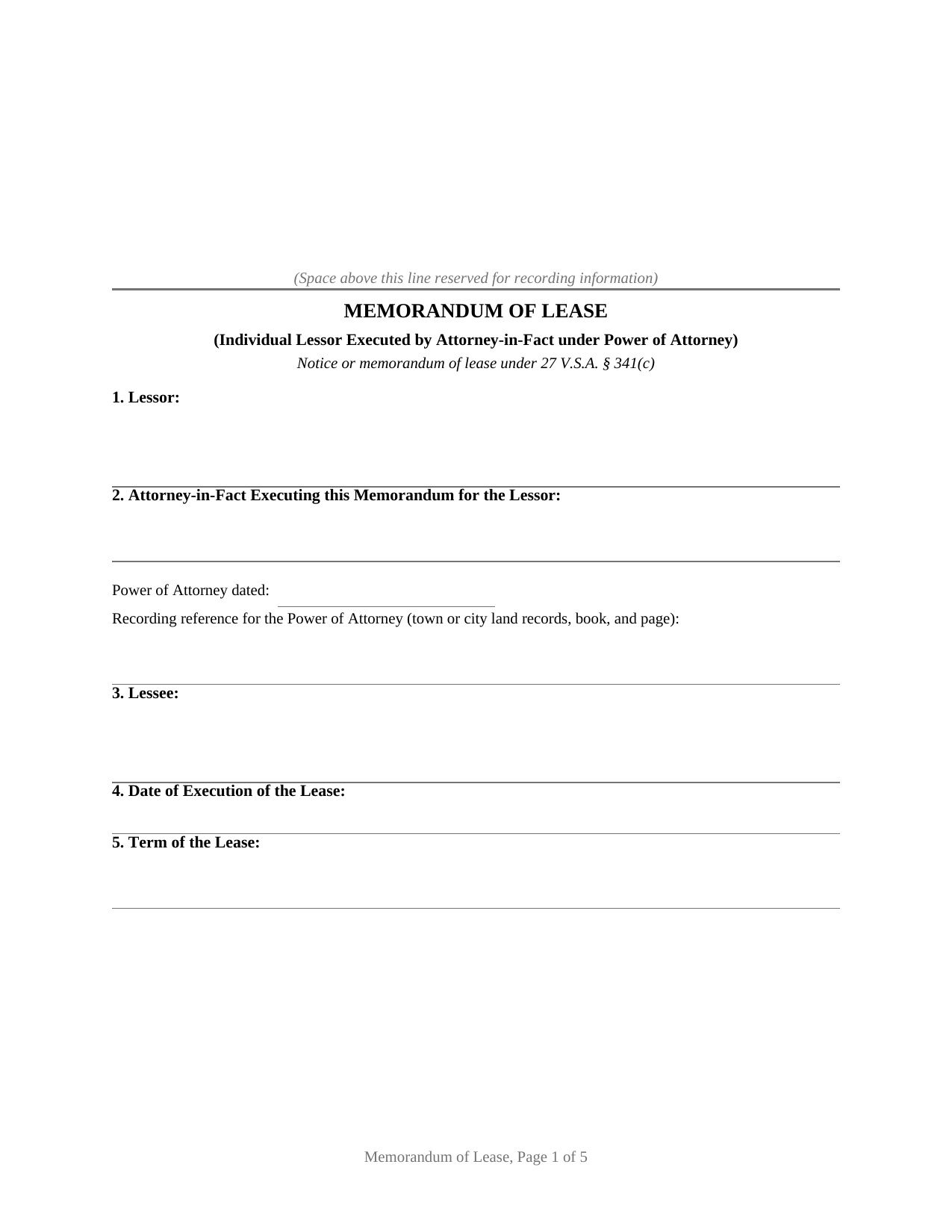
This Vermont memorandum of lease is arranged around one signature that stands in for another: an attorney-in-fact signs the recorded notice for an individual lessor under a recorded power of attorney, while the lessee signs personally. The package prepares the short notice that 27 V.S.A. § 341(c) permits a landlord and tenant to record in place of the lease itself whenever the term runs longer than one year from the making of the lease.
A recorded notice instead of the whole lease
Under 27 V.S.A. § 342, a lease for more than one year is not effectual to hold the estate against anyone beyond the lessor and the lessor's heirs unless it is acknowledged and recorded. Section 341(c) supplies the quieter path: the lease need not be recorded at length if a notice or memorandum of lease, executed and acknowledged as the statute provides, is recorded in the land records of the town where the property is situated. The rent and the other private economics stay in the unrecorded lease; the record carries the nine items the statute lists, and this form collects each one in a numbered section: the parties as named in the lease and their lease-stated addresses, the date of execution, the term, rights to extend or renew, the property description, purchase rights and rights of first refusal, restrictions on assignment, and the location of an original lease. Section 11 of the form then gives notice of the lease in operative prose and provides that the lease controls between the parties if the two documents ever diverge.
One signature line held by an agent
The form recites exactly one individual lessor, acting through one attorney-in-fact, plus the lessee. Section 2 identifies the agent and the power of attorney by date and by its recording reference in the town land records, because 27 V.S.A. § 305 has the power of attorney signed, acknowledged, and recorded in the same office where the supported instrument is recorded. The signature block presents the agency in the disclosure style of 14 V.S.A. § 4051, the principal's name by the agent's signature, and the agent's acknowledgment certificate is the representative-capacity short form of 26 V.S.A. § 5368(2), printed with the statute's own labeled blanks: the individual signing, the type of authority, and the party on whose behalf the record was executed. Under the Vermont Uniform Power of Attorney Act, general authority over real property includes authority to lease, per 14 V.S.A. § 4034, and the statutory real estate power of attorney form in § 4052 confers those powers. A lessor who has placed real estate matters in an agent's hands, and a long lease signed while the owner is away or unavailable, present the pattern this memorandum recites; an entity lessor signing through an officer, or a lessor signing personally, presents a different signature architecture than this form carries.
Recording with the town clerk, and the 50-year tax line
Vermont records land instruments by town and city, not by county, so the memorandum goes to the municipal clerk where the property lies, at the statewide fee of $15.00 per page under 32 V.S.A. § 1671(a). Most memoranda record without a transfer tax filing, and the statute draws the line by duration and rights: under 32 V.S.A. § 9601(3), a perpetual leasehold, a fixed term of 50 years or more, a shorter term whose renewal rights could reach 50 years, or a shorter term paired with a purchase right and construction rights counts as a transfer of title to property, and 32 V.S.A. § 9608 then requires the completed Property Transfer Tax Return before the clerk records. The guide walks through that analysis, the town-based recording system, and each numbered section of the form.
The package contains the fillable memorandum of lease form, a completed example showing a six-year Vermont farm lease recorded through an attorney-in-fact, and a plain-language guide to completing, signing, and recording the notice of lease. The materials are informational and are not legal advice; a Vermont attorney can apply these statutes to a particular lease or power of attorney.
Important: County-Specific Forms
Our memorandum of lease (individual lessor by attorney-in-fact) forms are specifically formatted for each of the 14 counties in Vermont.
After selecting your county, you'll receive forms that meet all local recording requirements, ensuring your documents will be accepted without delays or rejection fees.