Vermont Memorandum of Lease (Trustee Lessor)
County Specific Legal Forms Validated as recently as October 1, 2026 by our Forms Development Team
About the Vermont Memorandum of Lease (Trustee Lessor)
How to Use This Form
- Select your county from the list
- Download the county-specific form
- Fill in the required information
- Have the document notarized if required
- Record with your county recorder's office
What Others Like You Are Saying
"The forms are great. I kinda expected the guide to be bigger, maybe have some more information. Over…"
"This form was very helpful ... I wish I had run across your before it would have saved me a lot of m…"
"Deeds.com was fast and easy to file documents"
"Easy, Fast, Inexpensive and Responsive!"
"I used Deeds.com to record two judgments with the County Recorder's Office. The site was very easy t…"
4.8/5 from 4,817 reviews. Read all
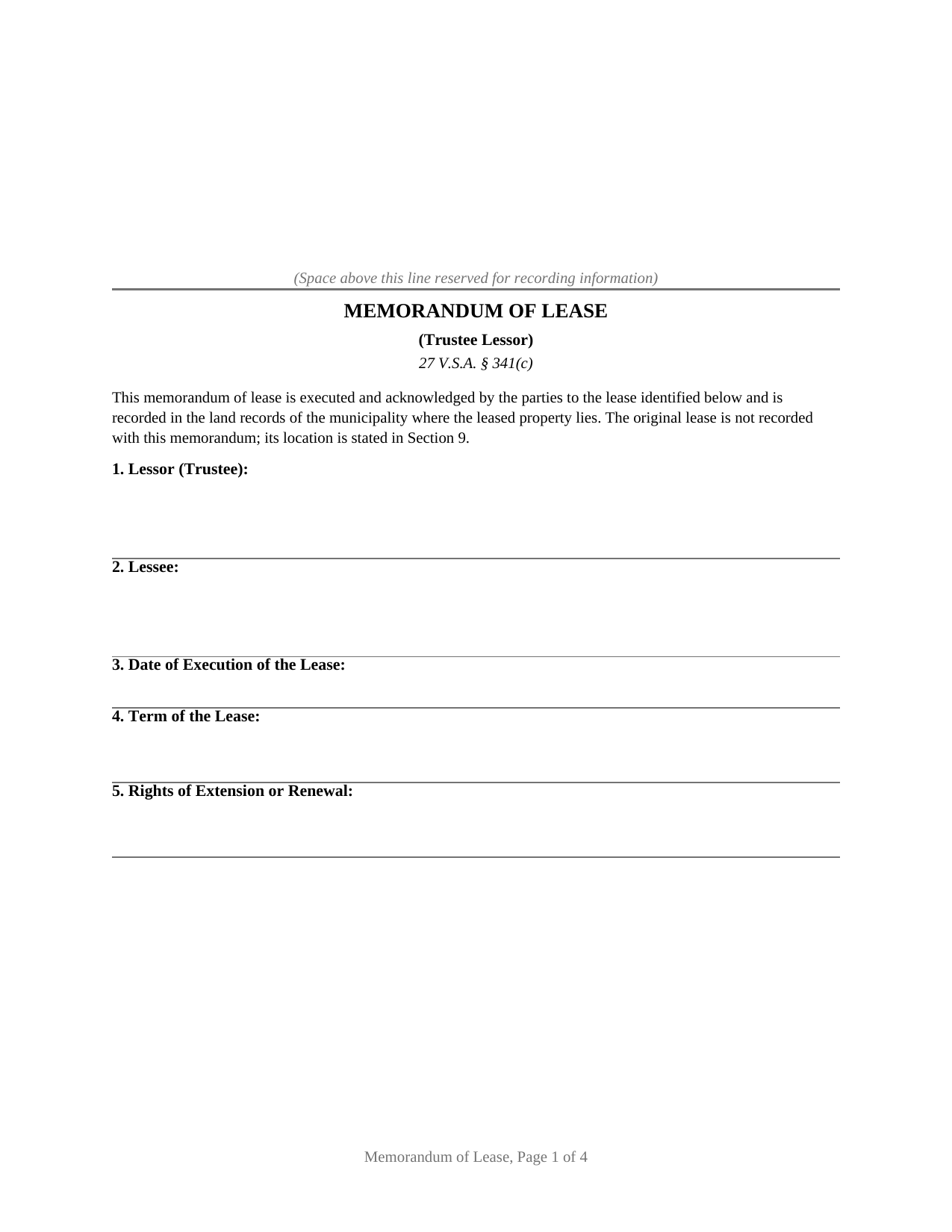
A Vermont lease often stays private while its existence still belongs on the public record. This fill-in-the-blank Vermont memorandum of lease carries the trustee lessor configuration: the lessor holds the leased property as trustee of a trust and signs solely in that stated capacity, the lessee joins, and the recorded memorandum places notice of the lease in the land records of the town or city where the property lies, under 27 V.S.A. Section 341(c), without recording the lease itself.
Notice on the land records without the full lease
Under 27 V.S.A. Section 342, a lease for a term of more than one year is not effectual to hold the leased estate against any person but the grantor and the grantor's heirs unless it is acknowledged and recorded. Vermont law supplies a way to satisfy the record without exposing the rent and the rest of the bargain: 27 V.S.A. Section 341(c) permits recording a notice or memorandum of lease, an instrument some drafters call a short form lease, that carries the names and addresses of the parties, the date of execution, the term, a description of the property, any rights of extension or renewal, any rights of purchase or first refusal, any restrictions on assignment, and the location of the original lease. The statute states that the memorandum is executed and acknowledged by the parties to the lease, so the lessor and the lessee both sign and both acknowledge.
A lessor who signs as trustee
The form recites exactly one lessor, named in a stated trustee capacity with the trust's full name, and one lessee. A sentence in the operative section limits the lessor's execution to that trustee capacity, so the record shows the trust relationship on its face. Trust-held rental property presents this pattern in Vermont land records: a family trust holding a leased commercial building, or a revocable living trust holding an income property, appears of record with the trustee as lessor. A lease signed by individual co-owners, or by several cotrustees each signing, presents a different signature architecture than this form carries.
The form carries a separate acknowledgment certificate for each signer, so the trustee and the lessee may acknowledge on different dates, before different notaries, or in different states. The acknowledgment blank holds a full representative capacity, in the style of the completed example's trustee entry. The trustee's authority to lease comes from the trust instrument and the Vermont Trust Code; a certification of trust under 14A V.S.A. Section 1013, prepared and recorded separately and not included in this package, is the sworn instrument Vermont law describes as evidence of that authority.
Recording at the town clerk, and the transfer tax line
Vermont records land instruments by municipality, so the memorandum goes to the clerk of the town or city where the property lies, at the statewide fee of $15.00 per page under 32 V.S.A. Section 1671. One tax question rides with every recorded lease instrument in Vermont: 32 V.S.A. Section 9601 defines a deed, for property transfer tax purposes, to include a memorandum of lease evidencing a transfer of title to property, and it defines title to property to reach perpetual leaseholds, terms of 50 years or more counting renewal rights, and shorter terms that pair a purchase right with a right to construct improvements. A memorandum of a lease within those definitions is recordable only with a completed Property Transfer Tax Return under 32 V.S.A. Section 9608. An ordinary fixed-term lease below those thresholds, like the five year term with one renewal option shown in the completed example, sits outside the statutory definitions, and the return requirement attached to taxable transfers does not reach it. The memorandum's term, renewal, and purchase entries carry exactly the facts that answer the question.
What arrives in the download
The package delivers the blank fillable memorandum of lease as a PDF, a completed example showing a trust-held Montpelier property from trustee entry through both acknowledgments, and a guide that walks each numbered section, the signing and notarization mechanics, and the recording steps at the municipal clerk's office. The materials describe Vermont law in general terms and are not legal advice; a Vermont attorney can address how these rules operate on a specific lease or trust.
Important: County-Specific Forms
Our memorandum of lease (trustee lessor) forms are specifically formatted for each of the 14 counties in Vermont.
After selecting your county, you'll receive forms that meet all local recording requirements, ensuring your documents will be accepted without delays or rejection fees.