Vermont Mortgage Deed (Sole Owner with Homestead Joinder)
County Specific Legal Forms Validated as recently as September 18, 2026 by our Forms Development Team
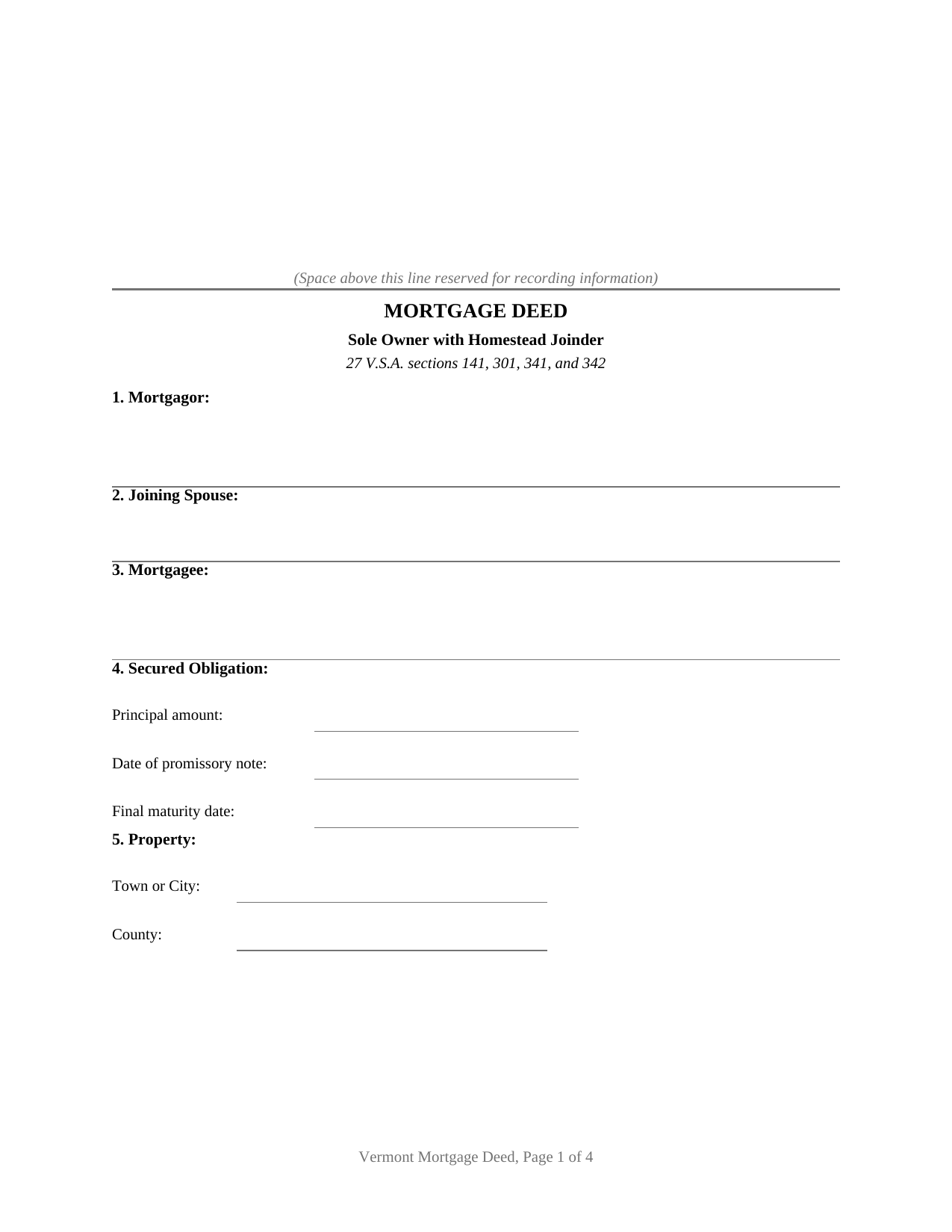
About the Vermont Mortgage Deed (Sole Owner with Homestead Joinder)
How to Use This Form
- Select your county from the list
- Download the county-specific form
- Fill in the required information
- Have the document notarized if required
- Record with your county recorder's office
What Others Like You Are Saying
"I found this sight very helpful. All the information that one needs to file a quit claim deed. thank…"
"Very pleased with the service provided. Will use again if the need arises. Thank you"
"easy sight and extra forms that I can use any time"
"The Lady Bird Deed appears to be fine with me as are the instructions. However, there apparently are…"
"Love the names on the example! thanks for the smiles!"
4.8/5 from 4,819 reviews. Read all
A Vermont mortgage deed signed by a married homeowner often carries a second signature from someone who neither owns the property nor owes a dollar of the debt. This form prepares a Vermont mortgage deed for one record owner who is married: the owner signs as mortgagor, and the owner's spouse signs as a joining spouse whose signature binds the homestead interest under 27 V.S.A. section 141.
Why the Spouse Signs a One-Owner Mortgage
Vermont's homestead statute, 27 V.S.A. section 101, shields up to $125,000 of the home place from most creditor claims, and 27 V.S.A. section 141 protects that interest at the signing table: a homestead, or an interest in one, shall not be conveyed by a married owner unless the spouse joins in the execution and acknowledgment of the conveyance, and the statute reaches a mortgage just as it reaches a sale. A mortgage signed without the joinder is inoperative as to the homestead, which leaves the lender's security incomplete on exactly the property the loan was measured against.
The statute carves out one mortgage from the rule: purchase money given at the time of purchase. A closing table mortgage that finances the acquisition binds the homestead without the spouse's signature. The mortgage this form prepares is the other kind, given by an owner already in title: a private or family loan secured against the home, seller financing arranged after the purchase, or a home improvement loan. The form recites exactly one record owner plus a joining spouse. Property held by two spouses as tenants by the entirety presents a different pattern, with both spouses conveying as mortgagors, and an unmarried sole owner mortgages without any joinder.
A Conveyance With a Condition
Vermont is a title theory state, so the granting clause conveys the property to the mortgagee as security, with covenants that the mortgagor is the sole owner, lawfully seised in fee simple, and holding free from encumbrances except those the form states. The condition follows: when the secured obligation is paid and performed, the mortgage deed is void. The debt itself lives in a promissory note, described in the mortgage by principal amount, note date, and maturity date; the note is a separate instrument, prepared separately and not included in this package, and it stays out of the public records.
The joinder clause states its own limits: the joining spouse signs to bind homestead rights under 27 V.S.A. sections 141 and 349 and undertakes no personal liability for the secured obligation. The form carries a separate acknowledgment certificate for each signer, so the mortgagor and the joining spouse may acknowledge on different dates, before different notaries, even in different states.
Recording in the Town Land Records
Vermont records land instruments by municipality, not by county. The completed mortgage deed goes to the clerk of the town or city where the land lies, at the statewide fee of $15.00 per page under 32 V.S.A. section 1671. A mortgage deed given to secure a debt sits outside the property transfer tax return category, so no Form PTT-172 accompanies it, a contrast with deeds that transfer title. Recording is what makes the mortgage effectual against anyone beyond the mortgagor and the mortgagor's heirs under 27 V.S.A. section 342, and it fixes the mortgage's priority against later recorded interests. The printed name lines under both signatures track 32 V.S.A. section 1405, which permits the clerk to look for typed, stamped, or printed names under signatures, with a $2.00 additional fee for an instrument that arrives without them. At payoff, discharge is its own recorded event, with 27 V.S.A. section 464 giving the mortgagee 30 days after full performance to execute and deliver it.
What the Package Prepares
The package contains the fillable mortgage deed form, a completed example showing the document filled in for a Waterbury, Washington County fact pattern, and a plain language guide that walks through every numbered section, the two-signer notarization, and the town recording process. The materials describe Vermont law in general terms and are not legal advice; a Vermont attorney can apply these statutes to a particular title or loan.
Important: County-Specific Forms
Our mortgage deed (sole owner with homestead joinder) forms are specifically formatted for each of the 14 counties in Vermont.
After selecting your county, you'll receive forms that meet all local recording requirements, ensuring your documents will be accepted without delays or rejection fees.