Vermont Mortgage Deed (Two Individuals)
County Specific Legal Forms Validated as recently as September 15, 2026 by our Forms Development Team
About the Vermont Mortgage Deed (Two Individuals)
How to Use This Form
- Select your county from the list
- Download the county-specific form
- Fill in the required information
- Have the document notarized if required
- Record with your county recorder's office
What Others Like You Are Saying
"I filed a Mechanic's Lien in PA. I appreciate that Deeds.com charges only a one time fee. When I too…"
"Great!"
"My 1st trip to your site. I give it a full 5-star rating! Thank you. I'll be back."
"very easy to use !!!"
"Loved every step of the process, from the detail explanation of the services/products provided, to t…"
4.8/5 from 4,820 reviews. Read all
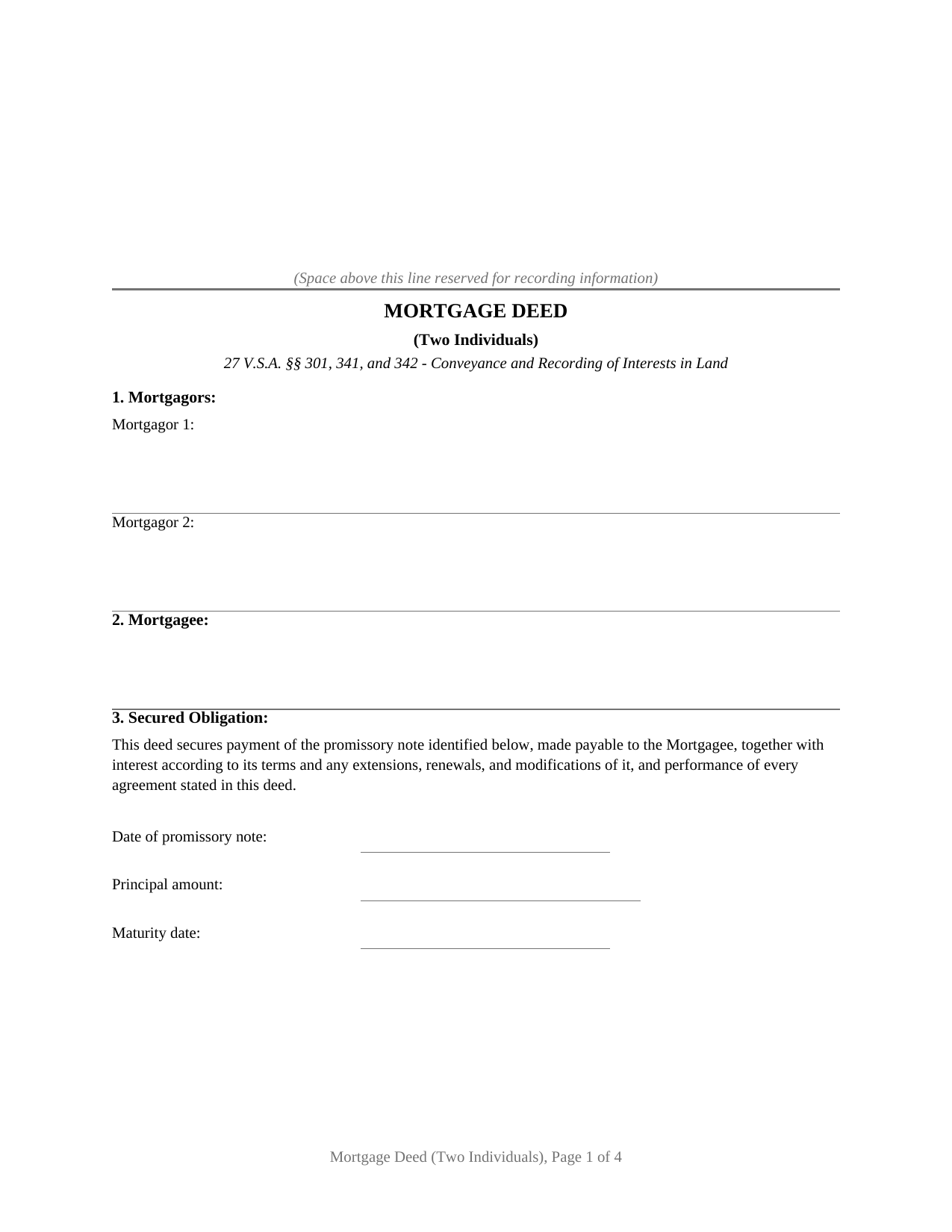
Two individual mortgagors sign this Vermont mortgage deed, and the form carries a separate notary acknowledgment certificate for each of them. It is the recorded half of a private loan against Vermont real estate: two people who own the property, often a married couple or a pair of co-owners, convey it to a named mortgagee as security for a promissory note, on the stated condition that the conveyance becomes void when the note is paid and every secured agreement is performed.
A conveyance that ends at payoff
Vermont treats a mortgage as a true conveyance. The statute that gives recorded instruments their effect against third parties, 27 V.S.A. § 342, names the mortgage alongside the deed of bargain and sale, and Vermont title practice describes the granting of a mortgage as a conveyance of legal title to the mortgagee, subject to the mortgagor's right to redeem. This form follows that structure. It conveys the property with full conveyance words and title covenants, identifies the promissory note by date, principal amount, and maturity, and then states the traditional condition: on full payment and performance, the deed is void. Vermont statute backs the ending as well. 27 V.S.A. § 464 requires the mortgagee to deliver a discharge within 30 days after full performance, with statutory damages for delay, and the discharge statutes at 27 V.S.A. §§ 461 through 464a supply the recorded instruments that clear the mortgage from the title.
The promissory note itself, prepared separately and not included in this package, holds the interest rate and payment schedule and stays off the public record. A seller financing a sale has a statutory reason to record the mortgage deed: under 27 V.S.A. § 307, a seller holds no lien for unpaid purchase money unless the lien is created or evidenced by a deed executed, acknowledged, and recorded in the manner required for deeds. The mortgage deed the buyers give back at closing is that instrument, which is why this form appears so often in owner financing.
Two mortgagors, two acknowledgment certificates
The form recites exactly two mortgagors, natural persons signing in their individual capacities, and one mortgagee, who may be an individual or an entity and does not sign. A married couple mortgaging the home they own together, two relatives who took title jointly, and unmarried co-owners borrowing against shared property present the two-signer pattern this deed recites. Each mortgagor signs before a notary, and the two certificates allow the signers to acknowledge on different dates, before different notaries, or in different states. Vermont homestead law runs through the same architecture: 27 V.S.A. § 141 makes a married owner's conveyance of homestead property inoperative as to the homestead unless the spouse joins in the execution and acknowledgment, apart from a purchase money mortgage given at the time of purchase, and a mortgage deed signed and acknowledged by both spouses answers that joinder rule on its face. A sole owner, an entity, or a fiduciary signing in a representative capacity presents a different signature architecture than this form is set up to recite.
Recorded with the town clerk, not a county recorder
Vermont land records are municipal. The completed mortgage deed goes to the clerk of the town or city where the land lies, at the statewide fee of $15.00 per page under 32 V.S.A. § 1671(a), and the top of the first page reserves space for the clerk's recording information. A mortgage deed is also one of the instruments the Vermont property transfer tax return does not reach: the Department of Taxes excludes mortgage deeds from the Form PTT-172 filing category, so the mortgage records without the return that accompanies a deed transferring title. Printed names appear under the signature lines because 32 V.S.A. § 1405 permits the recording official to require them.
The package contains the mortgage deed as a fillable PDF, a completed example showing the form filled in for a realistic Chittenden County fact pattern, and a plain language guide that walks through every numbered section, the notarization rules, and the recording steps. The materials describe Vermont law in general terms and are not legal advice.
Important: County-Specific Forms
Our mortgage deed (two individuals) forms are specifically formatted for each of the 14 counties in Vermont.
After selecting your county, you'll receive forms that meet all local recording requirements, ensuring your documents will be accepted without delays or rejection fees.