Vermont Mortgage Deed (Entity)
County Specific Legal Forms Validated as recently as September 30, 2026 by our Forms Development Team
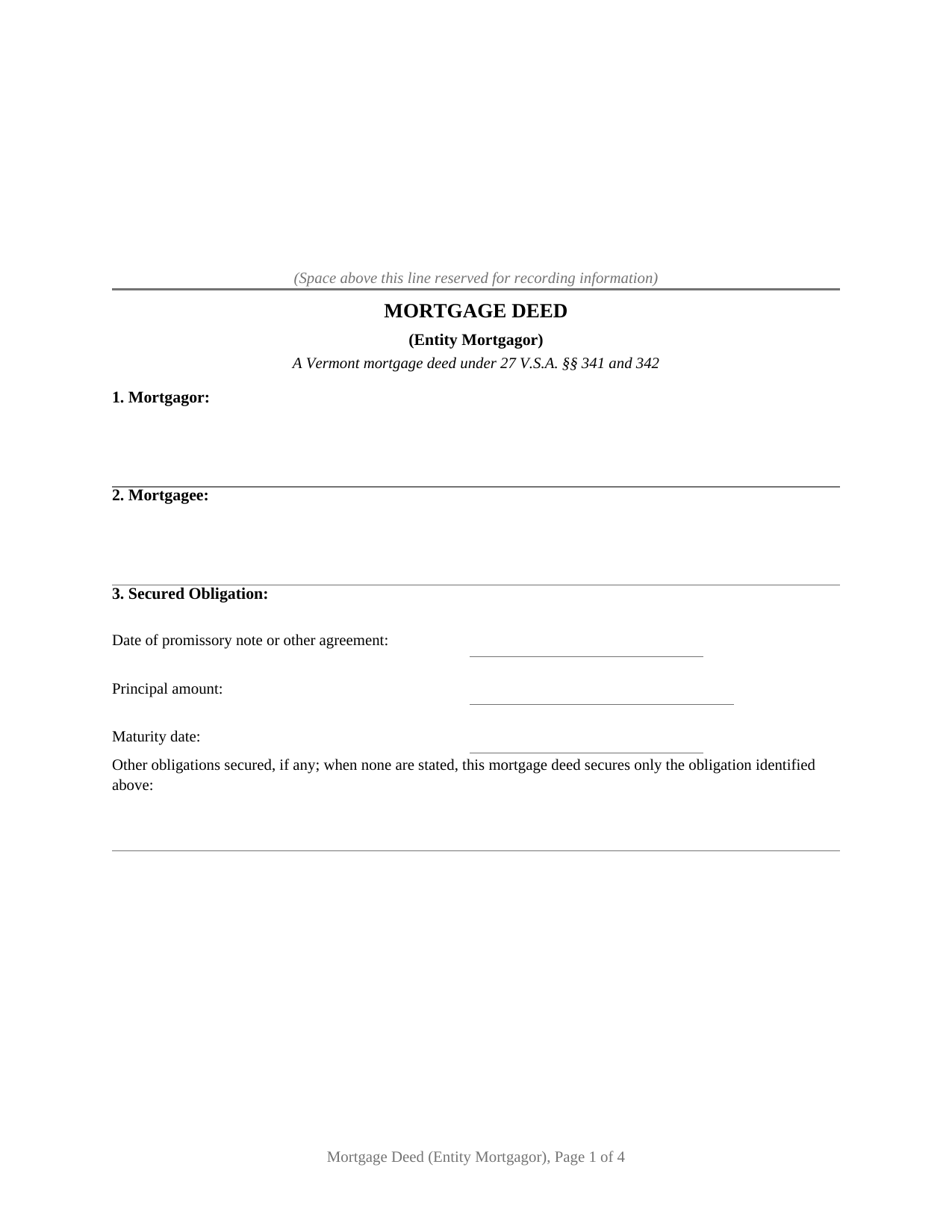
About the Vermont Mortgage Deed (Entity)
How to Use This Form
- Select your county from the list
- Download the county-specific form
- Fill in the required information
- Have the document notarized if required
- Record with your county recorder's office
What Others Like You Are Saying
"EASY. WORKED WITH PROBLEMS."
"I am so very thankful for the service that you provide for the public, thank you very much."
"excellent transaction...very informative prior to purchase.."
"I was very glad to have this option for filing a form as it would have taken 4 days due to offices b…"
"Every thing worked perfectly."
4.8/5 from 4,821 reviews. Read all
This mortgage deed is built around a Vermont property owner that is a business entity: one LLC, corporation, or partnership as mortgagor, one authorized representative's signature, and one representative capacity notary certificate. It secures a promissory note or other obligation against Vermont real estate and records in the land records of the town or city where the property lies.
A Conveyance With a Condition Attached
Vermont is a title theory state, and its mortgage instrument shows it. Rather than a lien rider stapled to a loan, a Vermont mortgage deed is a conveyance: the mortgagor grants the property to the mortgagee, to have and to hold as security, subject to the traditional condition that full payment and performance of the secured obligation voids the deed. This form carries that architecture in its own words, with express title covenants, a defeasance condition citing the discharge statutes, and a reference to the mortgagee's statutory remedies. When the loan pays off, Vermont law puts a deadline on clearing the record: 27 V.S.A. 464 gives the mortgagee 30 days after full performance to execute and deliver a discharge, with statutory damages of $25.00 per day, up to $5,000.00, for a mortgagee that does not.
One Entity, One Authorized Signature
The signature architecture is what makes the entity version its own instrument. The form recites exactly one entity mortgagor and identifies it the way lenders and town clerks expect: exact legal name, entity type, state of organization, and principal office. The signature block names the entity, then carries a By line for the authorized representative, with printed name and title or capacity beneath it, and the acknowledgment certificate's name line carries the representative capacity in the statutory style of 26 V.S.A. 5368(2): a named individual, as manager or officer, on behalf of the company. Because the record owner is an entity rather than a married individual, Vermont's homestead joinder statute has no signature role here, and the form carries no spousal signature line. An individual owner mortgaging personally held property presents a different signature and acknowledgment pattern; this form does not recite it.
Remedies That Turn on Who Owns the Property
Vermont foreclosure law draws a line that matters to entity owned real estate. Judicial foreclosure under 12 V.S.A. chapter 172 includes strict foreclosure, available only where the court finds no substantial equity beyond the debt, and foreclosure by judicial sale. Nonjudicial foreclosure under 12 V.S.A. 4961 is available, whether or not the mortgage contains a power of sale clause, for any property except farmland or a dwelling house owned by a natural person. Property held by an LLC or corporation is not a dwelling house owned by a natural person, so the nonjudicial path can reach entity owned property that is not farmland, following the statutory notice of intent to foreclose. The guide describes each path with its citations.
Recorded With the Town Clerk, Without a Transfer Tax Return
Vermont records land instruments by municipality, so this deed goes to the clerk of the town or city where the land lies, at the statewide fee of $15.00 per page under 32 V.S.A. 1671(a). Recording is what gives the mortgage effect against third parties: under 27 V.S.A. 342, an unacknowledged or unrecorded mortgage holds the estate only against the grantor and the grantor's heirs. One welcome simplification distinguishes a mortgage from a conveyance of title: the Vermont property transfer tax return, Form PTT-172, is not filed with a mortgage deed, because the Department of Taxes excludes security instruments from the return filing category. The recording package is the deed and the fee.
What the Download Contains
The package contains the mortgage deed as a fillable PDF, a completed example documenting a realistic Chittenden County loan from a Vermont LLC borrower start to finish, and a plain language guide that walks through every numbered section, the entity signature block, and the recording steps. The materials describe Vermont law in general terms and are not legal advice; an attorney can apply these rules to a particular entity, title, or loan.
Important: County-Specific Forms
Our mortgage deed (entity) forms are specifically formatted for each of the 14 counties in Vermont.
After selecting your county, you'll receive forms that meet all local recording requirements, ensuring your documents will be accepted without delays or rejection fees.