Vermont Mortgage Deed (Individual)
County Specific Legal Forms Validated as recently as September 22, 2026 by our Forms Development Team
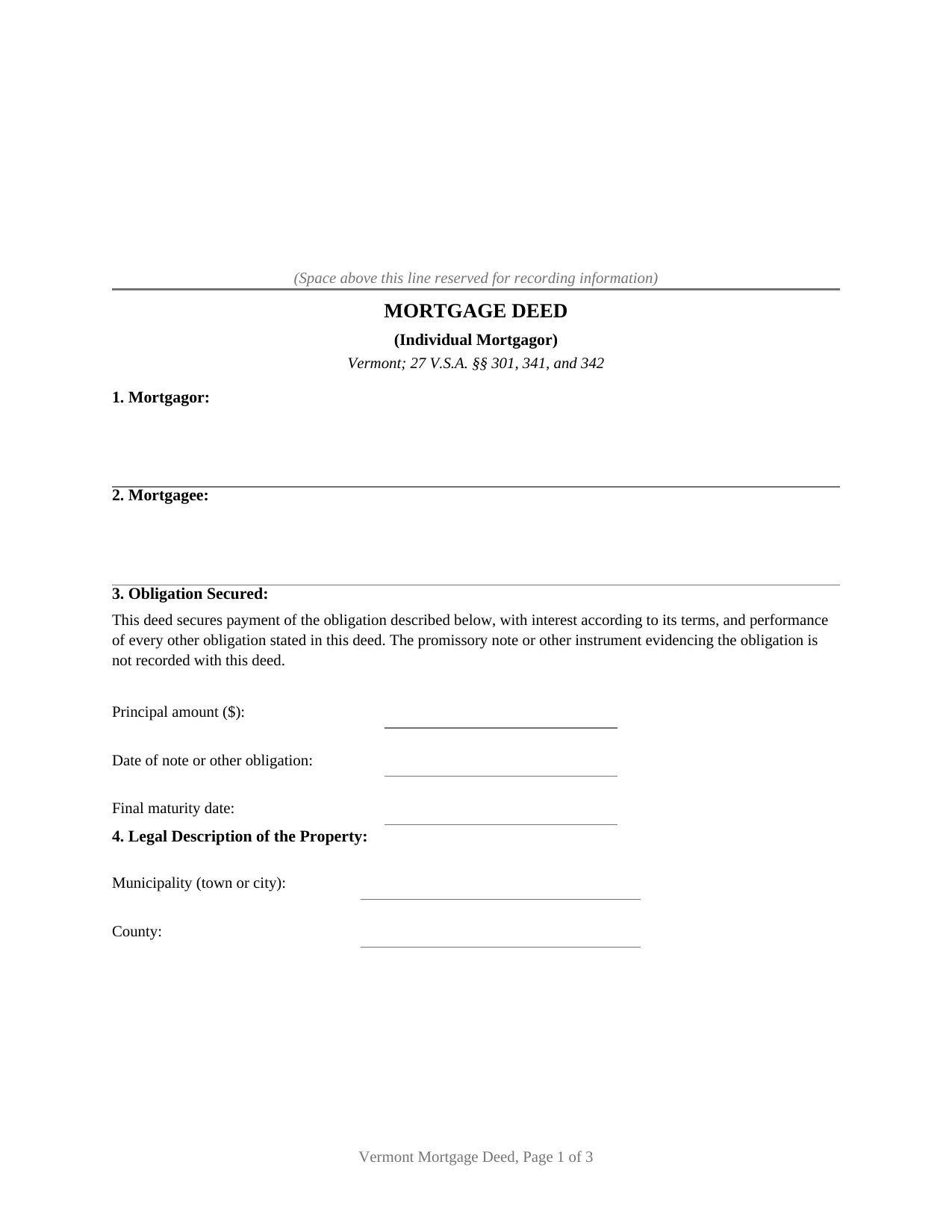
About the Vermont Mortgage Deed (Individual)
How to Use This Form
- Select your county from the list
- Download the county-specific form
- Fill in the required information
- Have the document notarized if required
- Record with your county recorder's office
What Others Like You Are Saying
"The service was excellent. The fee to use Deeds was more than I expected however, but the service wa…"
"My questions were answered promptly. I was not able to locate the deed I was searching for because m…"
"was great!"
"This was a very easy and organized system to use."
"Easy to use but the quit claim deep looked old and dated. The example of how to fill out should have…"
4.8/5 from 4,815 reviews. Read all
This fillable mortgage deed secures a loan against Vermont real estate for one individual borrower. The form recites a single mortgagor who signs before a notary public, the mortgagee who holds the security, and the terms of the promissory note the deed secures, the configuration that appears when a buyer finances a purchase through the seller, when a private lender or family member funds a loan, and when a sole owner borrows against land that is not the homestead of a married person.
A conveyance that ends when the debt is paid
Vermont is a title theory state, and its mortgage deed reads accordingly: the mortgagor grants, bargains, sells, conveys, and mortgages the property to the mortgagee, subject to a stated condition. When the obligation identified in the deed is paid in full and every other secured obligation is performed, the deed is void, and the mortgagee of record delivers a recorded discharge under 27 V.S.A. sections 461 through 464. Because no Vermont statute implies covenants from a deed label, the form states its title covenants expressly, with the encumbrances listed in the deed excepted, and it states the default provision under which the debt accelerates at the mortgagee's option and the mortgage may be foreclosed through the courts under 12 V.S.A. chapter 172. The promissory note itself stays off the public record; the deed identifies it by amount, date, and maturity without reproducing its terms.
One borrower, one signature, one certificate
The form carries one mortgagor entry, one signature line with a printed name line beneath it, and one acknowledgment certificate, so a single individual executes the whole instrument in one sitting before a notary. Vermont deeds take acknowledgment before a notary public as their execution formality under 27 V.S.A. section 341; witness signatures have no role on an ordinary Vermont conveyance, and the printed name line answers the typed or printed name practice of 32 V.S.A. section 1405 at the recording counter. The single mortgagor pattern this deed recites includes an unmarried buyer giving a purchase money mortgage back to the seller, an owner refinancing a private loan on investment land, and a borrower whose lender is a family member. The form is not set up as a two signer instrument: a married owner mortgaging Vermont homestead property outside the purchase money exception presents a spousal joinder pattern under 27 V.S.A. section 141 that calls for a different configuration.
Recorded with the town clerk, not a county recorder
Vermont land records live in the town or city where the property lies, so this mortgage deed is recorded with the municipal clerk rather than a county office. The statewide recording fee is $15 per page under 32 V.S.A. section 1671, and the form reserves the top of its first page for the clerk's recording information. A mortgage deed secures a debt rather than transferring title for consideration, so it records without the Vermont property transfer tax return that accompanies an ordinary conveyance. Recording is what gives the mortgage its reach: under 27 V.S.A. section 342, an unrecorded mortgage holds the estate only against the grantor and the grantor's heirs, so the recorded deed is what fixes priority against later interests.
The discharge on the other end
When the loan pays off, 27 V.S.A. section 464 gives the mortgagee of record 30 days after full performance to execute and deliver a valid and complete discharge, with statutory damages that accrue by the day when the duty goes unmet. The discharge is a separate instrument, prepared and recorded separately when the debt is satisfied, and it is not included in this package; the mortgage deed itself states the condition that entitles the mortgagor to it.
The download includes the blank fillable mortgage deed, a completed example showing a seller financed loan in the Town of Stowe, and a guide that walks through every section, the notary block, and recording with the town clerk. The materials are informational and are not legal advice.
Important: County-Specific Forms
Our mortgage deed (individual) forms are specifically formatted for each of the 14 counties in Vermont.
After selecting your county, you'll receive forms that meet all local recording requirements, ensuring your documents will be accepted without delays or rejection fees.