Vermont Mortgage Deed (Trust)
County Specific Legal Forms Validated as recently as October 7, 2026 by our Forms Development Team
About the Vermont Mortgage Deed (Trust)
How to Use This Form
- Select your county from the list
- Download the county-specific form
- Fill in the required information
- Have the document notarized if required
- Record with your county recorder's office
What Others Like You Are Saying
"Quick and simple process! I wish I would have used them sooner!"
"It just a little disconcerting that I was not able to preview any of the forms prior to purchasing t…"
"Simple and quick -- just what we needed!"
"Very easy to navigate around and to obtain desired forms and service."
"Money well spent. I used the example and filled out with no problem."
4.8/5 from 4,818 reviews. Read all
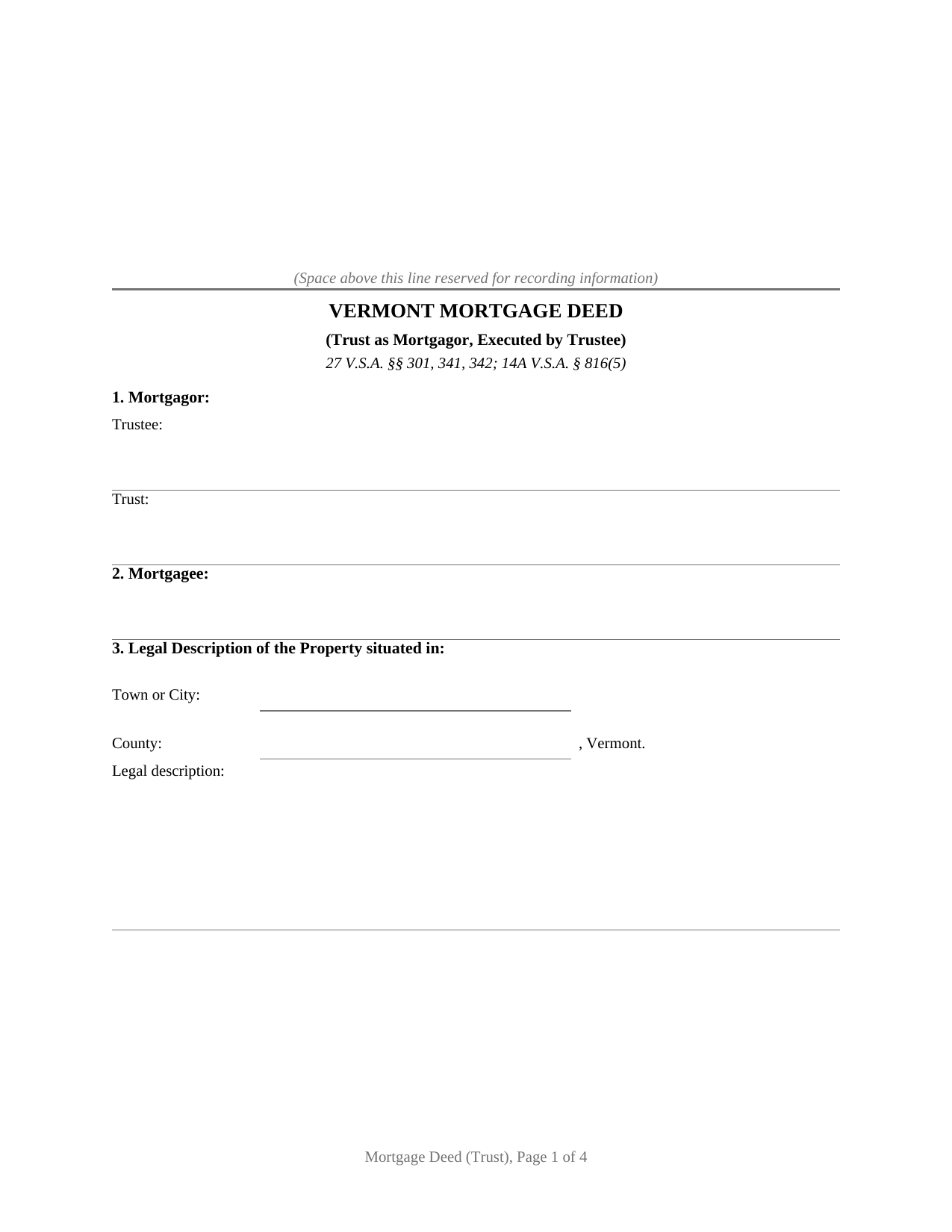
A mortgage on Vermont land held in trust carries one signature: the trustee's, given in the fiduciary capacity the deed recites on its face. This Vermont Mortgage Deed (Trust) prepares that instrument, a mortgage deed whose mortgagor is the trustee of a trust, conveying trust-held property to a lender as security for a loan under 27 V.S.A. §§ 301, 341, and 342.
One trustee, one certificate
The mortgagor section of the form carries two entries: the trustee, and the trust identified by its full name and the date of the trust instrument. The operative section then does the work that distinguishes a trust mortgage from an ordinary one. It recites that the mortgagor holds record title as trustee and signs in that fiduciary capacity, it points to the trustee's statutory power under 14A V.S.A. § 816(5) to borrow money and mortgage trust property, and it states that the covenants of title bind the trust estate rather than the trustee individually. One signature block and one acknowledgment certificate follow, and the notary's certificate carries the trustee's name with the representative capacity, in the style of Margaret H. Boisvert, as Trustee of the Boisvert Family Revocable Trust.
The form recites exactly one trustee holding record title. Property standing in an individual owner's name, and title held by two or more cotrustees, present different signature architectures from the one this deed recites. The patterns that do present this configuration in Vermont land records include a family revocable trust borrowing against the home or camp the trust holds, a trust that purchased land with seller financing and gave the seller a mortgage back, and a private refinance of trust-held rental or woodland parcels. A lender documenting the trustee's authority can request a certification of trust under 14A V.S.A. § 1013, a sworn summary the statute makes usable as evidence of authority to mortgage; that certification is prepared and recorded separately and is not included in this package.
Security by conveyance, ended by payment
Vermont keeps the traditional mortgage architecture: the mortgage deed conveys the property to the lender as security, subject to the mortgagor's right to redeem, and Vermont title practice treats the granting of a mortgage as a conveyance of legal title on exactly those terms. The form's operative clause gives, grants, bargains, sells, and conveys the property to the mortgagee, and its PROVIDED NEVERTHELESS condition states the other half of the bargain: when the promissory note and any other secured obligations described in the deed are paid and performed in full, the conveyance is void and the mortgage is discharged of record. Discharge has its own statutory machinery in 27 V.S.A. §§ 461 through 464a, including a 30 day duty on the mortgagee of record to deliver a complete discharge after full performance. The promissory note itself is a separate instrument, prepared separately and not included in this package; the deed secures the obligations its sixth section describes by date, principal amount, maker, and maturity.
Recording at the town clerk's counter
Vermont records land instruments town by town. The executed deed, acknowledged before a notary public as 27 V.S.A. § 341(a) provides, goes to the clerk of the town or city where the property lies, at the statewide fee of 15 dollars per page under 32 V.S.A. § 1671. A mortgage deed travels lighter than a transfer deed at that counter: the Department of Taxes places mortgage deeds outside the Property Transfer Tax Return filing category, so the deed records without the PTT-172 return and Act 250 certificate that deeds transferring title carry. Recording is also where the mortgage earns its priority, because under 27 V.S.A. § 342 an unrecorded mortgage deed is not effectual to hold the estate against anyone but the grantor and the grantor's heirs.
The package holds exactly three pieces: the Vermont mortgage deed as a fillable PDF, a completed example showing the form filled in for a trust-held property in Milton, and a plain language guide that walks through every numbered section, the signing formalities, and town recording. The materials describe Vermont law in general terms and are not legal advice.
Important: County-Specific Forms
Our mortgage deed (trust) forms are specifically formatted for each of the 14 counties in Vermont.
After selecting your county, you'll receive forms that meet all local recording requirements, ensuring your documents will be accepted without delays or rejection fees.