Vermont Trustees Deed (Corporate Trustee)
County Specific Legal Forms Validated as recently as October 5, 2026 by our Forms Development Team
About the Vermont Trustees Deed (Corporate Trustee)
How to Use This Form
- Select your county from the list
- Download the county-specific form
- Fill in the required information
- Have the document notarized if required
- Record with your county recorder's office
What Others Like You Are Saying
"THE PROCESS WENT VERY SMOOTH AND EASY"
"Great app works very well thank you very much"
"Directions were good. It was an easy process. Thank You."
"Outstanding forms and service. Liked that the main deed forms were PDF so I could fill them out on m…"
"They must have busy when I applied. The screen said it should be done in under10 mins unless heavier…"
4.8/5 from 4,817 reviews. Read all
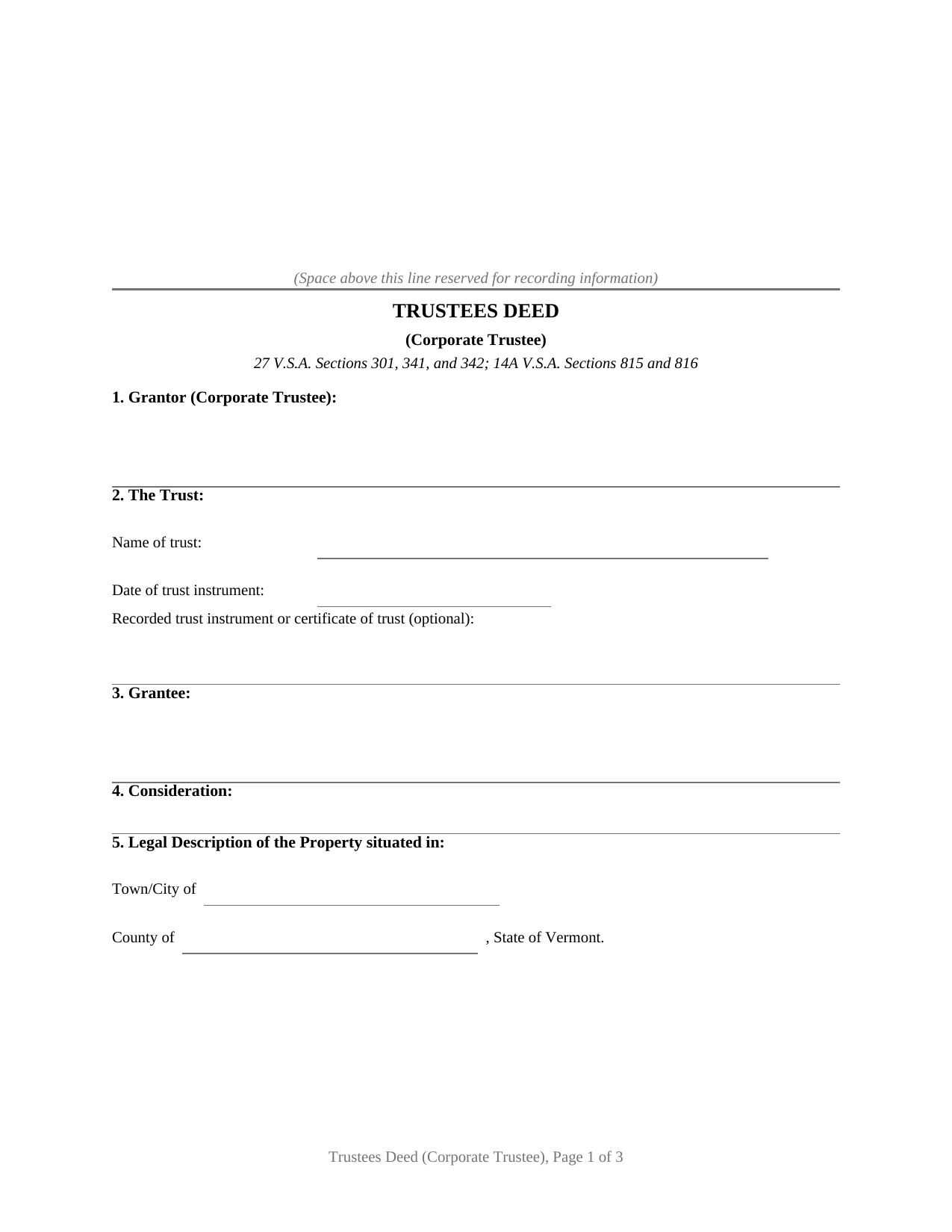
This fillable Trustees Deed is arranged for a corporate trustee: a bank, trust company, or other entity holding Vermont real property as trustee of a trust. The deed recites the entity as grantor acting solely in its trustee capacity, carries a single By signature line for an authorized officer with a printed name and title, and conveys with covenants limited to the grantor's own acts as trustee.
A deed signed through an officer, in a fiduciary capacity
The configuration is the point of this version of the form. The grantor section takes the entity's legal name, its form and jurisdiction of organization, and its principal office address; a dedicated trust section identifies the trust by name and date, with an optional line for a recorded trust reference. The operative section then states the capacity twice over: the entity conveys as trustee of the identified trust and not in its corporate or individual capacity, and a closing capitalized paragraph confines every covenant to the trustee capacity, so no obligation reaches the entity, its officers, or its agents individually. The trustee's power to sell at public or private sale and to sign and deliver instruments comes from 14A V.S.A. Sections 815 and 816 and from the trust instrument itself, and the deed recites that authority. One officer signs, one notary acknowledgment in a representative capacity follows, and the printed name and title lines meet the name-under-signature practice of 32 V.S.A. Section 1405.
Covenants that reach only the trustee's own acts
Vermont supplies no implied covenants for a general deed label, so this deed's warranty scope appears expressly on its face: the grantor covenants that it has not encumbered the property except as stated, and that it will warrant and defend against claims by, through, or under the grantor, but against none other. That is the special or limited warranty posture customary for a fiduciary deed, sometimes searched as a trustee deed or fiduciary deed, and it differs from a full warranty deed that reaches the whole chain of title. Numbered sections collect the legal description, source of title, the 27 V.S.A. Section 341(b) survey or plat reference, and the encumbrances the conveyance remains subject to.
The trust behind the deed
Vermont trust practice documents a trustee's authority through a certification of trust under 14A V.S.A. Section 1013, a sworn statement usable as evidence of authority to convey and recordable in the municipal land records where the land lies. The deed's trust section carries a line to cite such a recorded certificate by volume and page. The certification is its own instrument, prepared and recorded separately, and is not part of this package.
Recording with the town clerk, and the transfer tax return
Vermont records deeds by municipality rather than by county, so the completed deed goes to the clerk of the town or city where the land lies, at the statutory fifteen dollars per page. The deed cannot record alone: under 32 V.S.A. Section 9608 the clerk cannot accept it without a complete Vermont Property Transfer Tax Return, Form PTT-172, and the required Act 250 certificate. The general transfer tax runs 1.25 percent of value plus the 0.22 percent clean water surcharge, with different brackets for principal residences and statutory exemptions that include transfers involving no change in beneficial ownership, a pattern that appears when a trustee retitles property without changing who owns it beneficially. The guide included with the form walks through the return, the rates, and the exemption categories at the recording stage.
The download delivers this Trustees Deed as a fillable PDF, a completed example showing a Vermont corporate trustee conveyance from cover to acknowledgment, and a plain-language guide to each section, the signing formalities, and municipal recording. The materials describe Vermont law in general terms and are not legal advice.
Important: County-Specific Forms
Our trustees deed (corporate trustee) forms are specifically formatted for each of the 14 counties in Vermont.
After selecting your county, you'll receive forms that meet all local recording requirements, ensuring your documents will be accepted without delays or rejection fees.