Vermont Trustees Deed (Two Cotrustees)
County Specific Legal Forms Validated as recently as October 7, 2026 by our Forms Development Team
About the Vermont Trustees Deed (Two Cotrustees)
How to Use This Form
- Select your county from the list
- Download the county-specific form
- Fill in the required information
- Have the document notarized if required
- Record with your county recorder's office
What Others Like You Are Saying
"Easy and can add our own additional language in spaces provided. Thank you!"
"The best solution in creating deeds."
"Thank you for making this deed available. The guide was such a big help."
"recorded deed space to small for corrective deed requirement"
"Got the forms I needed after getting forms for the wrong county and paying twice. My bad!"
4.8/5 from 4,836 reviews. Read all
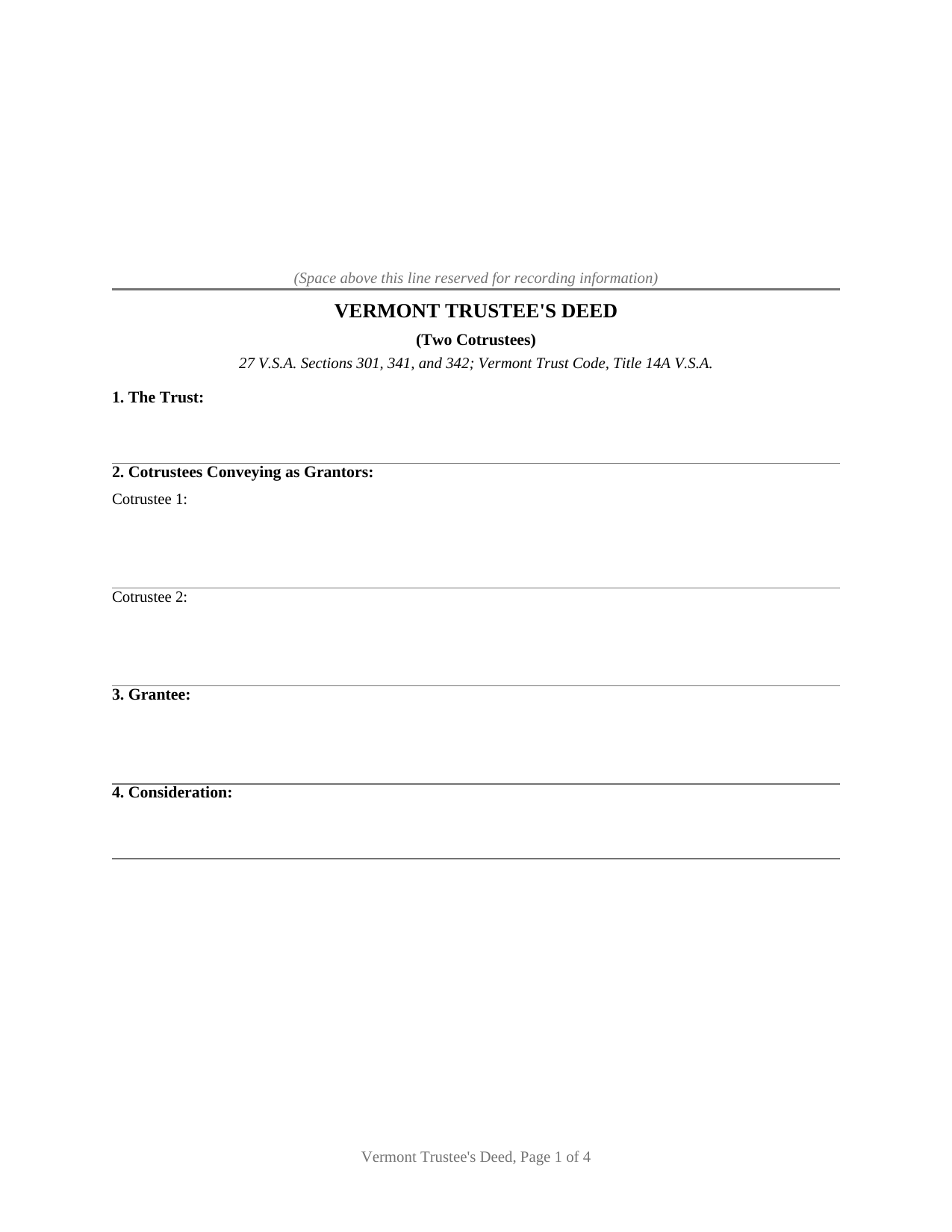
When a Vermont trust with two cotrustees sells or distributes its real estate, both cotrustees join in one deed, each signing in a fiduciary capacity with an acknowledgment certificate of their own. This Vermont trustee's deed is set up for exactly that configuration: a two cotrustee trust conveying Vermont real property, with a covenant limited to the trustees' own acts.
Why Both Cotrustees Sign
The Vermont Trust Code answers how cotrustees act. Under 14A V.S.A. Section 703, cotrustees who cannot reach a unanimous decision may act by majority decision, and where a trust has two cotrustees a majority is both of them. The deed recites that the signers are all of the trust's currently serving trustees and that both cotrustees join in the conveyance, so the recorded instrument shows on its face that the trustees acted together. The trustees' power to sell comes from the trust instrument and from 14A V.S.A. Sections 815 and 816, which give a trustee, absent contrary trust terms, the power to sell property at public or private sale.
A Covenant Limited to the Trustees' Own Acts
Vermont has no statutory deed forms with implied covenants for ordinary conveyances, so a Vermont deed carries exactly the covenants it states. This trust deed states a fiduciary covenant: the grantors, as cotrustees and not individually, covenant against encumbrances they made or suffered in that capacity and against claims arising by, through, or under them in that capacity, but against none other. The deed says plainly that it carries no other covenant or warranty of title. That posture matches how fiduciaries convey: the trustees stand behind their own administration of the title, not behind the whole chain back to its origin.
What the Form Carries
The form recites the trust by name and date, both cotrustees with addresses, the grantee with any co-ownership designation, the consideration, the town and county where the land lies, the legal description with a line for the recorded survey or plat reference 27 V.S.A. Section 341(b) contemplates, the property address, the source of title, and the encumbrances the conveyance remains subject to. Two signature blocks follow, then two acknowledgment certificates, each with the venue, date, and name and capacity lines and the notary's printed name, commission number, and expiration, matching the certificate content rule of 26 V.S.A. Section 5367. The two certificates are a feature of the layout: the cotrustees may acknowledge on different dates, before different notaries, or in different states. A trust with a sole trustee, or with three or more cotrustees, presents a different signature architecture than this form recites.
Recording with the Town Clerk, Return in Hand
Vermont records deeds by municipality. The completed deed goes to the clerk of the town or city where the property is located, at the statewide fee of 15 dollars per page, and the Vermont Property Transfer Tax Return, Form PTT-172, travels with it: under 32 V.S.A. Section 9608 the town clerk cannot record a deed evidencing a transfer unless the completed return and the required Act 250 certificate accompany it. The general transfer tax rate is 1.25 percent of value plus a 0.22 percent clean water surcharge, with a reduced bracket for a principal residence and stated exemptions for certain trust and family transfers, and the return is filed even when an exemption applies. Where a buyer or title insurer looks for evidence of the trustees' authority, Vermont practice uses a certification of trust under 14A V.S.A. Section 1013, a sworn instrument recorded separately and not included in this package.
What Is Included
The download contains the blank deed as a fillable PDF, a completed example prepared on a realistic Chittenden County fact pattern from the trust recital through both acknowledgment certificates, and a plain language guide that walks through every numbered section, the signing formalities, and the recording process. The materials are informational and are not legal advice.
Important: County-Specific Forms
Our trustees deed (two cotrustees) forms are specifically formatted for each of the 14 counties in Vermont.
After selecting your county, you'll receive forms that meet all local recording requirements, ensuring your documents will be accepted without delays or rejection fees.