Vermont Trustees Deed (Individual)
County Specific Legal Forms Validated as recently as October 7, 2026 by our Forms Development Team
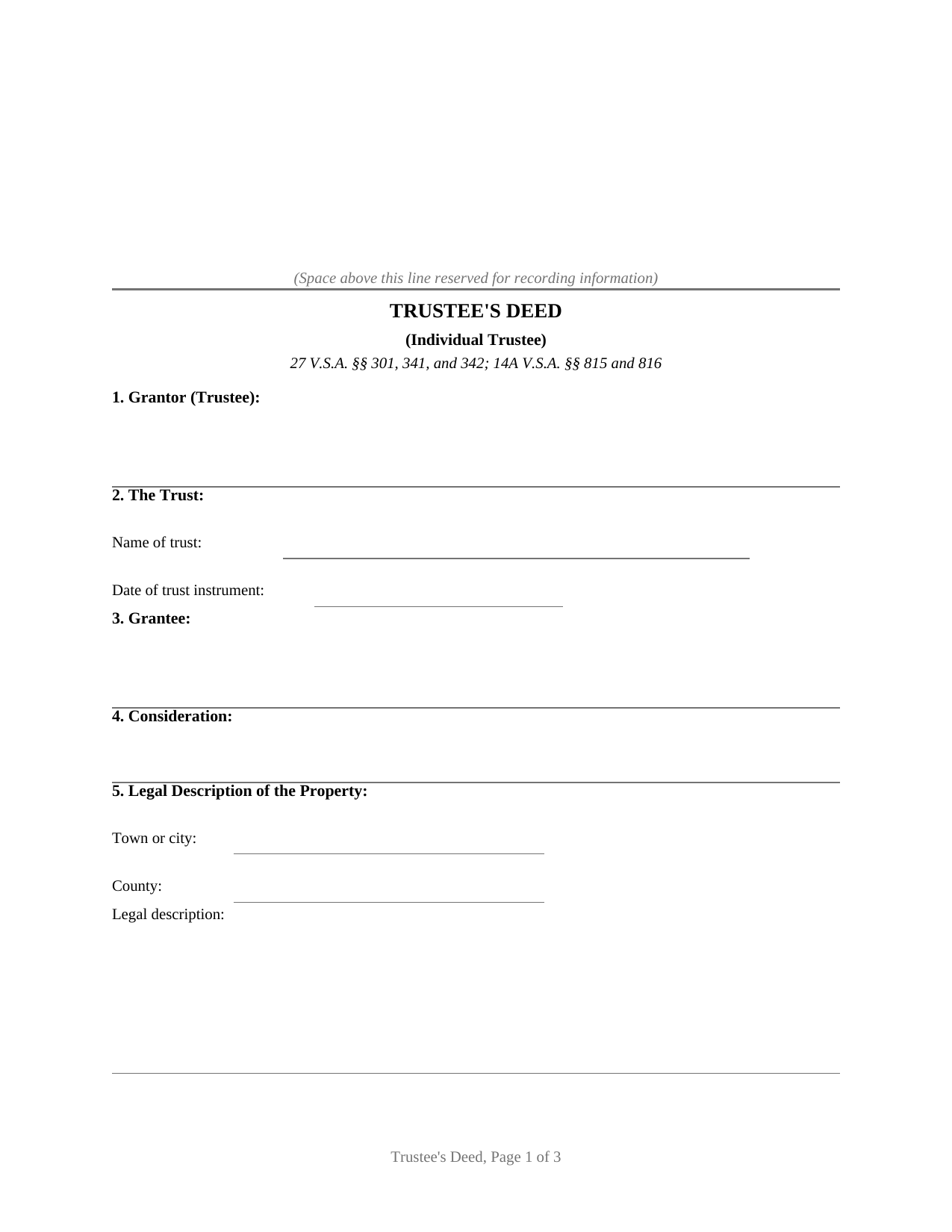
About the Vermont Trustees Deed (Individual)
How to Use This Form
- Select your county from the list
- Download the county-specific form
- Fill in the required information
- Have the document notarized if required
- Record with your county recorder's office
What Others Like You Are Saying
"I found this site when looking for help filing a quitclaim deed to change my property deed to my mar…"
"GREAT SERVICE. A MUST HAVE FOR EVERY REAL ESTATE TRANSACTION!!THANK YOU FOR PROVIDING SUCH A CONVIEN…"
"Wow -- amazingly fast turnaround and excellent customer service and communication. Thank you for sav…"
"Excellent service and actually better than expected. Plus if the information is not available you re…"
"County accepted the TODD form. Easy to understand and don’t have to hire an attorney! Excellent"
4.8/5 from 4,818 reviews. Read all
On a Vermont trustee's deed, one signature does the work of an office: the person who signs is an individual, and the capacity recited beside the name is the trusteeship that holds record title. This form prepares that deed for Vermont real property held in trust, configured for a single individual trustee as grantor, conveying with a covenant limited to the trustee's own acts.
A deed signed in an office, not just a name
The form's architecture follows the fiduciary configuration from top to bottom. The grantor section recites the trustee's name with the trustee designation; a dedicated trust section identifies the trust by its full name and the date of its instrument; the operative section states that the grantor executes the deed solely in the trustee capacity and not individually, and that record title stands in the trustee's name under the source deed the form cites. The signature line and the notary's certificate carry the same name and capacity, so the fiduciary office appears at every point where the record is later examined. The form recites exactly one individual trustee; deeds by co-trustees or by a corporate trustee acting through an officer present different signature and acknowledgment patterns than this form carries.
A covenant limited to the trustee's own acts
Vermont publishes no general statutory deed form and implies no covenants from a deed's label, so a Vermont deed warrants exactly what its text says. This trustee deed states its covenants expressly: the grantor has not encumbered the property or impaired its title except as the deed states, and the grantor warrants the property against persons claiming by, through, or under the grantor in the trustee capacity, against no other person and no other claim. That limitation matches what a fiduciary seller ordinarily undertakes, a warranty covering the period of the trust's own stewardship rather than the whole chain of title, and the deed says so in plain covenant language rather than leaving the point to inference.
Authority the record can verify
The Vermont Trust Code supplies the legal spine behind the recital. 14A V.S.A. § 816(2) states that a trustee may acquire or sell property at public or private sale, subject always to the terms of the particular trust, and 14A V.S.A. § 1012 protects a person who in good faith deals with a trustee. Vermont law also supplies the evidence device a buyer or title examiner looks for: the certification of trust under 14A V.S.A. § 1013, a sworn summary the trustee may record in the municipal land records as evidence of the trust's existence, the trustee's identity, and the authority to convey, without exposing the trust's dispositive terms. That certification is prepared and recorded separately and is not included in this package; the guide describes where it fits in the record.
Recording with the town clerk, and the return that gates it
Vermont records deeds by municipality, so the completed deed goes to the clerk of the town or city where the land lies, acknowledged before a notary as 27 V.S.A. § 341 provides; recording is what makes the deed effectual against third parties under 27 V.S.A. § 342. The statewide fee is fifteen dollars per page. The gatekeeper at the counter is the Vermont Property Transfer Tax Return, Form PTT-172: under 32 V.S.A. § 9608 the clerk does not record a deed unless the completed return accompanies it, with the required Act 250 certificate. The ordinary combined transfer tax rate is 1.47 percent of value, principal-residence and other brackets run lower, and the exemptions in 32 V.S.A. § 9603, including several trust patterns, are claimed on the return itself. The guide walks through the return, the rates, and the exemption patterns alongside every numbered section of the deed.
The package contains the trustee deed as a fillable PDF, a completed example showing the entire document filled in for a realistic Chittenden County fact pattern, and a plain-language guide to every section, the statutes behind it, and the recording process. The materials are informational and are not legal advice; a Vermont attorney can apply these rules to a specific trust and title.
Important: County-Specific Forms
Our trustees deed (individual) forms are specifically formatted for each of the 14 counties in Vermont.
After selecting your county, you'll receive forms that meet all local recording requirements, ensuring your documents will be accepted without delays or rejection fees.