Virginia Quitclaim Deed (Corrective)
County or Independent City Specific Legal Forms Validated as recently as October 20, 2026 by our Forms Development Team
About the Virginia Quitclaim Deed (Corrective)
How to Use This Form
- Select your county or independent city from the list
- Download the county or independent city-specific form
- Fill in the required information
- Have the document notarized if required
- Record with your county or independent city recorder's office
What Others Like You Are Saying
"I am so glad I found this resource! As the Executor of a family members estate I wanted to save mone…"
"DEEDS.COM IS THE BEST WAY TO E-RECORD DEEDS. THEY ARE FAST, POLITE AND A FANTASTIC DEAL FOR THE SERV…"
"Easy to use and quick turnaround. I would use again."
"The process was a little confusing to understand at first for someone like me with no experience doi…"
"A little difficult in the beginning but with the messaging back and forth it was very simple and fas…"
4.8/5 from 4,836 reviews. Read all
A recorded Virginia deed cannot be edited, and no clerk lifts a page back out of the book. What Virginia allows instead is a second recorded instrument that names the first, quotes the term standing wrong in the record, and gives the term as it was meant to read. This corrective quitclaim deed does that for one individual grantor, between the same two names the earlier deed carries.
A deed of correction, named where the money is
Virginia never invented a corrective deed. It treats one as an ordinary deed and then names it in the recordation tax law: under Code of Virginia Section 58.1-810, where the tax was paid at the time of the recordation of the original deed, no additional recordation tax is required for admitting a deed of correction to record. The Department of Taxation regulation at 23VAC10-320-100 separates it from its cousin the deed of confirmation, which adds legality to an earlier deed and, between the parties, relates back to that instrument's date. A deed of correction answers defects on the face of the original, among them misnomers, errors in the property description, and omitted grantee names.
Both deeds stay in the book
Correcting the land records is additive rather than substitutive. The earlier deed keeps its place, its recording date, and its priority under Section 55.1-407, while the correction sits later in the index with a reference tying the two together. So Sections 4, 5, and 6 read as they do: the date, parties, and book and page or instrument number of the deed being corrected, then the term as it presently stands of record, then the corrected term. Section 10 says in the deed's own words that the prior deed remains in full force except as corrected, and that this one neither enlarges nor limits the estate it conveyed.
One grantor signs, and the names stay put
The grantor side is fixed at one individual signing personally: a signature line, a printed-name line, a date, and one acknowledgment certificate whose venue reads city or county under Section 47.1-16(A). The grantor entry takes whoever granted the deed being corrected, the grantee entry takes whoever took under it, and the vesting designation line beside the grantee repeats the ownership form that deed established instead of rearranging it. A lot number transposed against the recorded plat, a party's name misspelled at settlement, and a grantee's name dropped from the granting clause all present the correction pattern this deed carries. No second grantor block prints, and no trustee, personal representative, corporate officer, or attorney-in-fact capacity appears. A change that would move the estate to a different grantee, or enlarge or shrink what the earlier deed passed, is a fresh conveyance rather than a correction of the recorded one.
Release words, and the covenants left out
Warranty in Virginia follows covenant language, not the heading on a page. Under Section 55.1-363, words of release in a deed carry the force of a remise, release, and forever quitclaim reaching whatever the grantor holds at law and in equity; Section 10 prints that language and leaves out every phrase Sections 55.1-354 through 55.1-362 turn into a covenant. Fixing a term in the description leaves liens, judgments, and chain defects where they were.
The narrower route Virginia gives an attorney
Some errors never need a deed. Section 55.1-609 authorizes a corrective affidavit, executed by an attorney licensed by the Virginia State Bar, to correct an obvious description error in a recorded deed, deed of trust, or mortgage. Notice duties run to the parties, the preparing attorney, the title insurer, and sometimes an adjoining owner, with a 30-day window for objection and relation back to the original recordation. That affidavit is drawn and recorded separately by the attorney and is not included here.
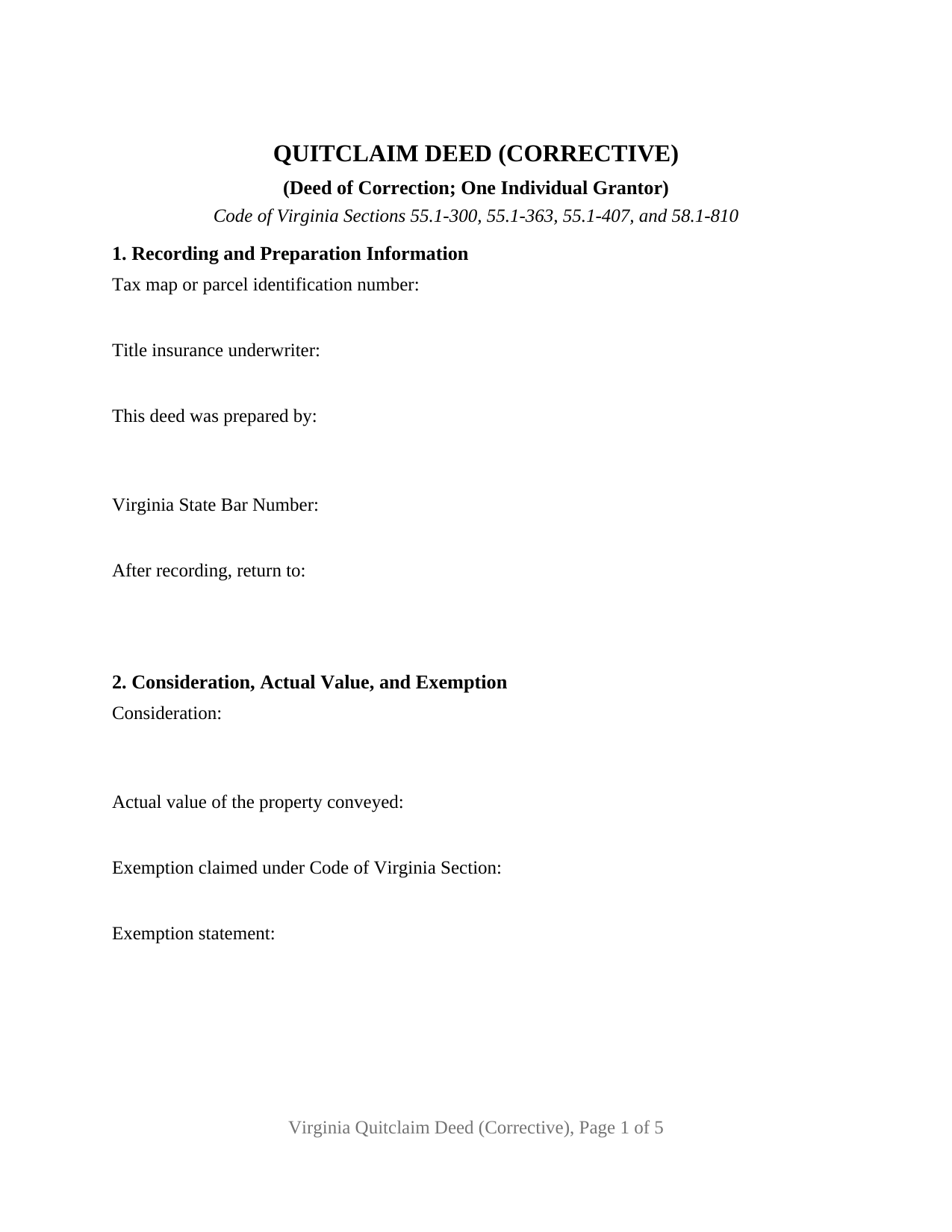
Page one carries what a clerk reads first: the underwriter and preparer statements of Section 17.1-223(B), the return address, and the parcel number Section 17.1-252 calls for in localities with unique parcel systems. Buyers reach this instrument searching for a corrective deed, a deed of correction, or a correction quit claim deed; this package prepares the Virginia version for one individual grantor correcting a recorded deed. It holds three items: the blank deed as a fillable PDF, a completed example worked through an Augusta County lot-number correction, and a plain-language guide covering the sections, the ownership forms open to a grantee, and the charges collected at the counter. These materials describe Virginia law in general terms and are not legal advice.
Important: County or Independent City-Specific Forms
Our quitclaim deed (corrective) forms are specifically formatted for each of the 132 county or independent cities in Virginia.
After selecting your county or independent city, you'll receive forms that meet all local recording requirements, ensuring your documents will be accepted without delays or rejection fees.