Virginia Quitclaim Deed (Married Couple as Grantors)
County or Independent City Specific Legal Forms Validated as recently as October 6, 2026 by our Forms Development Team
About the Virginia Quitclaim Deed (Married Couple as Grantors)
How to Use This Form
- Select your county or independent city from the list
- Download the county or independent city-specific form
- Fill in the required information
- Have the document notarized if required
- Record with your county or independent city recorder's office
What Others Like You Are Saying
"Easement deed contract was easy to complete, however after additional research raises some concerns …"
"Thank you so much for making it easy and professionally trustworthy. You are the best!!!"
"Easy process and staff was very helpful"
"Im an out of state realtor, but couldnt believe how quick and easy the process was. Recieved my deed…"
"It just a little disconcerting that I was not able to preview any of the forms prior to purchasing t…"
4.8/5 from 4,828 reviews. Read all
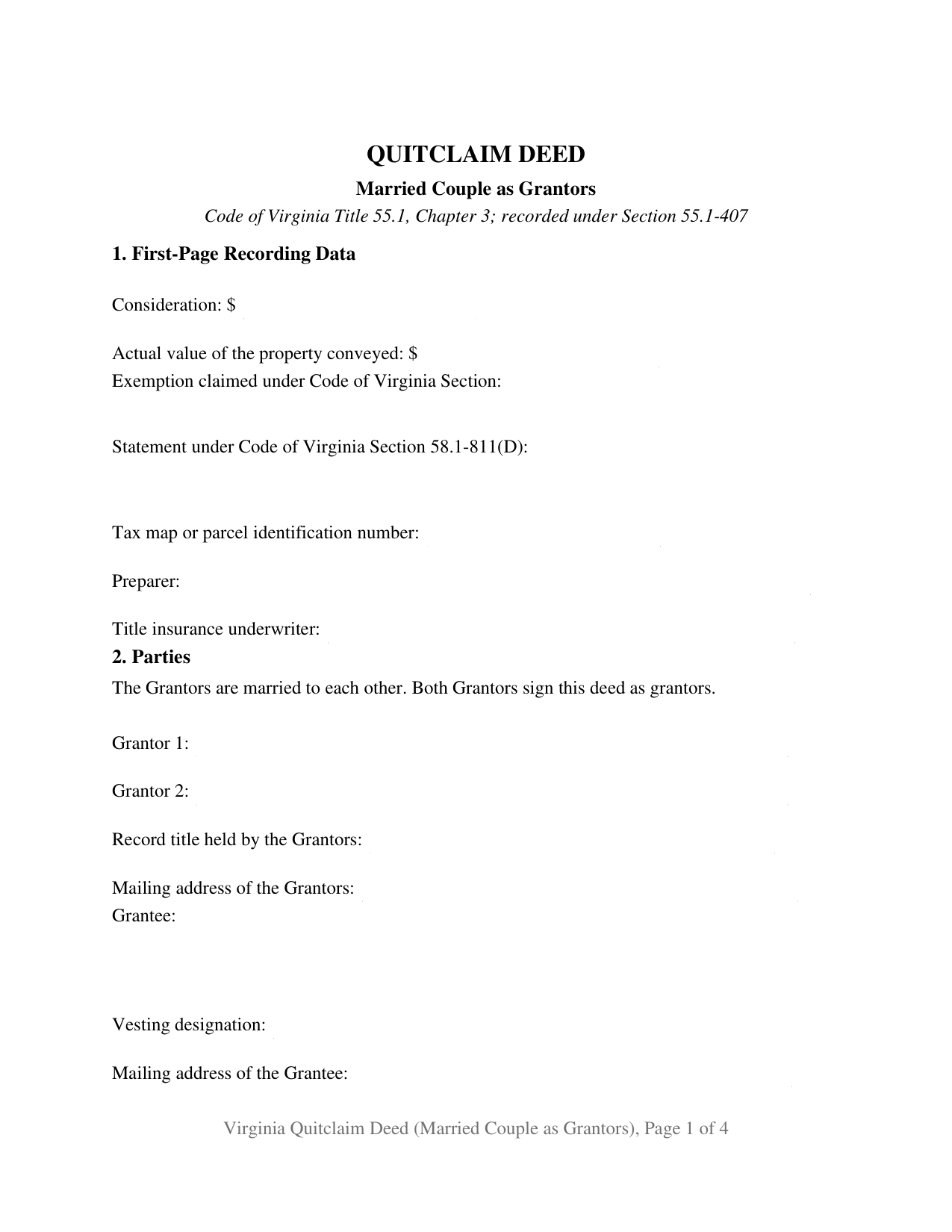
A Virginia quitclaim deed with both spouses on the grantor side does something a one-signature release cannot: it moves the whole of what a married couple holds, an estate held as tenants by the entirety included, in a single recorded instrument. The form recites the marriage, collects the record tenancy the couple holds under, and prints a signature line and an acknowledgment certificate for each spouse, ready for the circuit court clerk of the Virginia county or independent city where the land lies.
Both spouses on the grantor side
The grantor side is fixed at two spouses, married to each other, each signing personally. Section 2 carries the marital recital, both names as the clerk indexes them, a line for the tenancy the vesting deed shows, and the grantee entry with its own vesting designation line. That configuration answers Code of Virginia Section 55.1-136(B): except as otherwise provided, an interest in property held as tenants by the entirety is not severed by written instrument unless the instrument is a deed signed by both spouses as grantors. Spouses moving jointly held land into their own living trust, parents making a no-consideration transfer of a second property to an adult child, and a couple releasing a strip of ground to a neighbor to settle a boundary question all present the both-spouses release this deed recites. The form is not set up for a grantor signing as trustee, executor, attorney-in-fact, or entity officer, and it prints no third signature line.
An entireties estate that keeps its shield inside a trust
Virginia gives entireties property a creditor protection ordinary co-ownership does not carry, and Section 55.1-136(C) extends it across a conveyance into trust: property the spouses held as tenants by the entirety and conveyed to their joint trusts, or to their separate trusts, keeps the same immunity from the claims of their separate creditors, so long as they stay married to each other, the property stays in the trust, and it stays their property. That estate-planning transfer arrives with a tax answer attached. Section 58.1-811(A)(12) exempts a deed to trustees of a revocable inter vivos trust from the state recordation tax when the grantors in the deed and the beneficiaries of the trust are the same persons and no consideration passes between them. The completed example works that transfer through a Chesterfield County fact pattern, from the 15 digit tax identification number that county asks for on page one to both notary certificates.
Release language, and a warranty the deed refuses
Virginia reads covenant words rather than captions, and this deed carries none of the warranty phrases that Sections 55.1-354 through 55.1-362 give effect to. It remises, releases, and forever quitclaims whatever right, title, and interest the two spouses hold when the deed is delivered, declares in capital letters that it carries no covenant or warranty of title, and names the statutory covenants of seisin, quiet possession, and further assurances that the grantors do not make. Recording still does its own work: under Section 55.1-407 the deed reaches later purchasers for value and lien creditors once it sits in the land records of the correct county or city.
Consideration, exemption, and the lines read first
Section 1 gathers what Virginia statutes place on page one: consideration and actual value, which drive the 25 cents per $100 recordation tax on the greater of the two; the Code section under which an exemption is claimed; the classification statement that Section 58.1-811(D) has called for since July 1, 2026 on a quitclaim deed passing no consideration; the tax map or parcel number; the preparer statement naming the owner or the Virginia attorney with a bar number; and the title insurance underwriter statement. The guide takes those one at a time, with cover sheet practice, which differs from one circuit court clerk to the next, the grantor tax on realty sold, and the fees collected at the counter.
What comes in the download
Searchers reach this instrument as a quitclaim deed, a quit claim deed, or a release deed; this package prepares the Virginia version for a married couple releasing together. Three files arrive: the blank deed as a fillable PDF, the completed example filled in for the Chesterfield County transfer described above, and a plain-language guide covering every blank, the notarization rules under Title 47.1, the forms in which a grantee may hold title, and the recording steps at the clerk's counter. These materials describe Virginia law in general terms and are not legal advice.
Important: County or Independent City-Specific Forms
Our quitclaim deed (married couple as grantors) forms are specifically formatted for each of the 132 county or independent cities in Virginia.
After selecting your county or independent city, you'll receive forms that meet all local recording requirements, ensuring your documents will be accepted without delays or rejection fees.