Virginia Quitclaim Deed (Married Grantor with Non-Owner Spouse Joinder)
County or Independent City Specific Legal Forms Validated as recently as September 15, 2026 by our Forms Development Team
About the Virginia Quitclaim Deed (Married Grantor with Non-Owner Spouse Joinder)
How to Use This Form
- Select your county or independent city from the list
- Download the county or independent city-specific form
- Fill in the required information
- Have the document notarized if required
- Record with your county or independent city recorder's office
What Others Like You Are Saying
"Very prompt and excellent service!"
"WOW! I am so pleased the County Registrar’s office recommended Deeds.com. From start to a very quick…"
"Service was very convenient; I received prompt assistance with my document - staff was very helpful."
"They deliver!"
"Easy to use and very quick turn around ... Very satisfied with ease of use and services provided ..."
4.8/5 from 4,828 reviews. Read all
This Virginia quitclaim deed carries a second signature that conveys no ownership. One grantor appears on it, a married individual whose name alone sits on the vesting deed, and beside that grantor the form prints a joinder block for the husband or wife who was never added to title. The spouse signs to let go of whatever claim the marriage might be argued to have produced, and the instrument goes to the clerk of the circuit court of the Virginia county or independent city keeping the land records.
One owner on the deed, two names on the signature page
Section 3 takes the record owner, with the marital status stated, and Section 4 takes the spouse, with the statement that this second signer holds no record title. Each has a signature line and a notary certificate of its own. Because Section 47.1-16 requires every notarial act to show its own date and the county or city where it happened, the owner may sign in one locality and the spouse later in another, with one instrument still going to record. An owner who inherited the parcel while married and never retitled it, and an owner conveying to a buyer whose title examiner has asked for the spouse's signature before closing, both present the owner-plus-joinder configuration this deed recites. The form provides for two individuals signing in their own names, with no trustee, executor, attorney-in-fact, or entity capacity.
What Virginia asks of a spouse's signature, and what it does not
Virginia abolished dower and curtesy for deaths on or after January 1, 1991, in Section 64.2-301, and research for this product located no Virginia statute obliging a non-owner spouse to join in a lifetime conveyance of the other spouse's separately titled land. The rule that genuinely takes two spousal signatures, Section 55.1-136(B), reaches the severance of property already held as tenants by the entirety, a different title posture altogether. This joinder therefore does its work through its own words: Section 9 has the spouse remise, release, and quitclaim any right, title, interest, or claim that spouse holds or may hold, including any claim arising from the marriage. That is why settlement practice asks for the signature although no statute compels it, and the guide sets out the reasoning with its citations.
Release words, and the covenants withheld
Warranty in Virginia follows covenant language rather than the heading on the page, and the phrases that Sections 55.1-354 through 55.1-362 give effect to are absent here on purpose. Section 9 states in capital letters that no covenant or warranty of title is made or implied, and that only the interest the two signers hold at delivery passes, subject to the encumbrances then binding the parcel.
Page one and the entries a Virginia clerk reads there
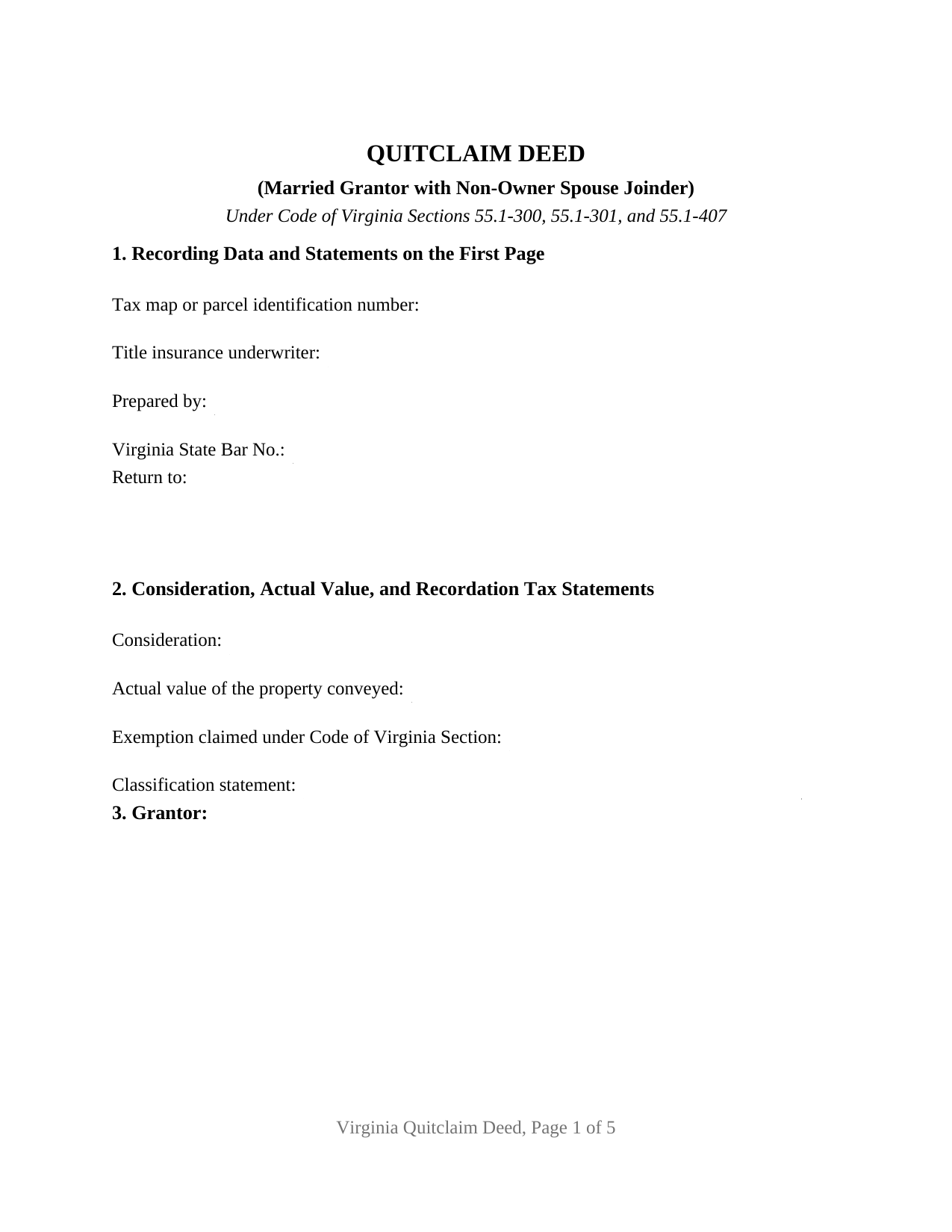
Section 1 gathers what Virginia places on the face of a residential deed of four dwelling units or fewer: the title insurance underwriter, or the fact that it is unknown, and the preparer statement naming the owner or the Virginia attorney with a bar number, both under Section 17.1-223(B), plus the return address contemplated by Section 17.1-223(A) and the parcel or tax map number required under Section 17.1-252. Section 2 takes the consideration and actual value behind the 25 cent per $100 recordation tax, plus the classification statement Section 58.1-811(D) has called for since July 1, 2026 where nothing is paid.
What the release does not reach
Releasing a claim in one parcel is not a waiver of what Virginia gives a surviving spouse. Section 64.2-308.14 provides that the elective share and the rights to homestead allowance, exempt property, and family allowance are waived by a written contract, agreement, or waiver signed by the surviving spouse, and Section 64.2-308.6 can pull a transfer made during marriage and within two years before death into the augmented estate. The guide covers those limits, the grantor tax on realty sold, cover sheet practice that changes from one circuit court clerk to the next, and the fees collected at recording.
Buyers reach this instrument searching for a quit claim deed, a release deed, or a spousal joinder deed; this package prepares the Virginia version for a married sole owner with a joining spouse. It holds three items: the deed as a fillable PDF, a completed example worked through a priced transfer of a separately titled residence in the City of Virginia Beach, and a plain-language guide covering each blank, notarization, and recording. These materials are not legal advice.
Important: County or Independent City-Specific Forms
Our quitclaim deed (married grantor with non-owner spouse joinder) forms are specifically formatted for each of the 132 county or independent cities in Virginia.
After selecting your county or independent city, you'll receive forms that meet all local recording requirements, ensuring your documents will be accepted without delays or rejection fees.