Virginia Quitclaim Deed (Two Grantors)
County or Independent City Specific Legal Forms Validated as recently as September 29, 2026 by our Forms Development Team
About the Virginia Quitclaim Deed (Two Grantors)
How to Use This Form
- Select your county or independent city from the list
- Download the county or independent city-specific form
- Fill in the required information
- Have the document notarized if required
- Record with your county or independent city recorder's office
What Others Like You Are Saying
"The service was very reliable and they even helped with filling out the paperwork properly. Very qui…"
"I was quoted $525 to do the exact same thing from Deeds.com for only $25. Seems like a no brainer to…"
"All required forms readily available at fair price. Easy to create account. Immediately acquired doc…"
"Was straight to the point... Easy to read instructions... smooth process"
"What a wonderful resource! Forms are so easy to use, made the process a breeze. Deeds even helped wi…"
4.8/5 from 4,828 reviews. Read all
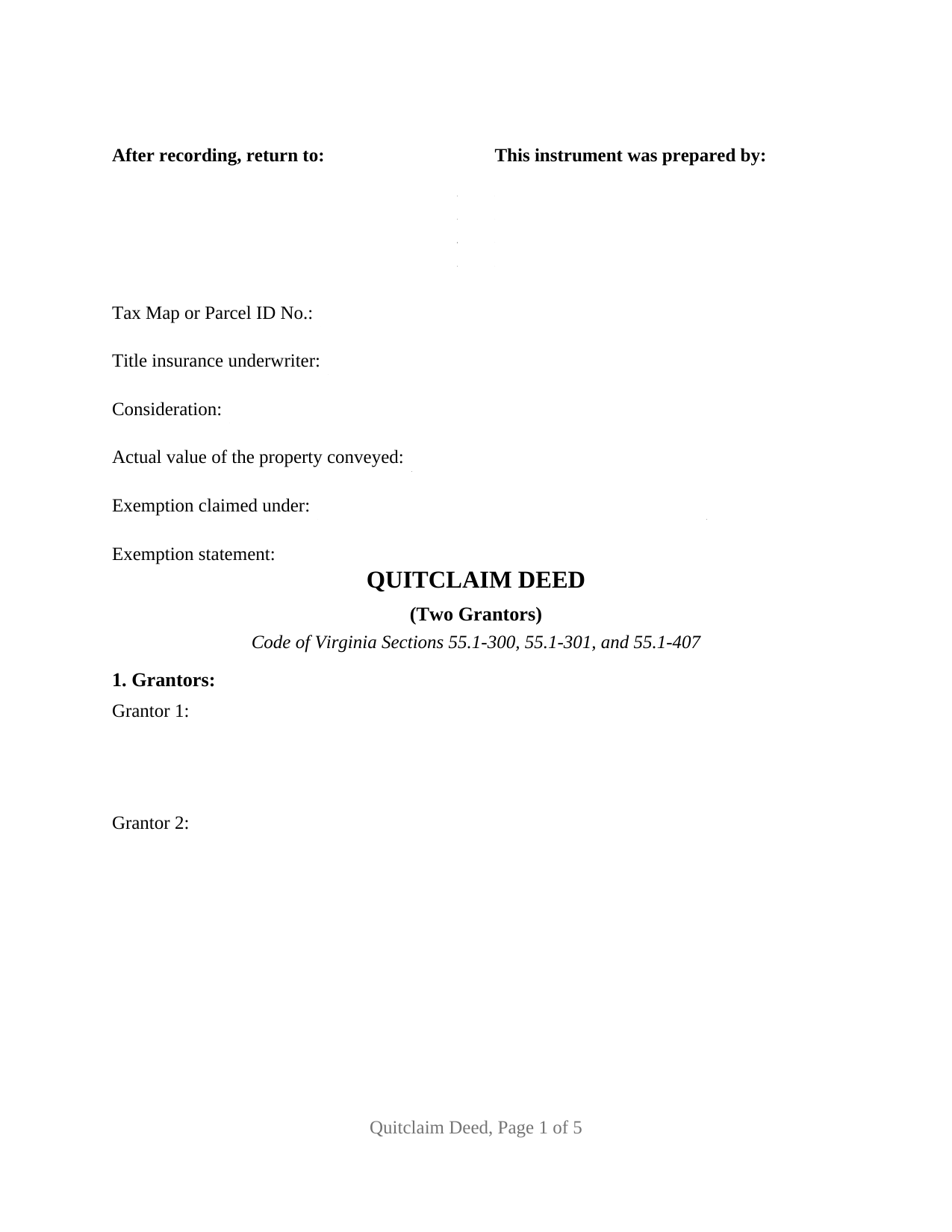
Two grantors, two signature blocks, and a separate notary acknowledgment for each: this Virginia quitclaim deed gathers both releases into a single recorded instrument. The form recites exactly two individual grantors who together pass whatever interest they hold in Virginia real property to one grantee, formatted for the circuit court clerk of any county or independent city under the statewide recording standards.
Two releases in one instrument
Each grantor releases that grantor's own right, title, and interest, so one recording carries the entire transfer. Two co-heirs passing their undivided shares to the family member keeping the property, co-owners moving a jointly held parcel into a single name, and former spouses conveying together after a divorce, which converts a tenancy by the entirety into a tenancy in common under Code of Virginia Section 20-111, present the two-grantor pattern this deed recites. The form is built around individuals signing personally; it is not set up as a trustee, entity, or attorney-in-fact conveyance, and it carries no third signature line.
The paired acknowledgment certificates do practical work. Every Virginia notarization shows its own date and the county or city where it was performed, and the form carries a certificate for each grantor, so the two signers may acknowledge on different days, before different notaries, or in different states, and the deed still records as one instrument.
The two-spouse severance written into the Code
One two-grantor pattern is statutory. Under Code of Virginia Section 55.1-136(B), except as otherwise provided, no interest in real property held as tenants by the entirety may be severed by written instrument unless that instrument is a deed signed by both spouses as grantors. A married couple restructuring entireties title, whether toward a tenancy in common or into one spouse's sole name as part of a settlement, signs in exactly the configuration this form prints: both spouses on the grantor side, each with an acknowledgment certificate of their own.
Release language without warranty
The deed remises, releases, and forever quitclaims, and it declares in capital letters that it carries no covenant or warranty of title. Virginia gives warranty effect to specific covenant phrases listed in Code of Virginia Sections 55.1-354 through 55.1-362, none of which appear in this form, and Section 55.1-407 recognizes the quitclaim form in the recording act itself: recording protects the grantee against later purchasers and lien creditors, and a grantee taking by quitclaim can still qualify as a purchaser for value without notice. What passes is the interest the grantors own at delivery, stated on the face of the deed.
First-page entries and the two recordation taxes
Virginia clerks index from the face of the deed, and this form's first page carries the entries they look for: consideration and the actual value of the property conveyed, the exemption law and exemption statement lines, the tax map or parcel identification number, the preparer entry identifying the owner or the Virginia attorney, with bar number, who prepared the deed, the title insurance underwriter entry, and the return address. A priced transfer pays the state recordation tax of 25 cents per $100 on the greater of consideration or actual value, plus the grantor tax of 50 cents per $500 of consideration under Section 58.1-802, which the clerk certifies on the deed at recording; a quitclaim without consideration states that fact on its face and claims the Section 58.1-811(D) exemption on the same lines. The completed example works a priced family buyout in Loudoun County from the first-page tax entries through both acknowledgments.
What arrives in the download
The package holds three pieces: the two-grantor deed as a fillable PDF blank, a completed example that fills every entry for the Loudoun County fact pattern described above, and a plain-language guide covering each blank, the signing and notarization rules, the county cover-sheet variations, and the fee and tax arithmetic. Buyers searching for a quit claim deed or a release deed for two owners reach the same Virginia instrument prepared here. The materials describe Virginia law generally and are not legal advice.
Important: County or Independent City-Specific Forms
Our quitclaim deed (two grantors) forms are specifically formatted for each of the 132 county or independent cities in Virginia.
After selecting your county or independent city, you'll receive forms that meet all local recording requirements, ensuring your documents will be accepted without delays or rejection fees.