Washington Warranty Deed
County Specific Legal Forms Validated as recently as October 4, 2026 by our Forms Development Team
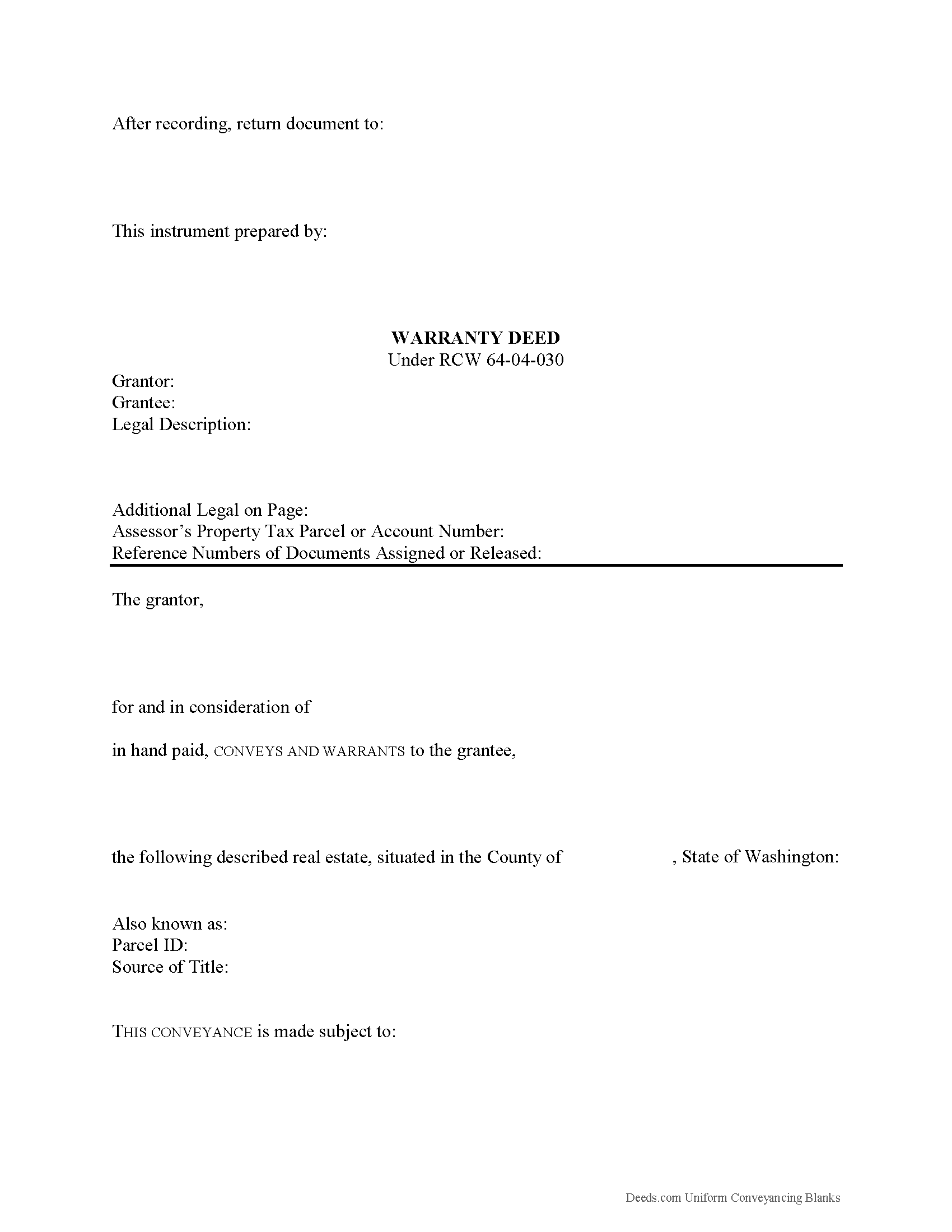
About the Washington Warranty Deed
How to Use This Form
- Select your county from the list
- Download the county-specific form
- Fill in the required information
- Have the document notarized if required
- Record with your county recorder's office
What Others Like You Are Saying
"The Lady Bird Deed appears to be fine with me as are the instructions. However, there apparently are…"
"Best platform to buy forms. Simple and easy."
"This service seems simple and reasonably priced. The deed I requested was not available, and they le…"
"Very easy to use, download and print. Thank you!"
"The requested forms were easy to access. Thank you."
4.8/5 from 4,836 reviews. Read all
The grantee line on a Washington deed carries more law than the grantor line does. Two names and nothing more produce a tenancy in common by force of RCW 64.28.020; the same names followed by an express declaration produce a joint tenancy with survivorship under RCW 64.28.010; and no combination of words produces a tenancy by the entirety, whose survivorship incident RCW 11.04.071 abolished. This fillable form is the general configuration of the Washington statutory warranty deed, the conveyance RCW 64.04.030 prints in the statute itself, with free-form party blocks holding one or two people per side and no preprinted ownership language.
A statute that prints the deed and keeps the covenants out of it
RCW 64.04.030 does two jobs in one section. It prints a form of deed, granting clause and all, and provides that warranty deeds may be substantially in that form without express covenants. Then it states what a deed in that substance promises, though the page never says so: that the grantor held an indefeasible fee simple at delivery, had the right and the power to pass it, that the property was then unencumbered, and that the grantor stands behind the grantee's quiet possession and will defend the title against anyone holding a lawful claim. They bind the grantor's heirs and personal representatives too, as if the deed spelled them out. The strongest deed in the state is therefore also one of the shortest, its posture turning on the verb pair in the granting clause that the neighboring sections swap for bargains, sells, and conveys in RCW 64.04.040 or conveys and quitclaims in RCW 64.04.050.
The words that follow the grantee names
Because the instrument preprints no ownership wording, the grantee entry is where the deed states how the grantees hold. Washington supplies a default and then demands an opt-out in writing: RCW 64.28.020 makes an interest created in two or more people an interest in common unless the deed declares a joint tenancy, and RCW 64.28.010 allows that declaration only in the written instrument. Married grantees and registered domestic partners add a layer, since RCW 64.28.040 presumes an interest held in joint tenancy by both to be community property that passes to the survivor. Each recognized form, and what happens to a co-owner's share at death, is in the guide.
One or two people on either side
The deed recites two free-form party blocks, one for grantors and one for grantees, each sized for one or two natural persons acting in their own capacity, with whatever status wording and ownership designation the transaction supplies. Execution matches: two grantor signature blocks and two acknowledgment certificates in the individual capacity short form of RCW 42.45.140, the second block and certificate left blank on a single owner conveyance. A company officer, a trustee, a personal representative, or an attorney in fact instead signs in a representative capacity and takes the representative short form of RCW 42.45.140(2), and three or more owners on a side outrun the party blocks; those are execution patterns this instrument is not set up to carry. Which owners sign is settled by the character of the title: under RCW 26.16.030(3) community real property passes only where both spouses or both domestic partners join in the deed and both acknowledge it, and RCW 6.13.060 imposes the same both sign requirement on homestead property.
Two counters, in order
A Washington conveyance reaches the auditor's counter only after the treasurer's. Chapter 82.45 RCW taxes sales of real property, WAC 458-61A-303 calls for an excise tax affidavit on a transfer of ownership by deed, and RCW 82.45.090 keeps the auditor from accepting a taxable instrument until the treasurer's verification is affixed or the not due notation made; a gift or other nonsale transfer travels the same route carrying an exemption code. The first page follows RCW 65.04.045: a three inch top band for the recording stamp, the return address inside it, and below the band the title, reference numbers, party names, an abbreviated legal description, and the assessor's parcel number. Fees, excise rates, and the cover sheet and nonstandard recording paths of RCW 65.04.047 and RCW 65.04.048 are in the guide.
This package delivers the blank deed as a fillable PDF, a completed example filled on a Snohomish County fact pattern, and a plain language guide covering the statute, signing, and recording. The materials are informational and are not legal advice; how these rules operate on a particular Washington title is a question for a Washington attorney.
Important: County-Specific Forms
Our warranty deed forms are specifically formatted for each of the 39 counties in Washington.
After selecting your county, you'll receive forms that meet all local recording requirements, ensuring your documents will be accepted without delays or rejection fees.