Alabama Certificate of Trust
County Specific Legal Forms Validated as recently as September 8, 2026 by our Forms Development Team
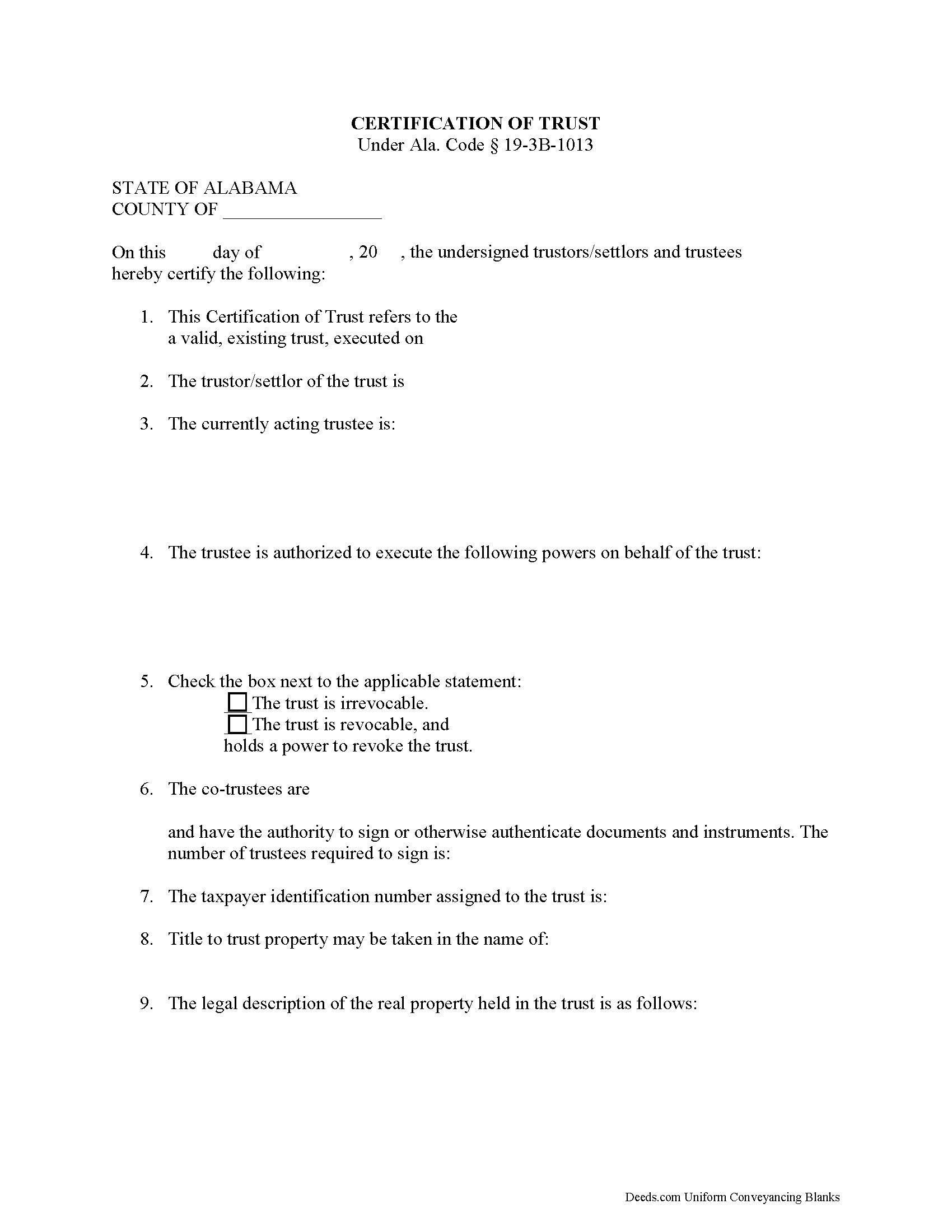
About the Alabama Certificate of Trust
How to Use This Form
- Select your county from the list
- Download the county-specific form
- Fill in the required information
- Have the document notarized if required
- Record with your county recorder's office
What Others Like You Are Saying
"I got exactly what I paid for. No fraudulent transaction on my card. I like that. This is an excelle…"
"The staff was wonderful we needed an additional state form for Wisconsin for the transfer. They went…"
"I'm not sure if KVH is the identity to the person who helped me. I hope it is so you know just how m…"
"It had all the info I was looking for!"
"Find what i was looking for, and got the answers to my questions!! Thank you"
4.8/5 from 4,819 reviews. Read all
An Alabama Certificate of Trust is used to verify the existence of a trust and confirm a trustee’s authority to act without disclosing the full trust document. In Alabama, this matters because financial institutions, title companies, and probate offices routinely require proof of a trustee’s authority when property is being acquired, transferred, or encumbered in the name of a trust. Alabama law specifically allows a certificate of trust to be used in place of the full trust agreement, provided it meets statutory requirements, making a compliant certificate essential for real estate transactions involving trusts.
What the Alabama Certificate of Trust does
An Alabama Certificate of Trust provides a summary of key trust information—such as the trust’s existence, the identity of the trustee, and the trustee’s authority—without revealing private terms of the trust. It is commonly used when real property is being purchased, sold, financed, or otherwise transferred into or out of a trust. The certificate allows third parties to rely on the trustee’s authority while limiting disclosure of beneficiaries and internal provisions.
Alabama statutory requirements under Ala. Code § 19-3B-1013
Alabama law governs certifications of trust under Ala. Code § 19-3B-1013. The statute allows a trustee to furnish a certification instead of the full trust instrument and specifies the type of information that may be included. A properly prepared certificate typically identifies the trust, confirms that it exists and is in effect, and states the trustee’s powers relevant to the transaction.
The statute also provides that a person receiving a certification may request excerpts from the trust instrument if necessary to confirm the trustee’s authority, but the certification itself serves as sufficient evidence of the facts it contains. This framework allows transactions to proceed without disclosing sensitive trust details while still providing legal assurance to third parties.
Execution requirements for an Alabama Certificate of Trust
The Alabama Certificate of Trust must be signed by the trustee or trustees acting on behalf of the trust. If the certificate is to be recorded—such as when used in connection with a deed or mortgage—it must comply with Alabama execution standards. Instruments affecting real property must be attested by at least one witness if the signer writes his or her name, unless the document is acknowledged before a notary public (Ala. Code § 35-4-20). A proper acknowledgment satisfies the statutory requirement for recording (Ala. Code § 35-4-23).
The trustee’s name and capacity should match the trust records and any related real estate documents to ensure consistency in the public record.
Alabama-specific traps that cause recording or title problems
- Incomplete statutory content: A certificate that does not include the required elements under Ala. Code § 19-3B-1013 may not be accepted by lenders or title companies.
- Preparer identification: If the certificate is recorded, Alabama requires the name and address of the preparer to appear on the document (Ala. Code § 35-4-110).
- Marital-status recital: When the certificate is used with a recorded conveyance, Alabama may require a marital-status recital for the conveying party (Ala. Code § 35-4-73).
- Name consistency: The trust name and trustee names must match exactly across the certificate, the trust instrument, and any related deed or mortgage.
- Authority limitations: If the certificate does not clearly state the trustee’s authority for the specific transaction, third parties may require additional documentation or delay closing.
- Recording mismatch: If the certificate is recorded in connection with a real estate transaction, it must be filed in the county where the property is located to align with the related instrument.
Recording process in Alabama
An Alabama Certificate of Trust is not always recorded on its own but is often recorded alongside a deed, mortgage, or other instrument involving trust property. When recorded, it is filed with the Judge of Probate in the county where the property is located. Recording provides public notice of the trustee’s authority in connection with the transaction and supports the validity of the recorded instrument.
Recording fees apply, and Alabama probate offices determine any applicable charges under Title 40, Chapter 22. Proper formatting, acknowledgment, and required recitals should be completed before submission to avoid delays.
Vesting considerations in Alabama
When real property is held in trust, title is typically vested in the name of the trustee acting on behalf of the trust. Alabama does not presume survivorship in co-trustee or co-ownership arrangements unless expressly stated (Ala. Code § 35-4-7). The certificate should accurately reflect how the trustee holds and exercises authority to ensure consistency with recorded title.
What is included in the download package
The Alabama Certificate of Trust package includes the certificate form, detailed instructions, and a completed example. It is designed to meet Alabama statutory requirements, including proper identification of the trust and trustee, acknowledgment or witness compliance for recording, and formatting suitable for use with Alabama real estate transactions.
Important: County-Specific Forms
Our certificate of trust forms are specifically formatted for each of the 67 counties in Alabama.
After selecting your county, you'll receive forms that meet all local recording requirements, ensuring your documents will be accepted without delays or rejection fees.