Gila County Lis Pendens Release Form
Last validated October 12, 2026 by our Forms Development TeamFormatted for recording in Gila County, for property anywhere in the county: rural and unincorporated areas as well as Claypool, Globe, Hayden, Miami, Payson, Peridot, Pine, Roosevelt and 4 more.
- 3 documents included
- Immediate PDF download
- Formatting guarantee
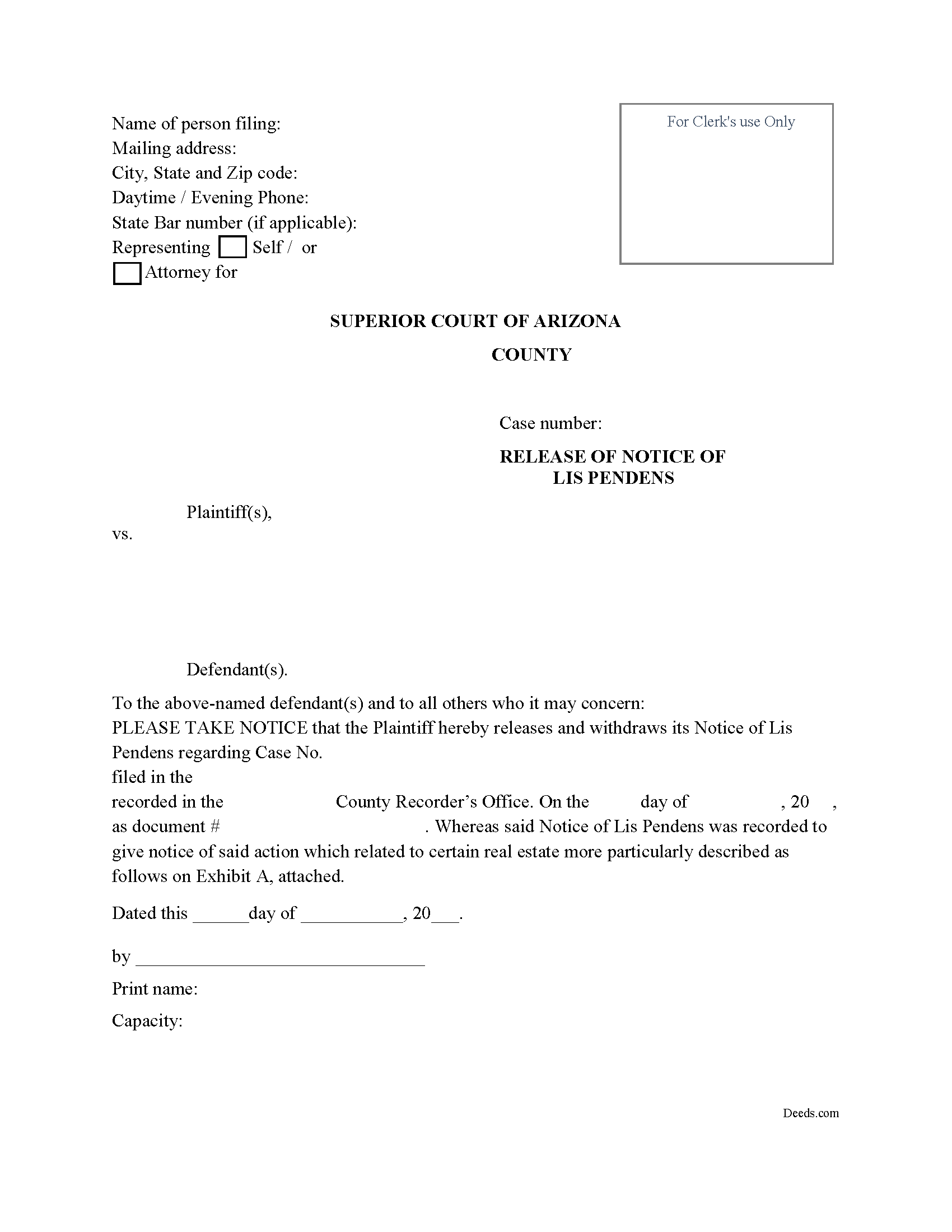
Gila County Lis Pendens Release Form
Fill in the blank form formatted to comply with all recording and content requirements.
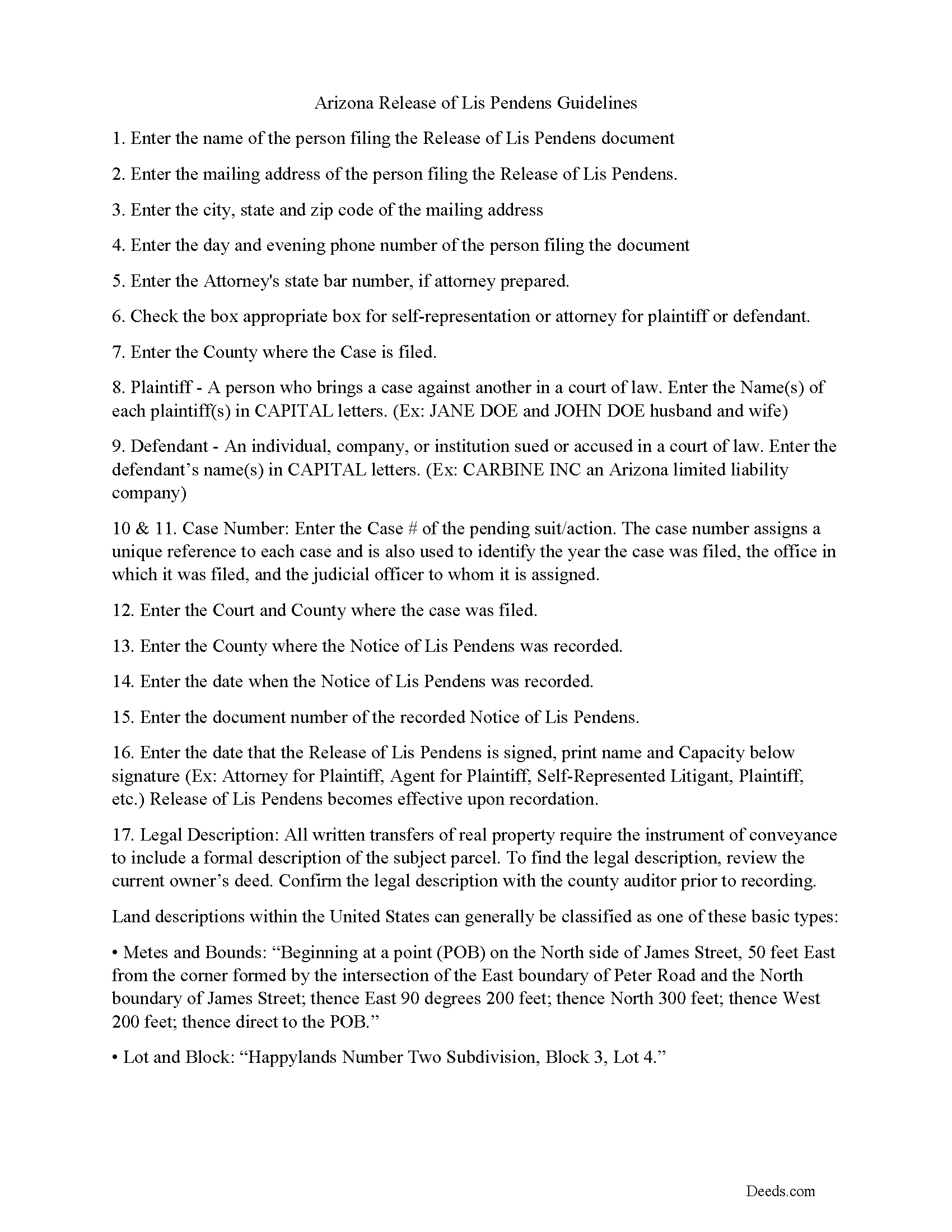
Gila County Lis Pendens Release Guide
Line by line guide explaining every blank on the form.
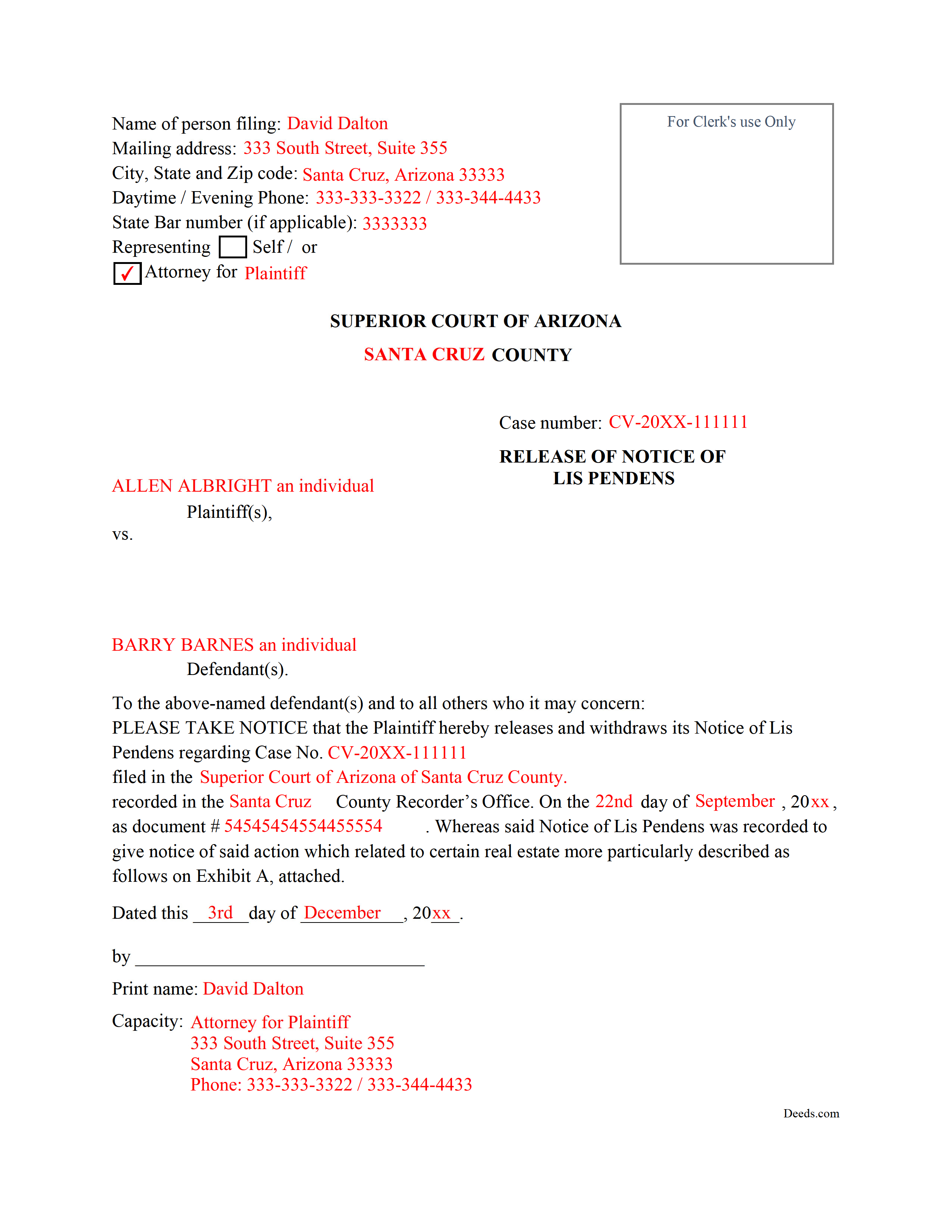
Gila County Completed Example of the Lis Pendens Release Document
Example of a properly completed form for reference.
All 3 documents above included • One-time purchase • No recurring fees
Immediate Download • Secure Checkout
Additional Arizona and Gila County documents included at no extra charge:
Where to Record Your Documents
Recorder: Main Office
Globe, Arizona 85501
Hours: 8:00 - 5:00 Monday through Friday
Phone: 928-402-8740
Satellite Office
Payson, Arizona 85541
Hours: 8:00 - 12:00 & 1:00 - 5:00 Monday through Friday
Phone: 928-474-7198
Recording Tips for Gila County:
- Bring your driver's license or state-issued photo ID
- Ensure all signatures are in blue or black ink
- Make copies of your documents before recording - keep originals safe
- Recorded documents become public record - avoid including SSNs
- Recording fees may differ from what's posted online - verify current rates
Cities and Jurisdictions in Gila County
Properties in any of these areas use Gila County forms:
- Claypool
- Globe
- Hayden
- Miami
- Payson
- Peridot
- Pine
- Roosevelt
- San Carlos
- Tonto Basin
- Winkelman
- Young
Hours, fees, requirements, and more for Gila County
How do I get my forms?
Forms are available for immediate download after payment. The Gila County forms will be in your account ready to download to your computer. An account is created for you during checkout if you don't have one. Forms are NOT emailed.
Are these forms guaranteed to be recordable in Gila County?
Yes. Our form blanks are guaranteed to meet or exceed the applicable formatting requirements used for recording in Gila County, including margin requirements, font requirements, and other layout standards. This guarantee applies to formatting, not to the legal sufficiency of information entered by the user or the suitability of a form for a particular transaction.
Can I reuse these forms?
Yes. You can reuse the forms for your personal use. For example, if you have multiple properties in Gila County you only need to order once.
What do I need to use these forms?
The forms are PDFs that you fill out on your computer. The free Adobe Acrobat Reader is recommended, and most PDF apps also work. You do NOT enter your property information online - you download the blank forms and complete them privately on your own computer.
Are there any recurring fees?
No. This is a one-time purchase. Nothing to cancel, no memberships, no recurring fees.
How much does it cost to record in Gila County?
Recording fees in Gila County vary. Contact the recorder's office at 928-402-8740 for current fees.
Questions answered? Let's get started!
The Arizona Lis Pendens Release is the recorded instrument that removes a previously filed notice of lis pendens from the county's chain of title, clearing the cloud on the property and restoring the owner's ability to sell, refinance, or otherwise deal with the parcel free of the litigation notice. Arizona's framework at ARS 12-1191(C) gives this release particular statutory weight: when a lis pendens has been recorded and the underlying action is later dismissed without prejudice for lack of prosecution, the plaintiff is required to issue the release within thirty days, and failure to do so creates a statutory damages claim of $1,000 plus liability for the property owner's actual damages. That mandatory-release-on-dismissal rule is distinctive to the Arizona framework, and it is only one of several scenarios where a release becomes legally or practically necessary.
When the Arizona Lis Pendens Release Is Used
The release is used whenever a previously recorded lis pendens no longer belongs on the record. Typical triggers include settlement of the underlying lawsuit, where the parties have agreed on a resolution and the plaintiff's claim affecting title is no longer in play; voluntary dismissal of the lawsuit by the plaintiff, either with or without prejudice; dismissal by the court for lack of prosecution (which triggers the ARS 12-1191(C) thirty-day mandatory release rule); final judgment in favor of the defendant on the title-affecting claim, extinguishing the plaintiff's basis for the notice; final judgment in favor of the plaintiff, where the judgment itself gets recorded and the lis pendens is no longer needed as a placeholder; and narrowing of the underlying claims so that the title-affecting component has been dropped even if other aspects of the lawsuit continue. The release is also used in more unusual scenarios — when a plaintiff has reconsidered the appropriateness of the filing and wants to remove it before the defendant challenges it, when parties agree to release the lis pendens in exchange for substitute security such as a bond or escrow deposit, and when a property owner has successfully moved the court to expunge the notice and a release is the vehicle for implementing the court's order.
The Mandatory Thirty-Day Rule Under ARS 12-1191(C)
ARS 12-1191(C) is the specific Arizona provision that creates a non-discretionary release obligation in one identified scenario. When a notice of pendency of action has been recorded and the underlying action is dismissed without prejudice for lack of prosecution — typically meaning the plaintiff failed to move the case forward within the court's required timeframes and the court dismissed under rule — the plaintiff has thirty days from the dismissal to issue a release of the notice of pendency. The release must be in the form of a recordable document, which means it must comply with ARS 11-480 formatting, be properly executed and acknowledged, and be suitable for filing with the county recorder. Failure to issue the release within thirty days subjects the person who filed the notice to liability of $1,000 plus actual damages suffered by the property owner during the period the lis pendens remained wrongfully on the record.
The rationale behind the thirty-day rule is that a plaintiff who has let their case go to dismissal for lack of prosecution no longer has any basis for claiming the lis pendens effect. The lawsuit is over — at least for the moment — and the continuing cloud on title serves no legitimate purpose. Arizona's response is to convert the plaintiff's inaction into affirmative statutory liability: inaction was how the case got dismissed in the first place; inaction after dismissal compounds the problem by leaving an unwarranted cloud on the owner's title. The $1,000 statutory minimum ensures that liability attaches even when actual damages are difficult to prove, and the actual-damages component reaches real consequences such as failed sale transactions, lost refinance opportunities, and other losses caused by the lingering notice.
Why Prompt Release Matters Even Outside the Statutory Thirty Days
ARS 12-1191(C)'s specific mandate applies only to dismissal-without-prejudice-for-lack-of-prosecution scenarios, but releasing promptly after any termination of the underlying basis for the lis pendens is important for reasons that extend beyond the statutory minimum. A plaintiff who has settled with the defendant, obtained a judgment, or otherwise concluded the litigation but has not released the lis pendens leaves a cloud on the owner's title that can continue to prevent sales and refinances. The owner, having paid the settlement or having the judgment in hand, is often the party most motivated to clear the record — but the release requires the filer's signature, and a filer who has moved on may be difficult to reach later.
The owner whose sale of the property falls through because a settled lis pendens was not released in time has a reasonable claim against the filer even outside the ARS 12-1191(C) framework. Common law damages for wrongful clouding of title, attorneys' fees in some circumstances, and specific performance of any settlement obligation to release the notice are all potentially available. The practical point for filers is simple: release promptly, regardless of the specific triggering scenario, and avoid being the party on the wrong side of a damages claim by a property owner whose transaction was frustrated by an unreleased notice. Best practice is to coordinate the release of the lis pendens with the final resolution of the underlying action — recording the release simultaneously with a stipulated dismissal, for example, rather than leaving the release for later attention.
Settlement and Release Together
When a lis pendens has been recorded and the parties are negotiating a settlement, the release of the lis pendens is typically part of the settlement's exchange. The defendant pays the agreed consideration (or performs whatever else the settlement requires) and the plaintiff releases the lis pendens. In practice, the release is drafted and signed at the same time as the settlement documents and is either recorded immediately by the plaintiff's counsel or held by an escrow agent to be recorded on completion of the defendant's performance. Structuring the transaction this way ensures that the property owner actually gets the benefit of the release — one of the items the property owner is paying for — rather than having to chase the plaintiff later. The release language in the settlement agreement itself should be explicit about the plaintiff's obligation to release and the timing; a settlement that leaves the release obligation vague invites disputes about who was supposed to do what and by when.
Contents of the Release
The release should identify itself clearly as a release of the previously recorded lis pendens, reference the original lis pendens by recording date and recording number (docket and page or instrument number, and the county of recording), identify the underlying action by case name, case number, and the court in which it was pending, describe the property by the same legal description that appeared in the original lis pendens, recite the basis for the release (settlement, dismissal, judgment, or other terminating event), and declare the release of the notice in terms that clear the record. The release should be signed by the party who originally filed the notice (typically the plaintiff) or by that party's authorized attorney; when the filer was a corporate entity or other business, the signatory's representative capacity should appear in the signature block.
Court-Ordered Release and Expungement
In some cases, the release is the product of court order rather than the filer's voluntary action. Under ARS 12-1191 and related case law, a property owner whose property is burdened by a lis pendens the owner believes was improperly recorded can move the court to expunge or cancel the notice. When the court agrees — typically on the ground that the underlying lawsuit does not actually affect title, that the filing was groundless, or that the filer lacks standing — the court enters an order directing the release of the notice. In that scenario, the release either recites the court order as its basis (the filer complying with the court's direction) or the court order itself is recorded in place of a release (a certified copy of the order becomes part of the title record). When dealing with court-ordered releases, it is important to follow the specific procedural direction of the court; practice varies on whether the court's order should be followed by a separate release instrument or whether the order itself is the releasing document.
ARS 33-420 and Groundless Filings
When a lis pendens is released because it was determined to be groundless — either through court order or through the filer's acknowledgment that the filing was inappropriate — the release itself does not cure the exposure the filer has under ARS 33-420 for having filed a groundless document affecting real property. The property owner retains the statutory cause of action for the greater of $5,000 or three times actual damages, plus attorneys' fees, for the wrongful recording. Releasing the notice stops the ongoing cloud on title but does not retroactively make the filing proper. Plaintiffs who reconsider the appropriateness of a lis pendens after recording should evaluate both the releasing obligation and the exposure the filing has already created, and should work with counsel on the timing and characterization of the release to avoid compounding the exposure.
Execution and Acknowledgment
Under ARS 33-401 and ARS 11-480, the release must be in writing, signed by the filer (or the filer's authorized attorney), and acknowledged before a notary public or other officer authorized to take acknowledgments. Original signatures are required unless another law provides otherwise (ARS 11-480(A)(3)). Arizona does not require subscribing witnesses on the release. Acknowledgments taken outside Arizona must comply with ARS 33-501, which recognizes notaries, judges and clerks of courts of record, and any other officer authorized to perform notarial acts in the jurisdiction where the acknowledgment is taken.
Affidavit of Property Value Exemption
The Affidavit of Property Value framework under ARS 11-1133 applies to instruments that transfer interests in real property. A release of lis pendens is not a conveyance — it clears a previously recorded notice rather than transferring any interest — and the Affidavit of Property Value and its associated exemption-recital practice do not apply in the way they apply to deeds and transfer instruments. County recorders generally do not require an affidavit or an exemption recital on a lis pendens release, but including a brief exemption recital on the face of the instrument (citing ARS 11-1134 generally) is harmless and avoids any recorder's-office question about whether an affidavit was expected.
Formatting and Recording
ARS 11-480 sets the formatting requirements for every recordable instrument: legible type of at least ten points, white paper no larger than 8.5 by 14 inches, a caption identifying the document (for example, "Release of Notice of Lis Pendens" or "Release of Lis Pendens"), a top margin of at least two inches on the first page reserved for the recorder's stamp, and minimum half-inch margins elsewhere. Record the release with the county recorder in the same county where the original lis pendens was recorded. When the original was recorded in more than one county because the property spans county lines, the release must be recorded in each county where the original appeared; a release recorded in only one of two counties clears only that county's record. Confirm current recording fees (ARS 11-475) and accepted forms of payment with the recorder's office in advance, and verify that the release has actually been indexed rather than relying on a drop-off or mailing receipt.
Race-Notice Consequences of Delayed Recording
Arizona's race-notice rule at ARS 33-412 attaches specific consequences to unrecorded instruments. A release executed but not recorded is effective between the original parties but does not clear the cloud on title as against third parties, because title examiners cannot see documents that are not in the recorder's index. A party who has obtained an executed release and is holding it unrecorded has not achieved the outcome the release was meant to produce. Recording is the entire point of the exercise; the executed-but-unrecorded release is exactly the situation the ARS 12-1191(C) thirty-day rule was designed to prevent, and the reasoning applies to all release scenarios even when the specific thirty-day mandate does not.
What's Included in the Download Package
The Arizona Lis Pendens Release package includes the release form drafted to reference the original recorded lis pendens and the underlying action that gave rise to it, with space for the recording information, case caption, legal description, and basis for the release, detailed guidelines covering the Arizona-specific drafting and recording requirements and the interaction with the ARS 12-1191(C) mandatory thirty-day rule and the ARS 33-420 groundless-document framework, and a completed example showing how the form should look for a typical release. All files are available for instant download after purchase.
Important: Your property must be located in Gila County to use these forms. Documents should be recorded at the county recording office listed above.
This Lis Pendens Release meets all recording requirements specific to Gila County.
Our Promise
The documents you receive here are guaranteed to meet or exceed the applicable Gila County recording format requirements. If there is a rejection caused by our formatting, we will correct the issue or refund your payment. This guarantee applies to document formatting only and does not extend to information entered by the user, the selection of the form, or the legal effect of the completed document.
Save Time and Money
Get your Gila County Lis Pendens Release form done right the first time with Deeds.com Uniform Conveyancing Blanks. At Deeds.com, we understand that your time and money are valuable resources, and we don't want you to face a penalty fee or rejection imposed by a county recorder for submitting nonstandard documents. We constantly review and update our forms to meet rapidly changing state and county recording requirements for roughly 3,500 counties and local jurisdictions.
4.8 out of 5 - ( 4,828 Reviews )
Noal S. 5 out of 5 stars
The download package is very thorough and complete for the Corrective Deed I needed to file. The material is state/county specific and includes a completed example. The price is reasonable compared to an attorney fee from $400 to $600
We appreciate your business and value your feedback. Thank you. Have a wonderful day!
Beth O. 5 out of 5 stars
Easy peasy! Thank y'all so much.
Thank you!
Brian W. 5 out of 5 stars
Easy, but it would be nice if there was an option for font size. It looks tiny, like 6 or 8.
Thank you for your feedback. We really appreciate it. Have a great day!
Marsha D. 5 out of 5 stars
Outstanding product and so easy to use! Highly recommend this product. We successfully used the Virginia deeds. Thank you.
Thank you!
Jeane W. 5 out of 5 stars
I needed to add my partner to my warranty deed and deeds.com made it easy to understand what form I needed, attached a great explanation of the form and a sample of the form filled out. Couldn't be happier. In fact I'm researching a Revocable Transfer on Death Deed now and they've given me the confidence to rewrite my own will on my own.
Your feedback is greatly appreciated. Thank you for taking the time to share your experience!
Michael S. 5 out of 5 stars
Recording a Warranty Deed with Mohave County AZ was easy and efficient by using Deeds.com. I will be using their service for all of my e-filing going forward. Thank you Deeds.com!!!!
We are delighted to have been of service. Thank you for the positive review!
Patricia C. 4 out of 5 stars
I found there were a large number of documents available to download. The file naming on the PDFs could be more descriptive, and it would be nice to be able to download a complete set with one click.
Thank you for your feedback. We really appreciate it. Have a great day!
Vicki L. 5 out of 5 stars
Quick results with accurate information and thorough information.
Thank you!
Heather W. 5 out of 5 stars
Easy to use Example provided Clear instructions
Thank you for your feedback. We really appreciate it. Have a great day!
Billie G. 5 out of 5 stars
Loved this service! It was quick, easy and effective! I'll definitely be using them again!
Thank you!
Diane C. 5 out of 5 stars
This was just the info I needed
Thank you!
Lynn T. 5 out of 5 stars
great service, thank you
Thank you!
Bruce B. 5 out of 5 stars
Worked great and was easy to use
Thanks Bruce, glad we could help.
Martin E. 5 out of 5 stars
documents and guidance need to properly comply with court
Thank you!
Michael H. 4 out of 5 stars
Found documents I needed quickly and at a reasonable price. MH
Thank you for your feedback. We really appreciate it. Have a great day!