Arizona Special Warranty Deed
County Specific Legal Forms Validated as recently as October 14, 2026 by our Forms Development Team
About the Arizona Special Warranty Deed
How to Use This Form
- Select your county from the list
- Download the county-specific form
- Fill in the required information
- Have the document notarized if required
- Record with your county recorder's office
What Others Like You Are Saying
"Responses to my needs were prompt and professional. I found the service easy to use and clearly outl…"
"Website is very informative and user friendly!"
"I love how quick and easy everything was. I'll definitely be using deeds.com again."
"Great way to get the forms you need. Quick, easy and affordable"
"Quick fast and easy transaction."
4.8/5 from 4,827 reviews. Read all
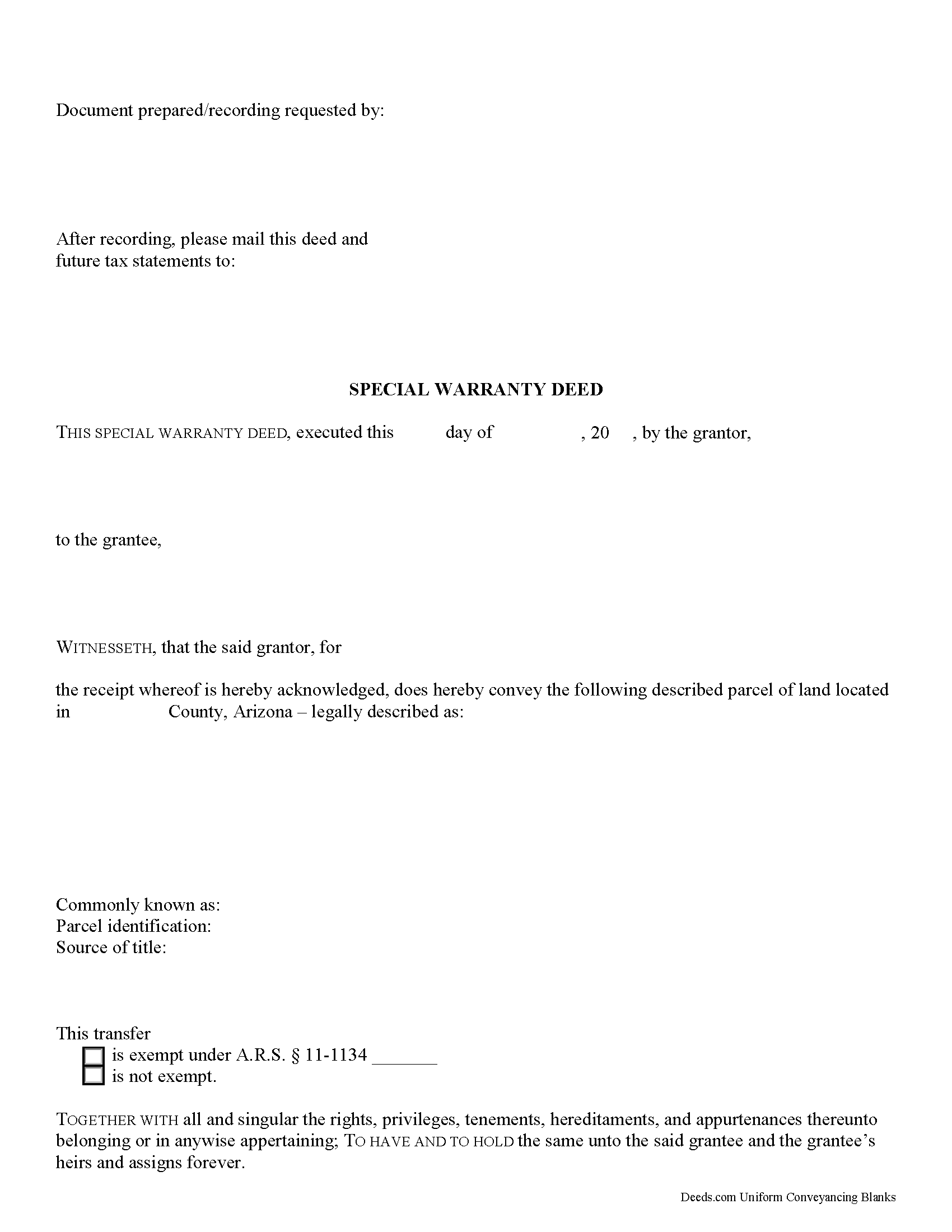
One grantor section, one signature line, one acknowledgment certificate: the Arizona Special Warranty Deed (Individual Grantor) is drafted for a single natural person conveying Arizona real property in that person's own name. The instrument pairs the statutory conveyance language of A.R.S. 33-402 with a warranty the grantor gives only for the span of the grantor's own ownership, limited to persons claiming by, through, or under the grantor.
One Grantor, One Signature, One Certificate
The form identifies a single record owner by name, marital status, and mailing address, and every execution element is built around that one person. The signature section carries one line, and the notary section carries one acknowledgment certificate in the A.R.S. 41-265 individual short form. Two record patterns present this configuration: an unmarried owner, whether single, divorced, or widowed, holding title alone, and a married owner conveying separate property under A.R.S. 25-213, property owned before the marriage or received by gift, devise, or descent. The form is not set up as a two-spouse instrument; a conveyance of community real property joins both spouses under A.R.S. 25-214(C)(1) and carries two grantor signatures, an architecture outside this deed's design.
Why One Signature Works in a Community Property State
Arizona presumes property acquired by either spouse during marriage to be community property under A.R.S. 25-211, and a disposition of community real property lacking one spouse's joinder is voidable by the spouse who did not join. Separate property runs on the opposite rule: A.R.S. 25-214(A) gives each spouse sole management and disposition of that spouse's own separate property, so a parcel held in one name, an inheritance kept separate, or a home bought before the wedding moves on one signature. The grantor section's marital status entry states the status the grantor asserts, and the source of title section shows when the grantor's ownership, and with it the warranty period, began.
The Reach of the Limited Warranty
On this form the grantor warrants and defends the title against every person lawfully claiming by, through, or under the grantor, but not otherwise. The deed also resolves Arizona's implied covenants in the same direction: A.R.S. 33-435 reads covenants of no prior conveyance and freedom from encumbrances into any fee conveyance using the word convey unless express terms restrain them, and the operative section of this deed restrains them expressly, conveying subject to the listed encumbrances and to matters of record. What remains is one coherent promise measured by the grantor's own tenure, more than a quitclaim's bare release of interest and narrower than the all persons whomsoever warranty of A.R.S. 33-402(3).
The Exemption Line Beneath the Legal Description
Arizona recording adds a document to the package at the counter: each deed evidencing a transfer of title arrives with a completed Affidavit of Property Value, or carries an exemption notation on its face, and A.R.S. 11-1133(C) directs the recorder to refuse a nonexempt deed presented without the affidavit. This form builds the notation into its geometry with a dedicated line beneath the legal description, the placement the Department of Revenue instructions give for the code, written in the style A.R.S. 11-1134 B3. Gift transfers and nominal consideration transfers among specified family members appear on the A.R.S. 11-1134 exemption list; a priced sale sends the affidavit along with the deed instead. The statewide recording fee is thirty dollars under A.R.S. 11-475, with the two dollar real estate transfer fee of A.R.S. 11-1132 folded in, and the first page of the form reserves its top two inches for recording information, with the requester and return address boxes placed inside the left 3.5 inches that A.R.S. 11-480(C) allows.
Buyers and sellers searching for this instrument also know it as a limited warranty deed; in Arizona the label matters less than the express wording, and this form states the limitation in full. The download delivers three files: the fillable special warranty deed configured for one individual grantor, a completed example showing a conveyance by an unmarried grantor recorded in Maricopa County, and a line-by-line guide to completing, signing, and recording the deed under Arizona law. The materials are informational and are not legal advice.
Important: County-Specific Forms
Our special warranty deed forms are specifically formatted for each of the 15 counties in Arizona.
After selecting your county, you'll receive forms that meet all local recording requirements, ensuring your documents will be accepted without delays or rejection fees.