California Grant Deed (Reserving Life Estate)
County Specific Legal Forms Validated as recently as September 17, 2026 by our Forms Development Team
About the California Grant Deed (Reserving Life Estate)
How to Use This Form
- Select your county from the list
- Download the county-specific form
- Fill in the required information
- Have the document notarized if required
- Record with your county recorder's office
What Others Like You Are Saying
"User Friendly- so easy to fill in online!!!"
"I have not yet used the product, but am confident that I will like it, because of this prompt reques…"
"Easy to use. Good information. Would use again."
"I was a little nervous about doing this, but it was very simple. I was thrilled that I could use the…"
"Service was fantastic. So helpful and they promptly get back with you. No reason to drive if you are…"
4.8/5 from 4,820 reviews. Read all
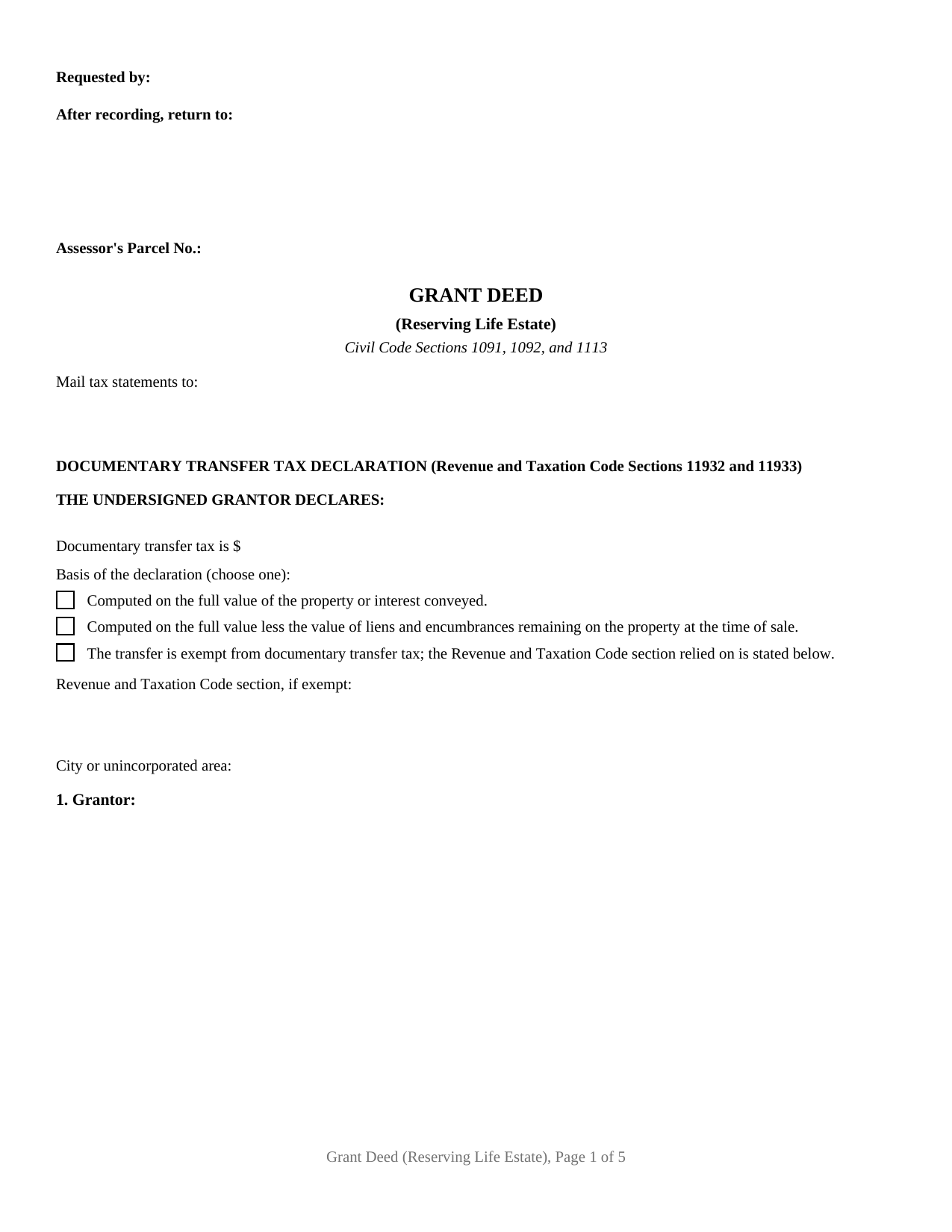
A grant deed reserving a life estate divides ownership of California real property along the line of time. Recorded once, it fixes two positions in the county record: the grantor holds a life estate, often the reason this instrument is searched simply as a California life estate deed, keeping the exclusive right to live in the property, rent it, and take its income for life, while the grantee holds the remainder, the ownership that takes possession the moment the life estate ends. This form is a California grant deed configured for exactly that split, with the reservation printed as fixed deed text and the documentary transfer tax declaration of Revenue and Taxation Code Sections 11932 and 11933 completing on page one.
The remainder vests now; possession waits
The operative word is grant, which imports the two Civil Code Section 1113 covenants into the remainder conveyance: no prior transfer of the same interest, and no encumbrance of the grantor's own making beyond what the deed discloses. The reservation paragraph then does the work that names this variant. The grantor excepts and reserves the life estate, and when two grantors sign, the printed text runs the estate for their joint lives and then for the life of the survivor, so the surviving grantor keeps the whole property's use and income until the second death. On the death of the last life tenant, possession and enjoyment pass to the remainder owner without a new conveyance; the succession is already of record.
What the life tenant keeps and carries
California states the reserved estate's ground rules in two short statutes. Civil Code Section 818 lets the owner of a life estate use the land as a fee simple owner would, short of injury to the inheritance, and Civil Code Section 840 assigns the carrying costs: repair against ordinary waste, the taxes and other annual charges, and a fair share of extraordinary assessments. The deed's mail tax statements entry, which Government Code Section 27321.5 places on the first page of every deed conveying fee title, pairs naturally with that allocation, and the guide describes where each entry comes from.
A reassessment clock that waits
Property taxes give this deed one of its most distinctive features. Under Revenue and Taxation Code Section 62(e) and Property Tax Rule 462.060(a), the creation of a life estate is a change in ownership at transfer unless the instrument reserves the estate in the transferor, the transferor's spouse, or the transferor's registered domestic partner. A deed on this form makes exactly that reservation, so recording it does not itself reset the assessed value; the change in ownership arrives when the reserved estate terminates and the remainder owner's possession vests, measured under the exclusions in effect at that time. The Preliminary Change of Ownership Report filed with the deed describes the reservation so the assessor applies the right rule. Transfer tax runs on its own track: the declaration prints in full, with selections for tax computed on full value, computed net of remaining liens, or exempt with the exemption section cited, so a family transfer without consideration and a transfer for value complete the same first page.
The configuration this deed recites
The deed identifies one or two natural-person grantors, the life tenants, and its grantee section is free form for the remainder owners and any co-ownership designation after their names. The execution area holds a signature block for each grantor, and each block is paired with an acknowledgment certificate printing the complete Civil Code Section 1189 wording, from the boxed identity notice through the penalty of perjury certification to its Signature and Seal close; a single grantor simply leaves the second block and its certificate empty. An owner putting the home's succession on record while continuing to live there for life, and two owners fixing where a family property goes while keeping its use and income between themselves for both lifetimes, present the pattern this deed recites. The reservation is an ordinary life estate: the form prints no retained power to sell, mortgage, or revoke without the remainder owner, so a later change to the arrangement is a new conveyance by the holders of the affected interests.
The purchase delivers the deed as a fillable PDF, a completed example showing two San Diego County grantors conveying the remainder in a family home while reserving the life estate, and a plain language guide to the entries, the notarization, and the recording steps. The materials are informational and are not legal advice; a California attorney can confirm how the arrangement fits a specific title and plan.
Important: County-Specific Forms
Our grant deed (reserving life estate) forms are specifically formatted for each of the 58 counties in California.
After selecting your county, you'll receive forms that meet all local recording requirements, ensuring your documents will be accepted without delays or rejection fees.