California Grant Deed (Gift)
County Specific Legal Forms Validated as recently as September 17, 2026 by our Forms Development Team
About the California Grant Deed (Gift)
How to Use This Form
- Select your county from the list
- Download the county-specific form
- Fill in the required information
- Have the document notarized if required
- Record with your county recorder's office
What Others Like You Are Saying
"Very helpful! Easy and clear guidance. Good examples on sample forms."
"Outstanding. There is nothing worse than finding the correct forms or having to hire an atty to do w…"
"nice to get everything I need for the county that the property is located."
"The deed itself was easy. I did notice that although the website says that the deed would exempt the…"
"Quick and easy."
4.8/5 from 4,817 reviews. Read all
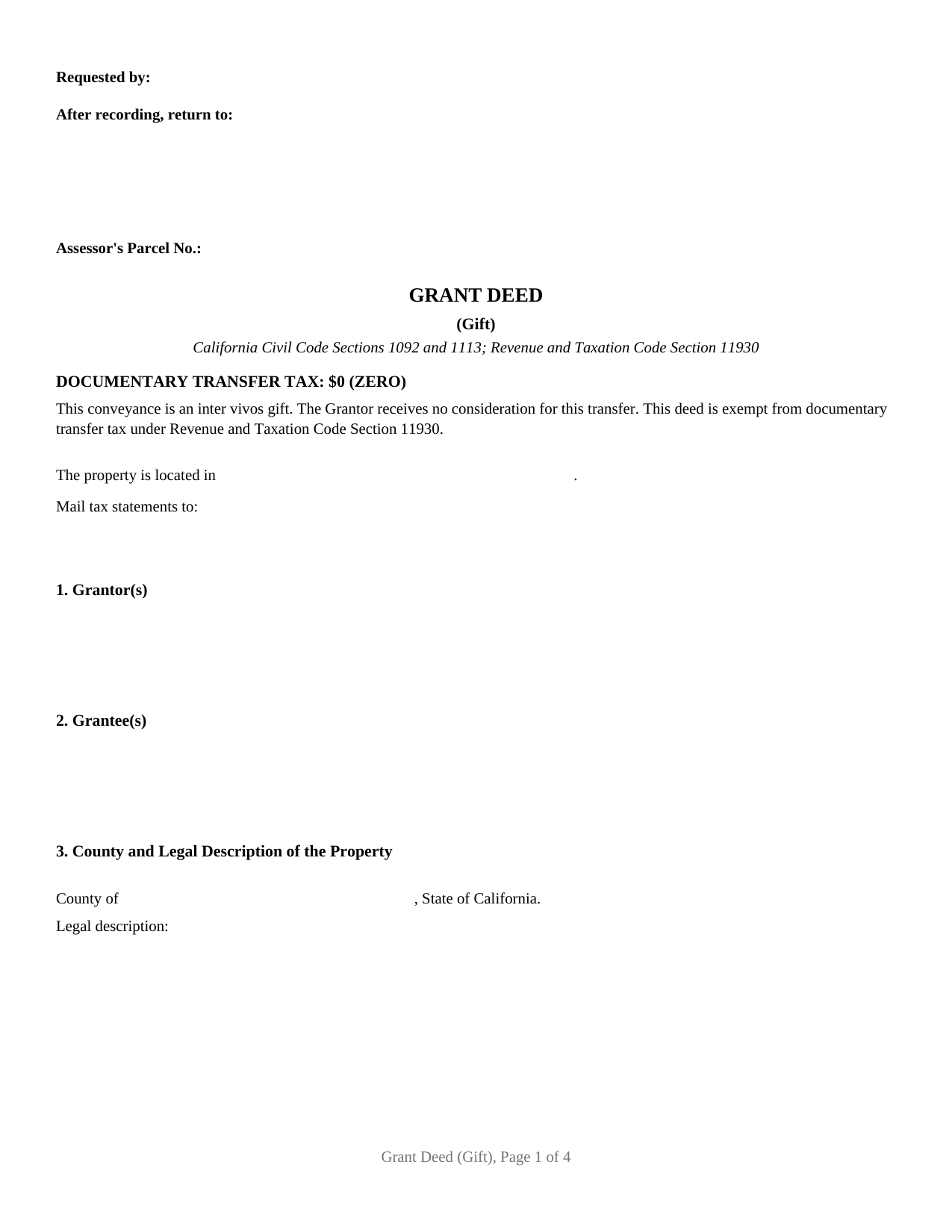
A California gift deed does its distinctive work in one fixed sentence: the grantor receives no consideration. This deed is a California grant deed prepared for exactly that transfer, a lifetime gift of real property between people, with the gift declaration and the documentary transfer tax exemption of Revenue and Taxation Code Section 11930 printed on its face rather than left to a blank. The first page states that the conveyance is an inter vivos gift, that no transfer tax is due, and that the deed is exempt under Section 11930, which is the recital county recorders look for when a deed moves title for love and affection instead of money.
A grant deed with the gift built in
The operative word is grant, the conveyancing word California has used since Civil Code Section 1092 supplied its short statutory deed form. Under Civil Code Section 1113, that single word implies two covenants and no others: that the grantor has not already conveyed the same interest to someone else, and that the property is free of encumbrances the grantor made or suffered. A gift deed built on the grant deed therefore carries more assurance than a bare release of interest and less than a full warranty; the grantee receives whatever the grantor owns, protected against the grantor's own double dealing, and takes subject to matters of record. The operative section conveys for no consideration, and as a gift, so the consideration posture is part of the instrument itself.
What the exemption changes at the recording counter
Because a gift is exempt from documentary transfer tax, the deed shows the exemption instead of a tax amount, and the one entry in the tax declaration is the line identifying the city or unincorporated area where the property sits. The exemption has a cost consequence worth knowing about: the Building Homes and Jobs Act fee of Government Code Section 27388.1 is not imposed on documents recorded with a transfer that pays documentary transfer tax, so a gift deed, which pays none, carries that seventy five dollar fee unless a different statutory category, such as the transfer of a residential dwelling to an owner-occupier, covers the recording. A Preliminary Change of Ownership Report accompanies the deed under Revenue and Taxation Code Section 480.3, and the county assessor then decides whether the gift is reassessed; qualifying family home transfers between parents and children can be excluded from reassessment under Revenue and Taxation Code Section 63.2, on a claim filed with the assessor. The guide walks through each of these filings and where the entries come from.
The configuration this deed recites
The form identifies one or two natural-person grantors and carries two grantor signature blocks, each followed by its own acknowledgment certificate in the full statutory form of Civil Code Section 1189, boxed notary notice included. Parents gifting a home to an adult child, a relative consolidating title in another relative's name, and one family member adding property to another's column all present the patterns this deed recites; when spouses give community real property, both sign, which is what the second signature block carries. When one grantor conveys, the second block and its certificate stay empty. The grantee section is free form, so the deed accommodates one or two recipients and whatever vesting designation follows their names, and the guide describes each form of California co-ownership in plain terms. The deed recites a no-consideration gift; a purchase for money or an assumption of debt follows a different pattern than this form prints.
A present transfer, not a plan
A recorded gift deed moves title now. It is not a will, it does not wait for a death, and once delivered it is not revocable by the grantor; the permanence is the point, and it is why the guide covers what the deed does not decide, from federal gift tax reporting to reassessment to marital property character. The deed records with the county recorder where the property sits, on letter size pages with the recording space reserved atop page one and the mail tax statements line California requires on every deed conveying fee title.
The purchase delivers this gift deed as a fillable PDF, a completed example showing a Los Angeles County gift from two parents to a daughter, and a plain language guide to completing, signing, notarizing, and recording it. The materials are informational and are not legal advice; a California attorney can apply these rules to a particular family and title.
Important: County-Specific Forms
Our grant deed (gift) forms are specifically formatted for each of the 58 counties in California.
After selecting your county, you'll receive forms that meet all local recording requirements, ensuring your documents will be accepted without delays or rejection fees.