California Grant Deed (Trust Transfer)
County Specific Legal Forms Validated as recently as September 17, 2026 by our Forms Development Team
About the California Grant Deed (Trust Transfer)
How to Use This Form
- Select your county from the list
- Download the county-specific form
- Fill in the required information
- Have the document notarized if required
- Record with your county recorder's office
What Others Like You Are Saying
"The link for the note guidelines just shows the same directions as for the mortgage. Other than that…"
"Got what I needed. Easy access."
"So far so good. Thanks for making this easy and affordable."
"Gave me exactly what i needed"
"Excellent and expeditious service. Will definitely use in the future when the need arises."
4.8/5 from 4,819 reviews. Read all
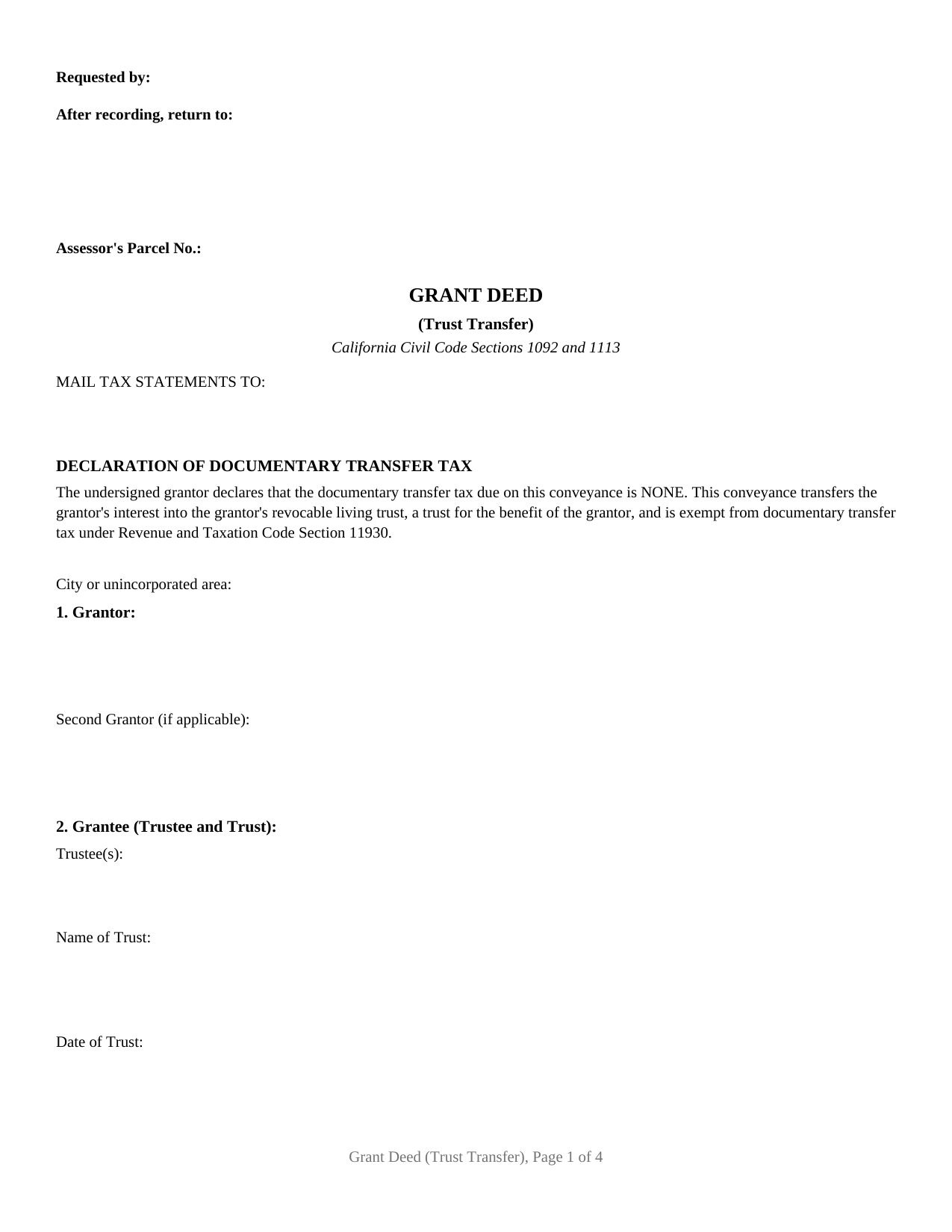
California puts one recorded step between signing a living trust and having the trust actually hold the real estate: a deed from the owner to the trustee. This form is that step, a California grant deed configured as a trust transfer deed, conveying property from one or two individual owners to the trustee of the trust named on its face, with the documentary transfer tax exemption of Revenue and Taxation Code Section 11930 and the trust transfer recital printed on the first page. Recorded with the county recorder, it moves record title into the trustee's name so the trust, rather than the individual, holds the property.
Title follows the deed, not the trust binder
A living trust controls only the assets titled in the trustee's name. Probate Code Section 15200 recognizes a trust funded by a lifetime transfer to the trustee, and for real property that transfer is a deed, executed, acknowledged, and recorded like any other California conveyance. Until the deed records, the county index still shows the owner individually, and property standing outside the trust at death is administered outside it. The trust transfer deed exists for exactly this handoff: the grantor and the trustee are usually the same people wearing two hats, the deed changes the name on the title rather than who enjoys the property, and the trust instrument then governs what happens to the property during incapacity and at death.
Two tax recitals, printed rather than improvised
The deed's first page declares that no documentary transfer tax is due and recites the Section 11930 exemption for a conveyance that moves the grantor's interest into the grantor's revocable living trust, a trust for the grantor's benefit, which is the recital California recorders look for on a trust funding deed; the single tax entry left to complete is the city or unincorporated area line that Revenue and Taxation Code Section 11932 requires. Property taxes follow a separate rule with a matching result: under Revenue and Taxation Code Section 62(d), a transfer by the trustor into a trust is excluded from change in ownership for as long as the trust is revocable or the transferor remains its present beneficiary, so a qualifying trust transfer does not itself reset the assessed value. The Preliminary Change of Ownership Report that accompanies the deed under Section 480.3 asks about that trust relationship directly, and the guide walks through the report alongside the recording fees, including how the Government Code Section 27388.1 Building Homes and Jobs Act fee interacts with an untaxed conveyance.
The configuration this deed recites
The form identifies one or two natural-person grantors signing in their individual capacity, and its grantee section is built for the trust: a line for the trustee or trustees, a line for the trust's full name, and a line for the trust's date as shown on its signature page. Two signature blocks follow, each with its own acknowledgment certificate in the complete Civil Code Section 1189 statutory form, boxed notary notice included, so spouses moving community real property into a shared family trust both sign, as Family Code Section 1102 provides, while a single owner funding an individual trust leaves the second block empty. The deed recites a conveyance into the grantor's own revocable living trust; a trustee deeding property out of a trust signs in a trustee capacity this form does not recite, and a transfer into an irrevocable trust for another person's benefit carries tax character the printed recitals do not cover.
Underneath, still a grant deed
The operative word is grant, so the two implied covenants of Civil Code Section 1113 travel with the conveyance: the grantor has not already conveyed the same interest away, and the property is free of encumbrances the grantor created. That matters even between an owner and the owner's own trustee, because the deed enters the permanent county record where later purchasers and title examiners read it. The form reserves the statutory recording space atop page one, carries the requester, return address, and assessor parcel number entries inside it, and prints the mail tax statements entry on the first page as Government Code Section 27321.5 directs.
The purchase delivers the trust transfer deed as a fillable PDF, a completed example showing two Orange County spouses deeding their home to themselves as trustees of a family trust, and a plain language guide to completing, signing, notarizing, and recording the deed. The materials are informational only and are not legal advice; a California attorney or the trust's drafter can confirm how a specific title and trust work together.
Important: County-Specific Forms
Our grant deed (trust transfer) forms are specifically formatted for each of the 58 counties in California.
After selecting your county, you'll receive forms that meet all local recording requirements, ensuring your documents will be accepted without delays or rejection fees.