California Grant Deed (Interspousal)
County Specific Legal Forms Validated as recently as September 17, 2026 by our Forms Development Team
About the California Grant Deed (Interspousal)
How to Use This Form
- Select your county from the list
- Download the county-specific form
- Fill in the required information
- Have the document notarized if required
- Record with your county recorder's office
What Others Like You Are Saying
"The website was very easy to work. The documents were just what I needed and everything that my stat…"
"Forms were spot on and able to save over $100 by not going to an attorney to complete the same docum…"
"Great informative site.... helped me find exactly what I was looking for. DETAILED information on my…"
"Over all quality of document was good. The issue I had was where it states claimant did not have a c…"
"Fantastic!"
4.8/5 from 4,817 reviews. Read all
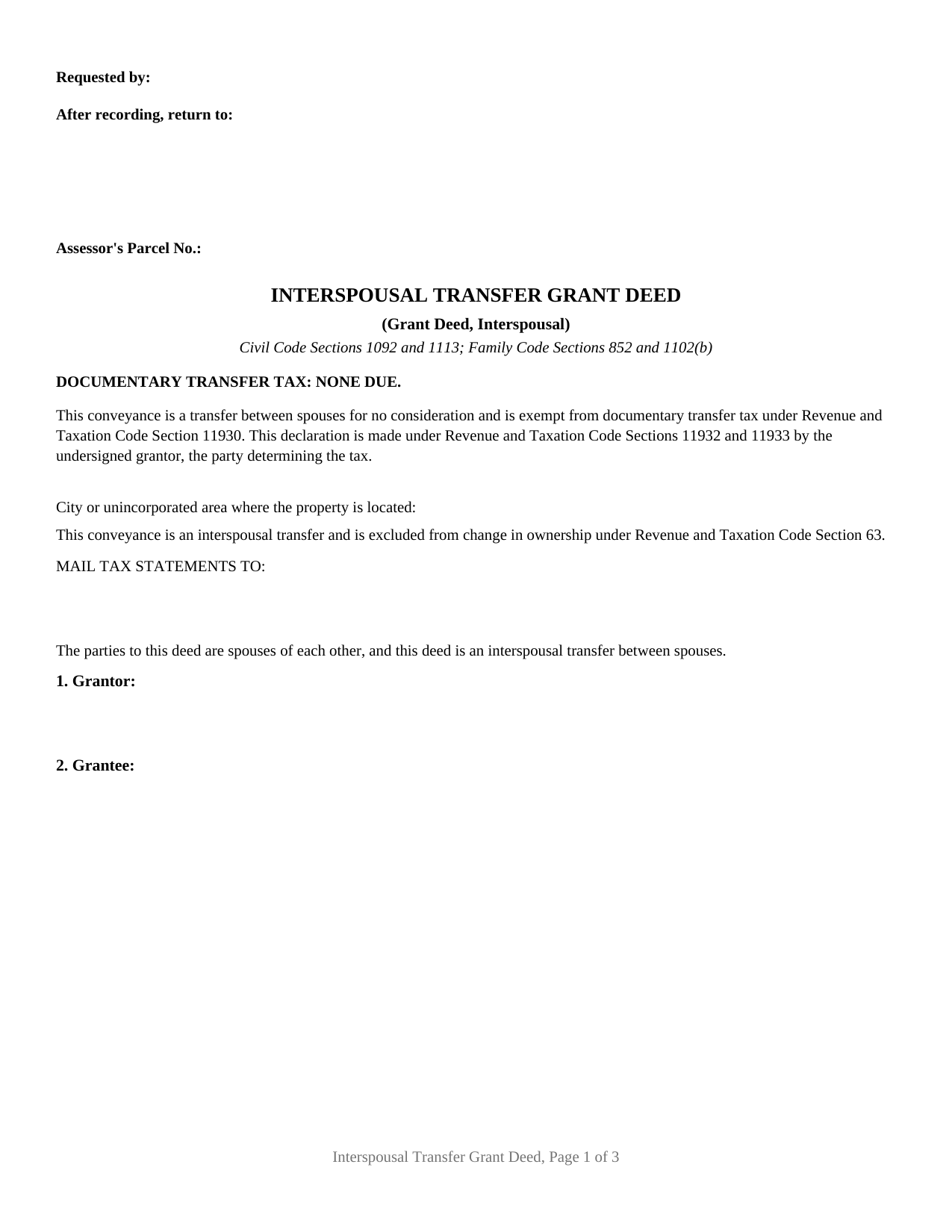
One signature moves this deed. California ordinarily requires both spouses to join in conveying community real property, and then steps aside for exactly this transfer: Family Code Section 1102(b) excludes a conveyance between spouses from the joinder rule, so an interspousal transfer grant deed is executed by the conveying spouse alone. This form is that deed, a California grant deed prepared for a transfer between spouses, with the spousal recital, the documentary transfer tax exemption, and the Revenue and Taxation Code Section 63 change in ownership exclusion printed on its first page.
The deed the joinder statute steps aside for
Family Code Section 1102(a) makes community real property a two-signature asset: both spouses join in an instrument that sells, conveys, or encumbers it. Subdivision (b) removes a transfer between spouses from that requirement, and this form is drawn to that subdivision: one grantor block, one signature line, and one acknowledgment certificate in the complete Civil Code Section 1189 form, boxed notary notice included. A spouse conveying separate property likewise acts without the other spouse's consent under Family Code Section 770(b), so the single-signature architecture holds whichever characterization the property carries. The operative word is grant, with the two implied covenants of Civil Code Section 1113 riding on it: the grantor has not already conveyed the same interest to another, and the property stands free of encumbrances the grantor created, except as the deed's express terms state.
An express declaration, because bare title decides little between spouses
California draws a hard line between whose name appears on a deed and whether property is community or separate. Estate of MacDonald requires a transmutation, a change in marital character, to be made by an express written declaration that states the change; In re Marriage of Valli and In re Brace show the state's highest court weighing community property presumptions against bare title form. A spousal deed that merely names a grantee leaves that question open. This deed prints the declaration Family Code Section 852 contemplates: the grantor expressly declares that ownership, and marital character to the extent needed, are changed so that the grantee holds the property in the form of ownership the grantee section states. Under Section 852(b), recording the deed is what makes a real property transmutation effective against third parties without notice.
Recitals the recorder and the assessor both read
The first page answers the two questions county offices ask of a spousal deed. For the recorder, the printed declaration states that the conveyance is between spouses for no consideration and exempt from documentary transfer tax under Revenue and Taxation Code Section 11930, with one entry for the city or unincorporated area line that Section 11932 requires. For the assessor, the deed recites Revenue and Taxation Code Section 63: a change of ownership does not include any interspousal transfer, so the conveyance does not itself reset the assessed value, and county assessor offices describe the exclusion as operating without a claim form. A Preliminary Change of Ownership Report travels with the deed to the recording counter; it is prepared separately and is not part of the recorded instrument. Because no transfer tax is paid, the seventy five dollar Building Homes and Jobs Act fee of Government Code Section 27388.1 attaches at recording unless a statutory exemption, such as a qualifying owner-occupied residential transfer, covers it, and the guide sets out that fee stack alongside the base recording fees.
One grantor spouse, a free vesting line
The form recites exactly one conveying spouse and prints the interspousal recital as fixed deed text: the parties to the deed are spouses of each other. The grantee section is free form, sized for the receiving spouse alone or for both spouses with a vesting designation, and the guide describes every California form that designation may carry, from sole and separate property through joint tenancy to community property with right of survivorship. Title settling into one spouse's name around a loan carried by that spouse alone, a couple moving a house acquired before the marriage into an express community property vesting, and a spouse coming onto title after a marriage present the patterns this deed recites. A deed on which both spouses sign as co-grantors conveying to someone outside the marriage follows a different configuration than this form prints, and a division of property in connection with a dissolution carries its own transfer tax recital under Revenue and Taxation Code Section 11927 that this deed does not include.
The purchase includes the interspousal transfer deed as a fillable PDF, a completed example in which one San Diego County spouse conveys the family residence to the other as sole and separate property, and a plain language guide covering completion, signing, notarization, and recording. The materials are informational only and do not constitute legal advice; a California attorney can apply these rules to a specific marriage and title.
Important: County-Specific Forms
Our grant deed (interspousal) forms are specifically formatted for each of the 58 counties in California.
After selecting your county, you'll receive forms that meet all local recording requirements, ensuring your documents will be accepted without delays or rejection fees.