California Grant Deed
County Specific Legal Forms Validated as recently as September 17, 2026 by our Forms Development Team
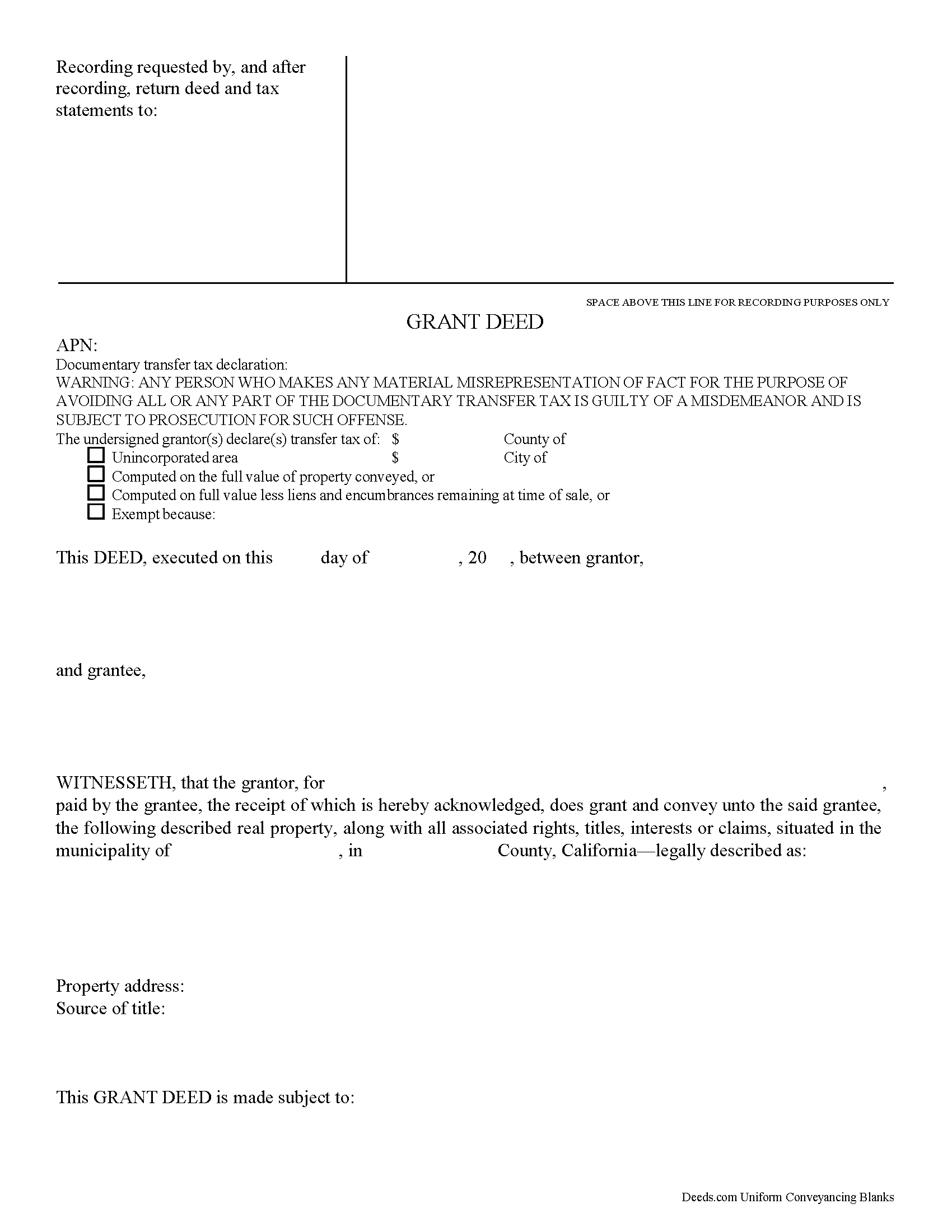
About the California Grant Deed
How to Use This Form
- Select your county from the list
- Download the county-specific form
- Fill in the required information
- Have the document notarized if required
- Record with your county recorder's office
What Others Like You Are Saying
"The form was very easy to fill out. The instructions were clear. Overall, a very user friendly produ…"
"Received the documents as ordered in a timely fashion. Can't ask for much better than that!"
"I received every form I requested, immediately upon payment. All forms were up to date and easy to e…"
"very professional"
"Very easy to use the service and responses came very quickly."
4.8/5 from 4,815 reviews. Read all
Most California real property changes hands on a grant deed, and the working part of the instrument is a single word. This form is the standard California grant deed: a present conveyance of real property from one or two individual owners to one or two new owners, arranged for recording with the county recorder of any California county. Its legal content comes from three short sections of the Civil Code rather than from pages of drafted warranties.
Two covenants riding on one word
Civil Code Section 1092 has supplied California's short deed form since the codes were adopted: I, AB, grant to CD all that real property situated in (county) County, State of California. When a conveyance passes a fee estate with the word grant, Civil Code Section 1113 implies two covenants from the grantor, and no others, unless the deed expressly restrains them: that the grantor has not previously conveyed the same estate or any interest in it to anyone else, and that the estate is free from encumbrances the grantor made or suffered. Civil Code Section 1106 completes the package with after-acquired title: a deed purporting to grant a fee simple passes any title the grantor later acquires, by operation of law. That combination is why California practice reaches for this instrument where other states reach for a warranty deed; the covenants attach by statute instead of being written out.
A first page the recording counter can process
California recorders read the top of page one before anything else, and this deed puts what they look for there. The documentary transfer tax declaration of Revenue and Taxation Code Sections 11932 and 11933 prints on the face: the amount due, a marked statement whether the tax was computed on the full value of the property or on full value less liens remaining at the time of sale, the city or unincorporated area where the land sits, and a signature block for the party determining the tax or that party's agent, since the recorder does not record a taxable deed until the tax is paid. Beneath it sits the mail tax statements entry of Government Code Section 27321.5, and above it the form reserves the statutory two and one half inches for recording information, with the requester, return address, and assessor parcel number entries in the left portion of that space where Government Code Section 27361.6 puts them.
The configuration this deed recites
The form identifies one or two natural-person grantors signing in their own capacity, in a free-form block that carries names and status wording exactly as the current title reads. The grantee section is free form as well: one or two names, followed by whatever vesting designation the parties supply, and the guide describes each form of co-ownership California recognizes, from tenancy in common to joint tenancy to community property with right of survivorship. Two grantor signature blocks follow, and a full Civil Code Section 1189 certificate of acknowledgment, boxed notice at its top, stands under each; a single conveying owner leaves the second block and its certificate blank. A sale closing between private parties, two spouses conveying the family home to a buyer pair who take title with a survivorship designation, and co-owners passing their whole interest to one new owner all present the one-or-two-grantor patterns this deed recites. The form is not set up as an entity or trustee conveyance and carries no attorney-in-fact signing blocks; a corporation, limited liability company, trustee, or agent under a power of attorney signs through a different configuration than this form prints.
What recording adds
Delivery is what moves title between the parties under Civil Code Section 1054, and recording is what protects it. California runs a race-notice system: an unrecorded conveyance is void against a later good-faith purchaser who records first under Civil Code Section 1214, so the deed is built to record cleanly the day it is signed, on letter pages with acknowledgment certificates the county recorder accepts under Government Code Section 27287.
The download contains the grant deed as a fillable PDF, a completed example recording a Sacramento County sale between two couples, and a plain language guide covering each numbered section, the signing rules for married owners, and the recording fees and companion filings. The materials describe the form and the statutes in general terms and are not legal advice; a California lawyer can apply these sections to a particular title and transfer.
Important: County-Specific Forms
Our grant deed forms are specifically formatted for each of the 58 counties in California.
After selecting your county, you'll receive forms that meet all local recording requirements, ensuring your documents will be accepted without delays or rejection fees.