Connecticut Trustee Deed
County Specific Legal Forms Validated as recently as October 9, 2026 by our Forms Development Team
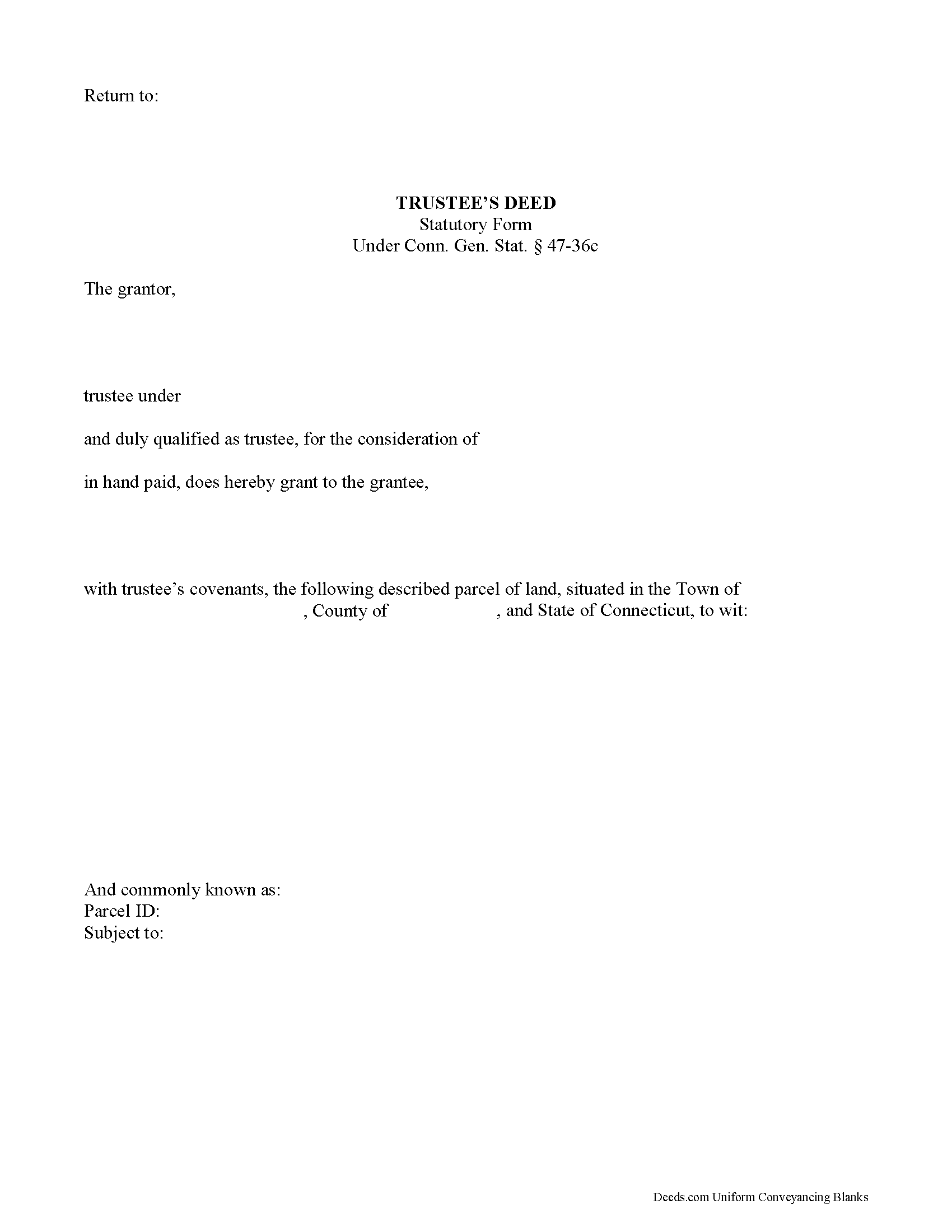
About the Connecticut Trustee Deed
How to Use This Form
- Select your county from the list
- Download the county-specific form
- Fill in the required information
- Have the document notarized if required
- Record with your county recorder's office
What Others Like You Are Saying
"Where have you been my whole life. I will join if I can afford it. Do you have a form for a Private …"
"Absolutely wonderful customer service. I am very pleased with the service I received and highly reco…"
"Was very helpful!"
"I wanted the Lady Bird Deed for my estate, and it was very easy to download, fill out and file. My c…"
"Thanks worked out great as the form was perfect and no problems filing it with the county."
4.8/5 from 4,824 reviews. Read all
The trustee's deed is a statutory conveyance under Section 47-36c of the Connecticut Statutes. Unlike other forms of conveyance, it is named for the person executing the deed rather than the type of deed it is.
Used in trust administration, the trustee's deed conveys real property out of a trust. Since trusts cannot legally hold title to property in Connecticut, the trustee holds title to real property as a representative of the trust. The trustee must be authorized by the trust instrument to hold the position of trustee and to act on the trust's behalf.
A basic trustee's deed will name the trust's original trustee as the grantor and vest title in the name of a grantee. Sometimes, the grantor appears as a successor trustee if the original trustee is unavailable, due to death, for example. Documentation evidencing the change in trustee must be recorded in the town's land records.
When correctly executed, the trustee's deed grants title in fee simple to the grantee with the following trustee's covenants, pursuant to Sec. 47-36s of the Statutes: (1) the trustee is duly qualified to act as trustee, (2) the trustee has full power and authority as trustee to bargain and sell the described premises in manner and form as set forth, and (3) the trustee and the trustee's successors shall warrant and defend the granted premises against all claims and demands of any person claiming by, from or under the trustee. Sometimes, a third party may request a declaration or certification of trust as proof of trustee's authority to transfer title.
As with all documents affecting real property, the trustee's deed should contain a legal description of the subject parcel. All trustees must sign the deed in the presence of a notary for a valid transfer. Two witness signatures are required (Conn. Gen. Stat. 47-5(a)(4)). In Connecticut, land records are recorded in the individual town where the property is located, and not at the county level.
Each case is unique, so contact an attorney with specific questions or for complex situations.
Important: County-Specific Forms
Our trustee deed forms are specifically formatted for each of the 8 counties in Connecticut.
After selecting your county, you'll receive forms that meet all local recording requirements, ensuring your documents will be accepted without delays or rejection fees.