Polk County Unconditional Waiver upon Final Payment Form
Last validated October 2, 2026 by our Forms Development TeamFormatted for recording in Polk County, for property anywhere in the county: rural and unincorporated areas as well as Alturas, Auburndale, Babson Park, Bartow, Bradley, Davenport, Dundee, Eagle Lake and 22 more.
- 3 documents included
- Immediate PDF download
- Formatting guarantee
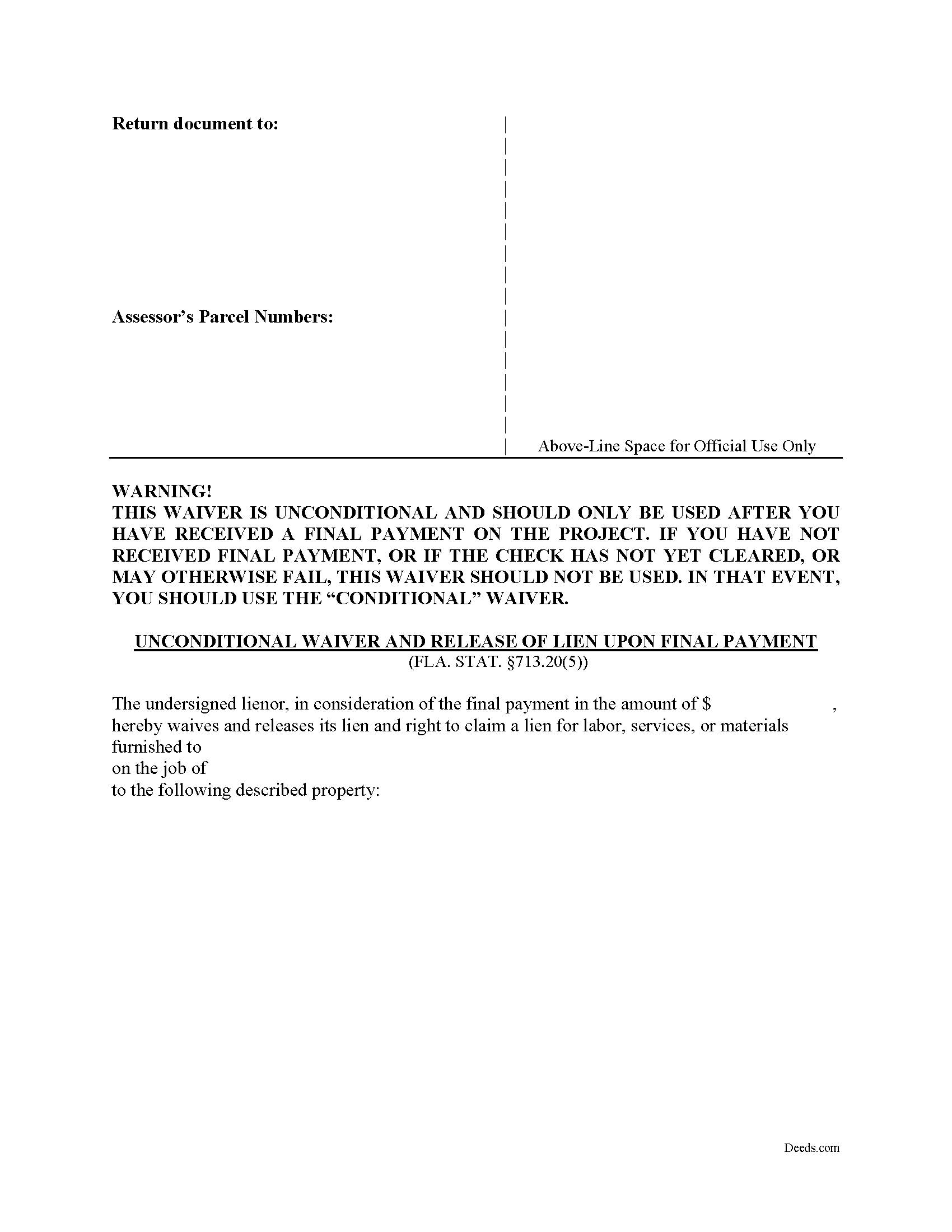
Polk County Unconditional Waiver upon Final Payment Form
Fill in the blank form formatted to comply with all recording and content requirements.
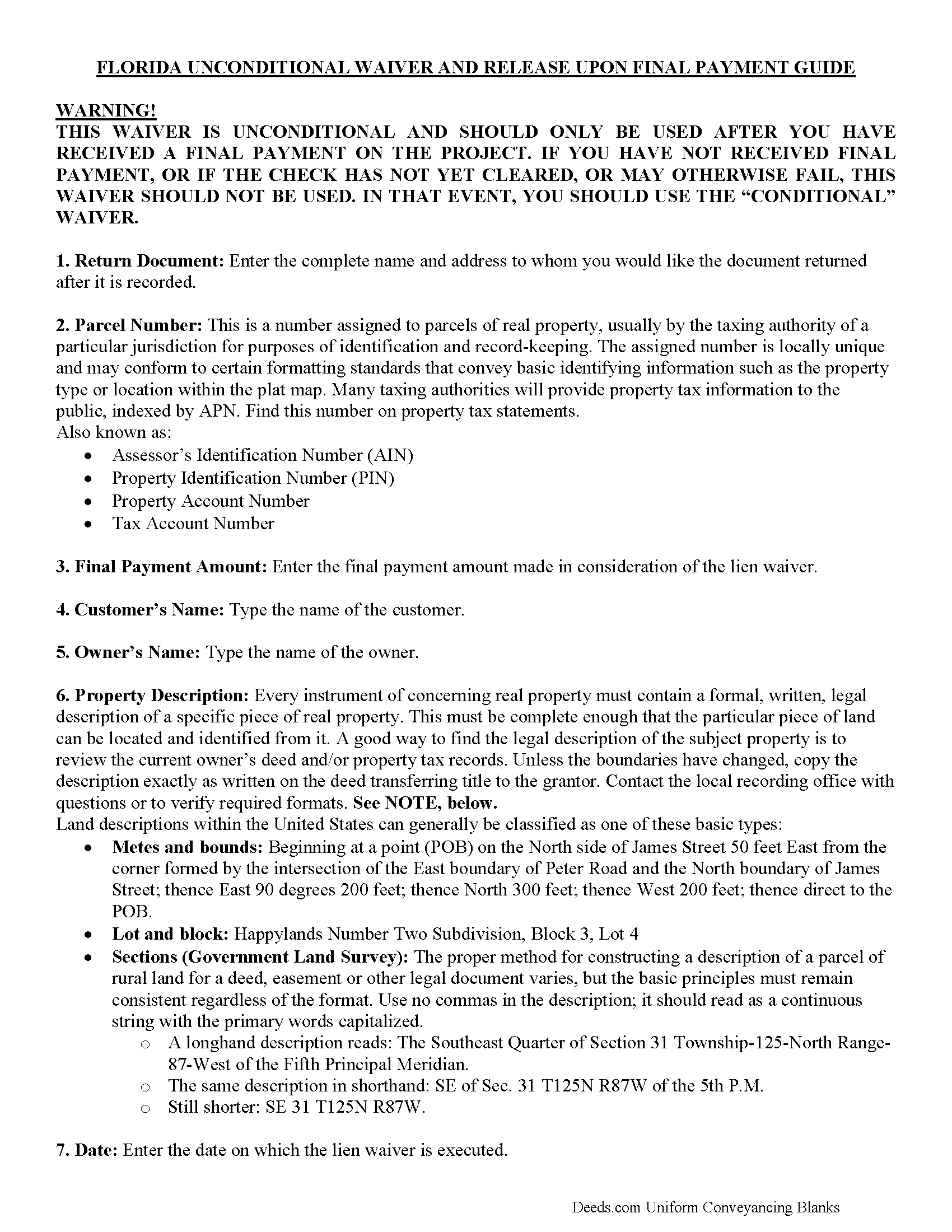
Polk County Unconditional Waiver upon Final Payment Guide
Line by line guide explaining every blank on the form.
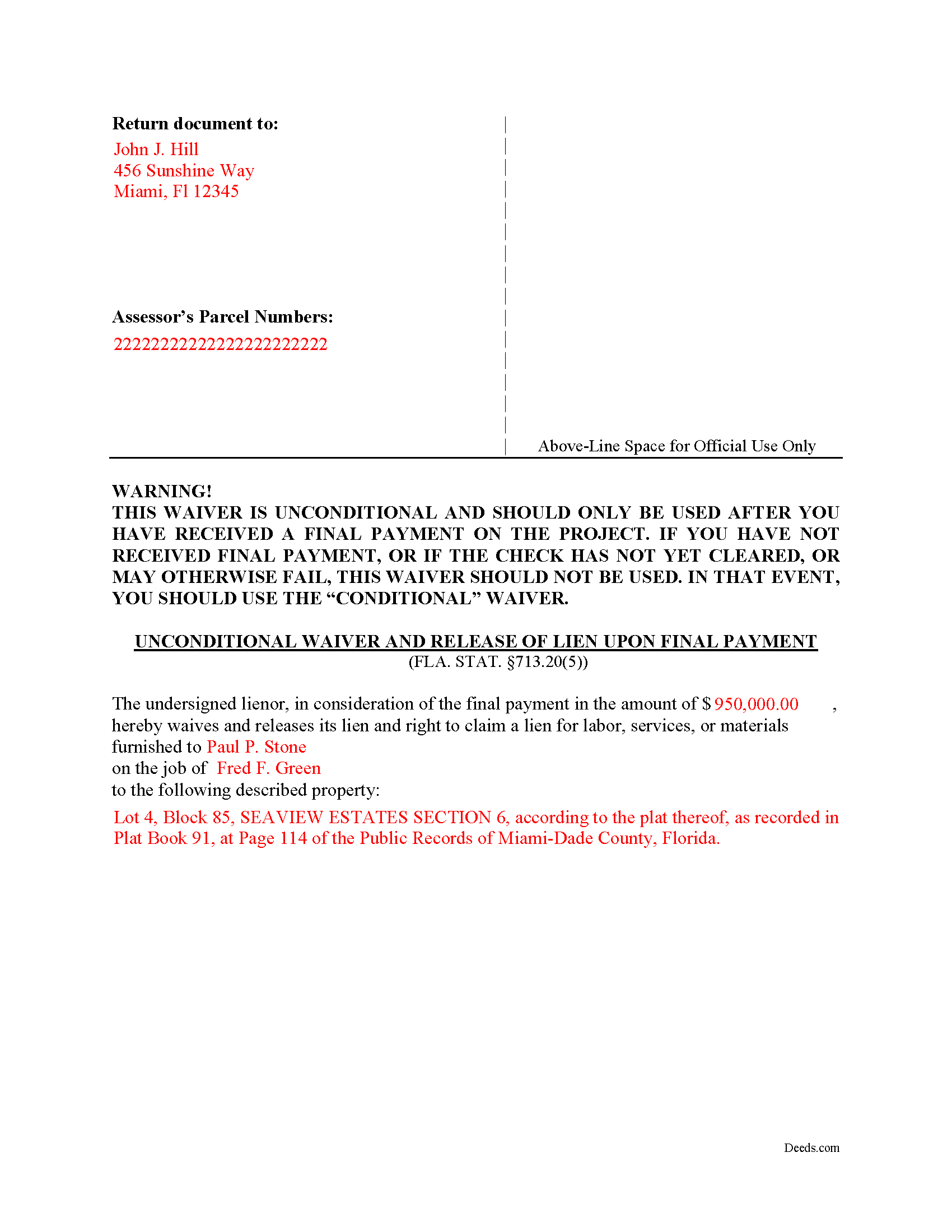
Polk County Completed Example of the Unconditional Waiver upon Final Payment Document
Example of a properly completed form for reference.
All 3 documents above included • One-time purchase • No recurring fees
Immediate Download • Secure Checkout
Additional Florida and Polk County documents included at no extra charge:
Where to Record Your Documents
Clerk of Circuit Court - Official Records
Bartow, Florida 33830
Hours: 8:00am - 5:00pm M-F
Phone: (863) 534-4516
Mail to: Clerk of Circuit Court - Official Records
Bartow, Florida 33831
Hours: for mailing purposes
Phone: N/A
Northeast Branch - NE Polk Co. Gov. Center
Winter Haven, Florida 33881
Hours: 8:00am - 5:00pm M-F
Phone: (863) 401-2400
Lakeland Branch
Lakeland, Florida 33801
Hours: 8:00am - 5:00pm M-F
Phone: (863) 603-6412
Recording Tips for Polk County:
- Bring your driver's license or state-issued photo ID
- Ensure all signatures are in blue or black ink
- White-out or correction fluid may cause rejection
- Ask about their eRecording option for future transactions
- Avoid the last business day of the month when possible
Cities and Jurisdictions in Polk County
Properties in any of these areas use Polk County forms:
- Alturas
- Auburndale
- Babson Park
- Bartow
- Bradley
- Davenport
- Dundee
- Eagle Lake
- Eaton Park
- Fort Meade
- Frostproof
- Haines City
- Highland City
- Homeland
- Indian Lake Estates
- Kathleen
- Kissimmee
- Lake Alfred
- Lake Hamilton
- Lake Wales
- Lakeland
- Lakeshore
- Loughman
- Mulberry
- Nalcrest
- Nichols
- Polk City
- River Ranch
- Waverly
- Winter Haven
Hours, fees, requirements, and more for Polk County
How do I get my forms?
Forms are available for immediate download after payment. The Polk County forms will be in your account ready to download to your computer. An account is created for you during checkout if you don't have one. Forms are NOT emailed.
Are these forms guaranteed to be recordable in Polk County?
Yes. Our form blanks are guaranteed to meet or exceed the applicable formatting requirements used for recording in Polk County, including margin requirements, font requirements, and other layout standards. This guarantee applies to formatting, not to the legal sufficiency of information entered by the user or the suitability of a form for a particular transaction.
Can I reuse these forms?
Yes. You can reuse the forms for your personal use. For example, if you have multiple properties in Polk County you only need to order once.
What do I need to use these forms?
The forms are PDFs that you fill out on your computer. The free Adobe Acrobat Reader is recommended, and most PDF apps also work. You do NOT enter your property information online - you download the blank forms and complete them privately on your own computer.
Are there any recurring fees?
No. This is a one-time purchase. Nothing to cancel, no memberships, no recurring fees.
How much does it cost to record in Polk County?
Recording fees in Polk County vary. Contact the recorder's office at (863) 534-4516 for current fees.
Questions answered? Let's get started!
The Florida Unconditional Waiver upon Final Payment is the closeout document for a Florida construction project under section 713.20 of the Florida Statutes. It is the most consequential of the four statutory waiver forms because, on signing, the lienor releases all remaining lien rights against the property — for every category of labor, services, and materials furnished — and the release takes effect immediately, whether or not the final payment is actually received. Florida codified the unconditional final waiver to give owners, contractors, and construction lenders a clean instrument they can rely on at job close, and to give title insurers the documentary basis they need to issue policies free of construction lien exceptions. For the lienor, signing an unconditional final waiver is the act that closes the door on chapter 713 remedies for the project.
What the Florida Unconditional Waiver upon Final Payment Does
This form is delivered by a lienor at the conclusion of a construction project to release all remaining lien rights against the property in exchange for the final payment. "Unconditional" means the release is effective on signing, without regard to whether the final payment is actually received. "Final" means the waiver is not tied to a single billing or progress draw — it covers the lienor's entire contribution to the project. The most common use is at closeout, when the owner or lender is funding the last disbursement and needs documentation that no party in the chain of contractors and suppliers retains lien rights against the property.
Florida Statutory Requirements Under Section 713.20
Florida is unusual in legislating the exact wording of construction lien waivers. Section 713.20 lays out four statutory waiver forms — conditional or unconditional, progress or final — and requires that any waiver "substantially follow" the form for the scenario it addresses. The statute supplies the unconditional, total release language that gives this form its closing force. Substituting a generic release, or modifying the statutory text in ways that change its meaning, can prevent the document from being treated as a section 713.20 unconditional final waiver — which in turn can leave the parties arguing about whether lien rights actually remain.
The form must identify the lienor, the customer, the property owner, and the property — typically by parcel identifier and legal description (§ 713.20). Unlike the progress payment versions, the final payment forms do not require a "through date," because the waiver covers the lienor's entire involvement in the project.
Execution: No Witnesses, No Notary Required
Section 713.20 waivers do not require witnesses, notarization, or an acknowledgment. The lienor signs and dates the form. Many construction lenders and title companies nonetheless require a notarized unconditional final waiver as a matter of underwriting practice — the document is doing significant work at closeout, and counterparties want the additional layer of identity verification a notary provides. A notarized waiver remains effective; the notary is simply not a statutory prerequisite.
Florida-Specific Traps
The unconditional final waiver is the single most dangerous lien waiver a Florida contractor or supplier can sign. Several issues regularly cause problems:
- It is truly final. Once signed, the lienor has no remaining construction lien rights against the property for the project. There is no implied "the rest is for retainage" carveout, no implied exception for change orders, no implied reservation for warranty work — unless the lienor writes the carveout into the form and the parties agree to it.
- Retainage exposure. Owners and general contractors typically hold back retainage until well after substantial completion. A lienor who signs an unconditional final waiver before retainage is paid has released the lien rights that protect that retainage. The conditional final waiver is the standard alternative when retainage is still outstanding.
- Punch list and warranty work. A waiver signed before all corrective and punch list work is complete may sweep in unbilled labor and materials. If additional work is required after the final waiver is delivered, the lienor may have contract remedies but no construction lien remedy.
- Unbilled change orders and extras. Any extra work the lienor has performed but not yet invoiced — change order extras, time and material tickets, stored materials in transit — falls under the unconditional release if the form is signed before those items are billed and resolved.
- Advance waivers are void. Florida law prohibits waiving lien rights for work not yet performed (§ 713.20). A final waiver signed before the lienor has actually completed its work cannot release rights for that future work.
- Unconditional means unconditional. If the final check is dishonored after the waiver is delivered, the lienor's lien rights are gone. The lienor is left to chase a contract claim and any guaranty or surety remedies — chapter 713 has been waived.
- Notice of Termination interaction. When an owner records a Notice of Termination under section 713.132, lien rights for further work are cut off on a defined timeline. A lienor signing an unconditional final waiver near the end of a project should confirm that any post-termination work has been billed and resolved before executing.
- "Substantially follow" still applies. A reworded unconditional final waiver that does not substantially follow the statutory form may not qualify as a section 713.20 waiver. That ambiguity is exactly the opposite of what the document is supposed to deliver, and is a frequent source of dispute when owners or lenders accept non-statutory closeout releases.
How the Waiver Is Used
The unconditional final waiver is not recorded in the county's official records. It is delivered to the owner, general contractor, construction lender, or title company at closeout, and is retained as part of the project closing file. Title insurers underwriting an owner's or loan policy after construction frequently require unconditional final waivers from every lienor in the chain in order to issue the policy without a construction lien exception. Construction lenders use the document to authorize the final disbursement and to close out the construction loan.
Download Package
The download package includes the Florida Unconditional Waiver upon Final Payment, drafted to follow the statutory wording at section 713.20, a completed example showing how each field is filled in, and a guide explaining the form's role at closeout, the statutory framework, and how it compares to the other three statutory waiver scenarios. The forms are prepared by Deeds.com's forms development team and are delivered as instant downloads.
Important: Your property must be located in Polk County to use these forms. Documents should be recorded at the county recording office listed above.
This Unconditional Waiver upon Final Payment meets all recording requirements specific to Polk County.
Our Promise
The documents you receive here are guaranteed to meet or exceed the applicable Polk County recording format requirements. If there is a rejection caused by our formatting, we will correct the issue or refund your payment. This guarantee applies to document formatting only and does not extend to information entered by the user, the selection of the form, or the legal effect of the completed document.
Save Time and Money
Get your Polk County Unconditional Waiver upon Final Payment form done right the first time with Deeds.com Uniform Conveyancing Blanks. At Deeds.com, we understand that your time and money are valuable resources, and we don't want you to face a penalty fee or rejection imposed by a county recorder for submitting nonstandard documents. We constantly review and update our forms to meet rapidly changing state and county recording requirements for roughly 3,500 counties and local jurisdictions.
4.8 out of 5 - ( 4,828 Reviews )
Joan H. 5 out of 5 stars
I am happy I can record this this way.
Thank you!
Kay C. 5 out of 5 stars
that worked great I like to see what I'm filling out and the extra info is really helpful..
Thank you!
Holly M. 5 out of 5 stars
This was the simplest method of filing a document that I've ever encountered. I've already recommended it my colleagues, and would highly encourage anyone to use it. Fast, easy, simple.
We appreciate your business and value your feedback. Thank you. Have a wonderful day!
Cynthia S. 5 out of 5 stars
Great service got everything I needed with a click of a tab. Thank You...
Thank you for your feedback. We really appreciate it. Have a great day!
Byron M. 5 out of 5 stars
Very easy to sign up. Very quick to respond for payment once uploaded. Great communication. More expensive than other recording services.
Thank you for your feedback. We really appreciate it. Have a great day!
JOHN B. 3 out of 5 stars
Process of acquiring an account and submitting a document was VERY easy. Failure was on the Recorders office, for not accepting the survey. Cheers.
Thank you!
Melvin F. 5 out of 5 stars
Was a little frustrated first using your site, but due to my mental state, I expected that! Got what I needed, thank you very much.
Thank you for your feedback. We really appreciate it. Have a great day!
catheirne o. 5 out of 5 stars
Easy to use!
Thank you!
Maxwell G. 5 out of 5 stars
I am so very happy with the service provided by Deeds.com. The process was simple and saved me a lot of time by not having to go to the courthouse, wait in line, and waste a big part of my day. In addition, the cost is a lot less than I expected. I highly recommend this service.
Your feedback is greatly appreciated. Thank you for taking the time to share your experience!
Danny A. 5 out of 5 stars
This app is a fast and convenient way to download documents you need.
Thank you!
Allen O. 5 out of 5 stars
The website was easy to use and the forms will guide me as our family sells interest in property to other family members in Central New York.
Thank you for your feedback. We really appreciate it. Have a great day!
Roy K. 5 out of 5 stars
Just what we were looking for. Very easy to fill out. Thanks
Thank you Roy. We appreciate your feedback.
Casey W. 5 out of 5 stars
Excellent service, quick and right to the point, without a monthly subscription! Perfect for filers of single documents! Thanks!
Thank you for your feedback. We really appreciate it. Have a great day!
Jubal T. 5 out of 5 stars
This is the most comprehensive, helpful real estate tool I have seen. I was at first worried because the 330# didn’t have live operators but I received messages in my account as quickly as a conversation had by text and was able to download a deed and record it the same day in a county 1,300 miles away. Highly recommended!
We are sincerely grateful for your feedback and are committed to providing the highest quality service. Thank you for your trust in us.
Patrick S. 5 out of 5 stars
Excellent!
Thank you!