Georgia Transfer on Death Deed (Two Owners as Tenants in Common or Married Couple)
County Specific Legal Forms Validated as recently as October 21, 2026 by our Forms Development Team
About the Georgia Transfer on Death Deed (Two Owners as Tenants in Common or Married Couple)
How to Use This Form
- Select your county from the list
- Download the county-specific form
- Fill in the required information
- Have the document notarized if required
- Record with your county recorder's office
What Others Like You Are Saying
"Deeds.com had what I needed at the time that I needed it. Thank you very much."
"I LOVE THE EASE OF GETTING THE INFORMATION I REQUESTED. YOUR SERVICE IS MORE THAN WHAT I EXPECTED."
"thanks for providing my with exactly what I needed, almost instantly!"
"This was so easy and seemless. I wish I had found deeds.com for eRecording sooner! I submitted my do…"
"Very quick and painless process!"
4.8/5 from 4,830 reviews. Read all
Two Georgia co-owners who hold as tenants in common own two separate undivided interests, and a transfer on death deed signed by both of them runs on two separate clocks: each owner's half passes to the named beneficiary at that owner's death, not at the second death. This form prepares that deed for exactly two record owners under O.C.G.A. § 44-17-1 through § 44-17-7, on the statutory form of § 44-17-3, and it is the configuration a Georgia married couple presents whenever the vesting deed names both spouses without survivorship language.
Two undivided interests, two deaths
A tenancy in common is Georgia's default co-ownership under O.C.G.A. § 44-6-120, and under § 44-6-190 a right of survivorship exists only where the deed says so in express words. The transfer-on-death chapter treats each tenant in common as the record owner of that owner's own interest, which § 44-17-1(1) defines broadly enough to reach an undivided half. The deed therefore states, in a fixed paragraph after the legal description, that the interest each Grantor conveys on death is that Grantor's undivided interest, that it transfers on the death of that Grantor, and that ownership passes to Grantee upon the acceptance affidavit § 44-17-2 describes. The § 44-17-6 rule that holds a joint owner's designation until the last joint owner dies plays no part here, because the Grantors are not joint tenants.
What a married couple sees after the first death
When the first Grantor dies and the beneficiary records an acceptance affidavit with the death certificate attached, the beneficiary becomes a tenant in common with the surviving Grantor: a child named as Grantee holds an undivided interest beside the surviving parent, whose own half passes under the same deed only at that parent's later death, on a second acceptance. Georgia recognizes neither community property nor tenancy by the entirety in real property, and § 53-1-3 abolishes dower and curtesy, so the married-couple pattern and the ordinary tenancy-in-common pattern are one and the same on the record.
The configuration on the page
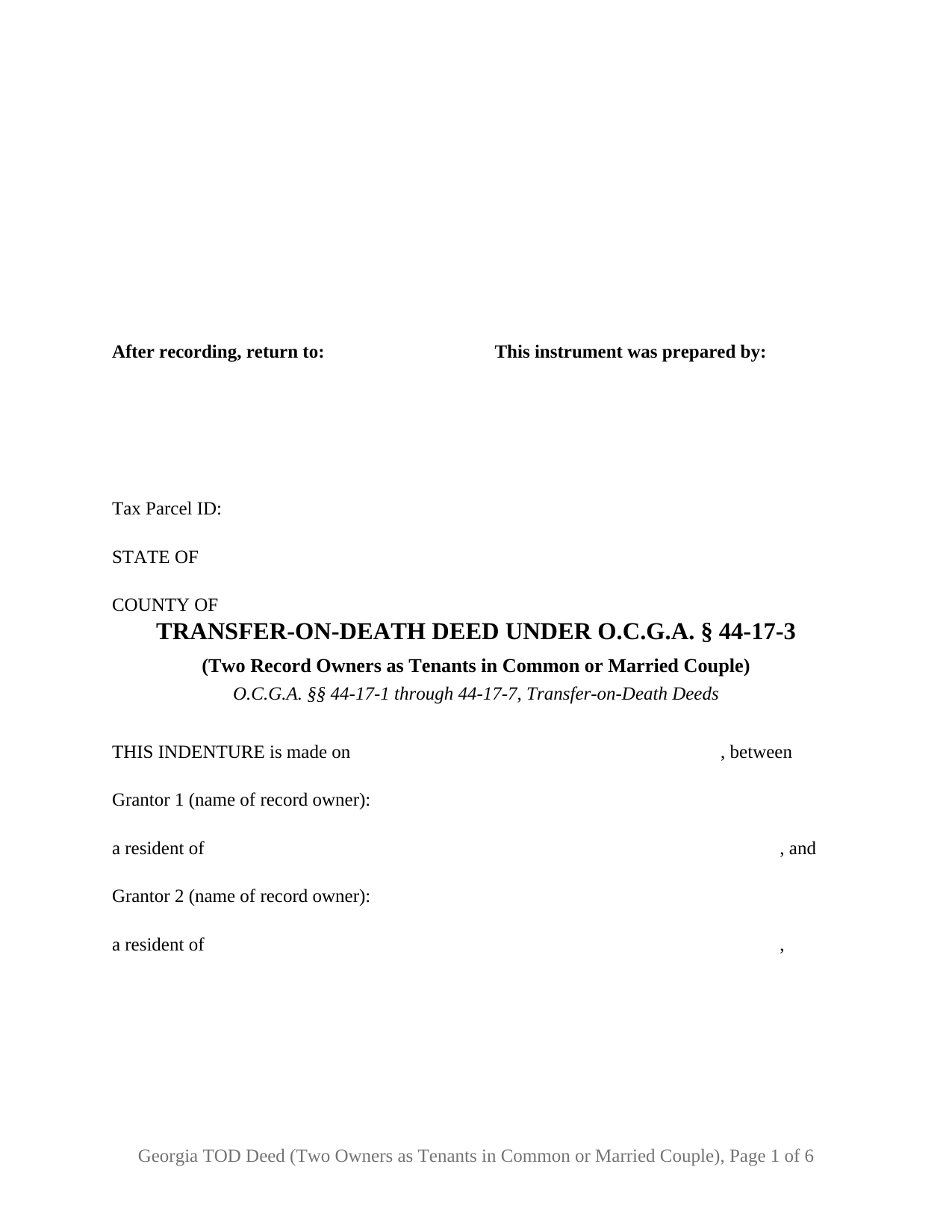
The deed recites exactly two record owners. Two Grantor entries open the indenture in the style of the statutory form, each with a name and place of residence, followed by the Grantee entry, an optional alternate-beneficiary entry under § 44-17-2(a)(5)(A), a fixed recital that the two hold as tenants in common and not as joint tenants with right of survivorship, and a line for the vesting instrument. The granting sentence and the capitalized limitation notice are the statute's own, word for word. Both Grantors sign on lines carrying the form's (SEAL) notation, and because Georgia deeds are attested rather than acknowledged, each signature is followed by its own unofficial witness block and its own attestation certificate with a reserved area for the notary seal. Spouses whose deed names both of them with no survivorship words, two heirs who each received an undivided half of a parent's land, and two unmarried co-purchasers who took title without survivorship language present the pattern this deed recites. A sole record owner, two owners holding with an express right of survivorship, a trustee or entity owner, and three or more co-owners are configurations the form is not set up as.
Recorded before death, accepted after it
Section 44-17-3 gives the deed its effect only when it is executed, attested, and placed of record with the superior court clerk of the county where the real estate sits, before the record owner dies; recording while both owners live puts both designations of record. The owners' recording carries no PT-61 under § 44-17-2(a)(7), while the beneficiary's acceptance filing after a death does. Until then each Grantor keeps everything: § 44-17-7 leaves each record owner the legal and equitable owner of that owner's interest, a recorded revocation instrument or a later transfer-on-death deed revokes the designation, a sale of the interest revokes it under § 44-17-4(d), and a will does not revoke it at all. The acceptance affidavit and any revocation instrument are separate instruments, prepared at their own time and not included in this package.
The first page leaves the three inches O.C.G.A. § 15-6-61(a)(10) reserves for the clerk and places the § 44-2-14(b) return block as the first content below it. The download is the fillable deed, a completed example built on a Gwinnett County fact pattern, and a plain-language guide covering each entry, the attestation formalities, and both recording steps; the materials are informational and are not legal advice.
Important: County-Specific Forms
Our transfer on death deed (two owners as tenants in common or married couple) forms are specifically formatted for each of the 159 counties in Georgia.
After selecting your county, you'll receive forms that meet all local recording requirements, ensuring your documents will be accepted without delays or rejection fees.