Georgia Transfer on Death Deed
County Specific Legal Forms Validated as recently as October 21, 2026 by our Forms Development Team
About the Georgia Transfer on Death Deed
How to Use This Form
- Select your county from the list
- Download the county-specific form
- Fill in the required information
- Have the document notarized if required
- Record with your county recorder's office
What Others Like You Are Saying
"Good after I figured out the form process. Hopefully I won't be charged for two as I redid the reque…"
"I like the content and the availability to conduct valuable business online"
"Received the quit claim form as ordered. Seemed clear and concise, easy to follow instructions and t…"
"Seems to be just what I needed. I will certainly keep your services handy in the future. I will reco…"
"I was very pleased and satisfied with the ease of use, expeditious turnaround and costs involved to …"
4.8/5 from 4,829 reviews. Read all
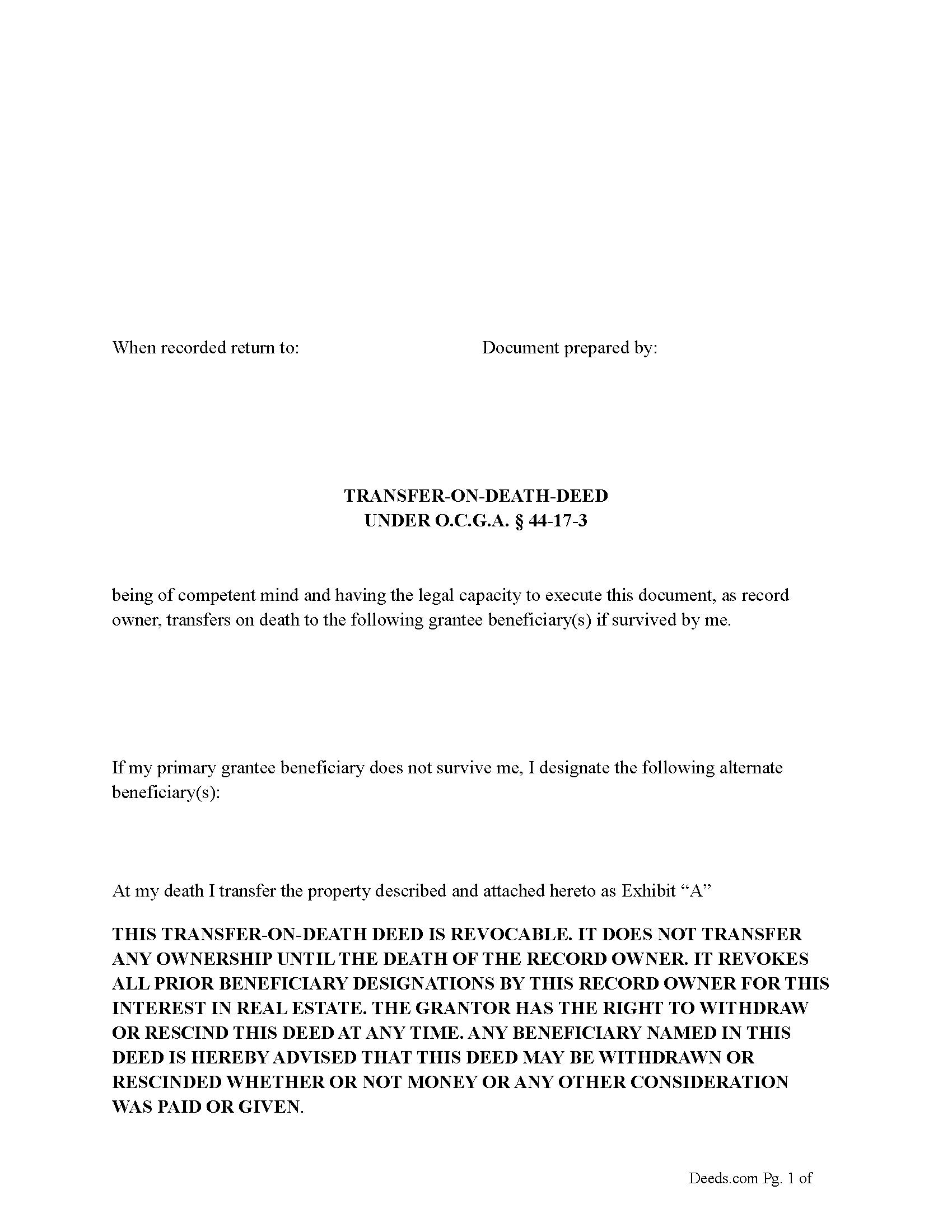
Georgia wrote its transfer on death deed into the statute line by line, and this product is that form: the deed O.C.G.A. § 44-17-3 prints, from the AFTER RECORDING, PLEASE RETURN TO caption at its head to the attestation block at its foot, prepared for one or two Georgia record owners naming one or more grantee beneficiaries. Searched for as a Georgia beneficiary deed or TOD deed, the instrument is the transfer-on-death deed of Chapter 17 of Title 44, here in its base configuration.
The words the statute chose
Section 44-17-3 does not describe the deed; it reproduces it, and a deed in substantially that form, executed, attested, and recorded before the record owner dies, is what titles an interest in transfer-on-death form. This form carries the statute's elements in the statute's order: the indenture opening between Grantor and Grantee, the granting sentence that conveys and confirms on death, a habendum in fee simple subject to the capitalized limitation notice, the warranty limited to persons claiming by, under, or through the Grantor, the testimonium, two (SEAL) signature lines, and the closing block headed Signed, sealed, declared and delivered in the presence of. The house adds only what the form leaves open: a tax parcel line, mailing address blocks, an alternate-beneficiary entry under § 44-17-2(a)(5)(A), and the clerk's three inch reserve under § 15-6-61(a)(10).
One or two owners, written in by the owner
The Grantor block is free-form, and that is the point of the base configuration. The form preprints nothing about marital status, how title is held, or capacity; the owner or owners write their own names and residences into the block, in the style of the statutory form. Four count patterns appear within it: one record owner designating one beneficiary or several, and two record owners designating one or several. Two signature blocks follow, OWNER and SECOND OWNER (if applicable), each with its own unofficial witness line and its own officer certificate, so a one-owner deed leaves the second set blank. The form is not set up as an entity or trustee owner, as an owner signing through an attorney in fact (a signature § 44-17-2(a)(3) does not permit), or as three or more owners on one instrument.
Where two owners sign, Chapter 17 decides the timing from the vesting deed. O.C.G.A. § 44-17-1(2) defines a joint owner as a joint tenant with right of survivorship, and § 44-17-6 postpones a joint owner's transfer until the last joint owner dies, leaving the joint tenancy unsevered; two owners who hold as tenants in common are each the record owner of an undivided interest that passes at that owner's own death. The form fixes neither reading; the record does.
Any beneficiary the chapter allows
The Grantee block is as broad as the statute. A natural person is named in full; a trust takes through its trustee, named as grantee beneficiary under § 44-17-2(a)(5)(B); an entity is named by its registered legal name. Where several grantee beneficiaries are named, Georgia's general co-ownership rules supply the shares, equal tenancy in common under § 44-6-120 unless the deed uses the survivorship words of § 44-6-190, and § 44-17-5(b) splits a lapsed share evenly among the remaining designated beneficiaries living at the record owner's death.
Attested, not acknowledged, and recorded twice
A Georgia deed is signed in the presence of an officer named in O.C.G.A. § 44-2-15, in ordinary practice a notary public, and one other witness, under § 44-5-30; the certificate on this form is captioned ATTESTATION for that reason, with a reserved area for the seal § 45-17-6(a)(1) requires. The owner's recording, with the clerk of superior court of the county where the land lies and before death, carries a $25 fee under § 15-6-77(f) and no PT-61, since § 44-17-2(a)(7) says none is filed with the owner's deed. The transfer itself waits for a second filing: after the death, the grantee beneficiary records the acceptance affidavit § 44-17-2 describes, with the death certificate and a PT-61, and the section as rewritten by 2026 Act 379 sets no deadline for it. That affidavit and any revocation instrument are prepared separately at their own time and are not included in this package.
The download delivers the fillable deed formatted to Georgia recording standards, a completed example built on a Cherokee County fact pattern, and a plain-language guide to every entry, the attestation formalities, and both recordings; the materials are informational and are not legal advice.
Important: County-Specific Forms
Our transfer on death deed forms are specifically formatted for each of the 159 counties in Georgia.
After selecting your county, you'll receive forms that meet all local recording requirements, ensuring your documents will be accepted without delays or rejection fees.