Georgia Transfer on Death Deed (Trust Beneficiary)
County Specific Legal Forms Validated as recently as October 21, 2026 by our Forms Development Team
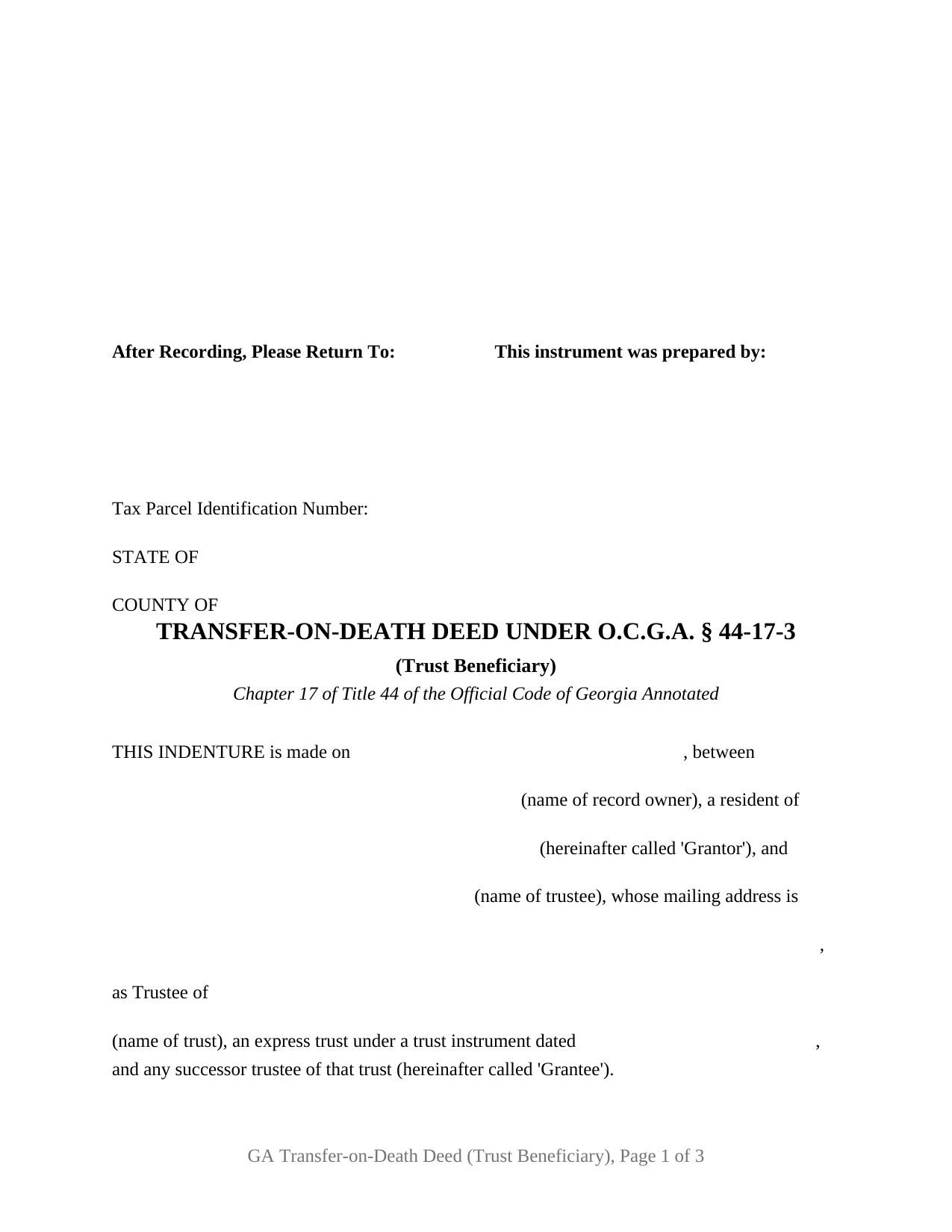
About the Georgia Transfer on Death Deed (Trust Beneficiary)
How to Use This Form
- Select your county from the list
- Download the county-specific form
- Fill in the required information
- Have the document notarized if required
- Record with your county recorder's office
What Others Like You Are Saying
"The staff of DEEDS.COM is in a class of excellence all by themselves! From my own personal experienc…"
"It was easy to find what I needed but I thought the price was too high."
"I was very satisfied with your service. Prompt, and thorough. Price was reasonable. Will use your se…"
"Faster AND less expensive than recording in person. Will be using again (and not just because of COV…"
"Deeds.com was an amazing experience. They made it so easy and stress free. The agent I worked with w…"
4.8/5 from 4,831 reviews. Read all
A Georgia transfer on death deed can name a trust as the party who takes the real estate at the owner's death, and the statute says how: O.C.G.A. § 44-17-2(a)(5)(B) lets the record owner convey the beneficiary interest to an express trust by naming the trustee as the designated grantee beneficiary. This form prepares that deed on the statutory form of § 44-17-3 for one record owner naming one trustee. Searched as a beneficiary deed or TOD deed to a trust, the Georgia instrument is the transfer-on-death deed of Chapter 17 of Title 44, here with a trustee in the beneficiary's place.
The trustee takes, the trust holds
The Grantee line names a person or an institution in a capacity: a named trustee, as Trustee of a named express trust under a trust instrument of a stated date, with the trustee's mailing address, and any successor trustee of that trust. Those words are fixed deed text. A recital following the property description states that the deed conveys the beneficiary interest to the trust by naming its trustee, and that the deed does not create or declare an express trust, the limit § 44-17-2(a)(6) places on the instrument. The trust exists before the deed does, as a signed writing under O.C.G.A. § 53-12-20, and the trust instrument, not the deed, governs who serves as trustee, who succeeds, and how the land is held or distributed afterward.
Two acts the 2026 amendment tells apart
Georgia's 2026 amendments (Act 379, HB 413, effective April 22, 2026) added § 44-17-4(d), under which a transfer-on-death deed is rendered revoked where the record owner conveys the interest to a trustee of the record owner's express trust before death. That provision describes a lifetime deed into the trust, the ordinary funding conveyance; this form performs the different act of naming the trustee as beneficiary while the owner keeps title. The owner remains the legal and equitable owner under § 44-17-7, free to sell, mortgage, or lease, and under § 44-17-2(b) no signature, consent, or notice of the trustee is required during the owner's life.
What the trustee records after the death
Nothing passes to the trust automatically. Under § 44-17-2(c), ownership transfers upon the trustee's execution and recording of an acceptance affidavit, with the death certificate attached, in the same superior court clerk's office, and subsection (c)(2) names a trustee among those who may accept. Until that recording the interest remains part of the deceased owner's estate. The affidavit is prepared after the death and is not included in this package; the amended section states no deadline for it.
One signature line, one trustee line
The deed carries one record owner as Grantor, one Grantor signature line with the seal notation the statutory form prints, one unofficial witness block, and one officer attestation certificate; the trustee does not sign, and no alternate beneficiary line exists, because the trust instrument rather than the deed supplies what happens next. A settlor naming the trustee of the settlor's own revocable living trust so the homeplace joins the trust estate at death without a lifetime conveyance, and a parent naming the trustee of a trust established for a child, present the pattern this deed recites. A designation naming a natural person, a designation dividing the interest among several beneficiaries, and a deed signed by two co-owners who hold with survivorship each follow a different pattern; this form recites one owner and one trustee, and a trust with two or more co-trustees is not expressed on its single trustee line.
Georgia form, Georgia execution
The instrument reproduces the § 44-17-3 form from its return caption through the granting words that convey and confirm on death, the capitalized limitation notice, the limited warranty, and the Signed, sealed, declared and delivered execution block. An officer named in § 44-2-15 and one other witness attest the owner's signature under § 44-5-30, and under § 44-17-2(a)(3) an attorney in fact may not sign for the owner. Recording with the clerk of superior court of the county where the land lies, before the owner's death, is part of titling the interest in transfer-on-death form, and under § 44-17-2(a)(7) no PT-61 transfer tax declaration accompanies the owner's recording.
The package delivers the fillable deed, a completed example on a Gwinnett County fact pattern in which the trustee of a family trust is named, and a plain-language guide to each entry, the Georgia attestation formalities, and both recordings; the materials are informational and are not legal advice.
Important: County-Specific Forms
Our transfer on death deed (trust beneficiary) forms are specifically formatted for each of the 159 counties in Georgia.
After selecting your county, you'll receive forms that meet all local recording requirements, ensuring your documents will be accepted without delays or rejection fees.