Hancock County Quitclaim Deed (Trustee Grantor) Form
Last validated September 11, 2026 by our Forms Development TeamFormatted for recording in Hancock County, for property anywhere in the county: rural and unincorporated areas as well as Augusta, Basco, Bowen, Carthage, Colusa, Dallas City, Elvaston, Ferris and 8 more.
- 3 documents included
- Immediate PDF download
- Formatting guarantee
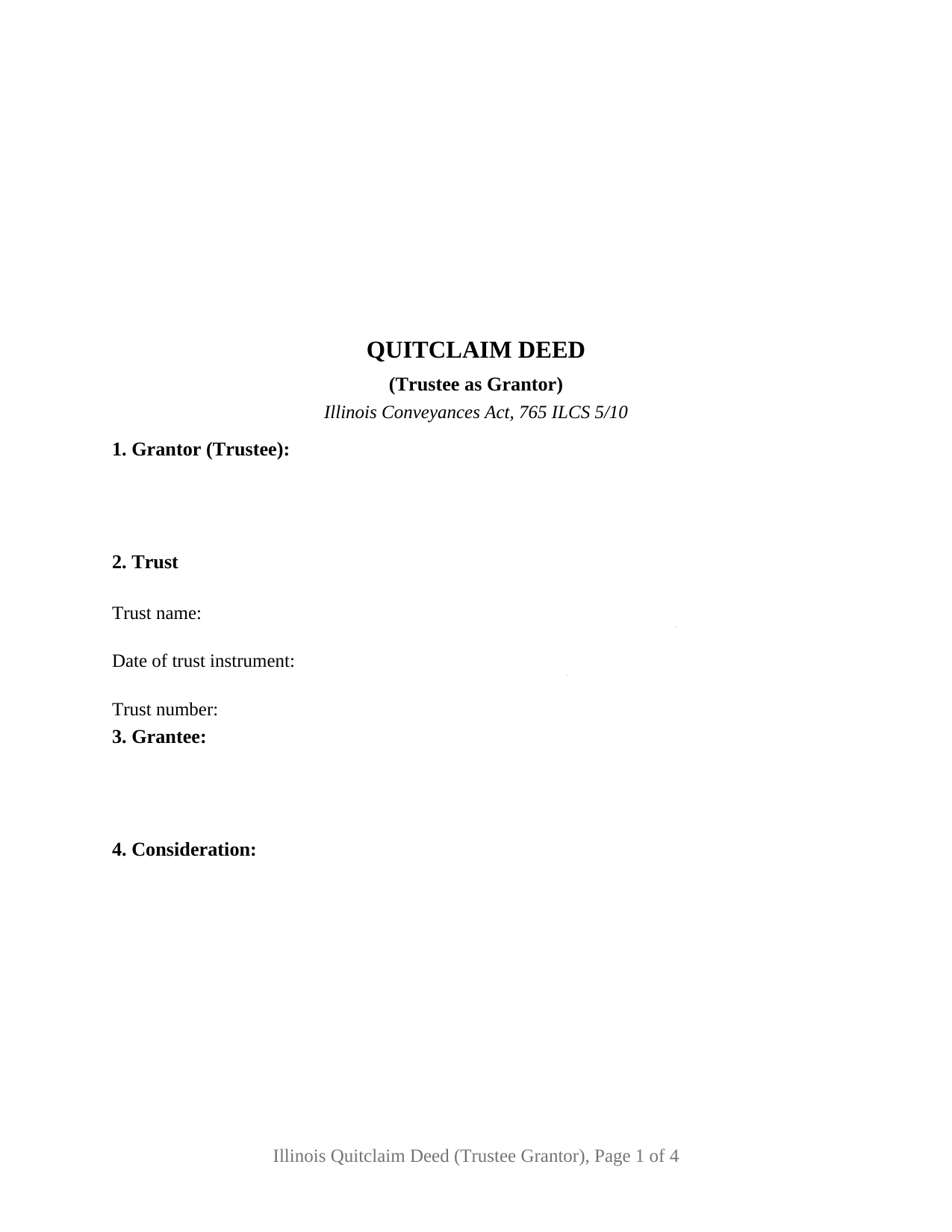
Hancock County Quitclaim Deed (Trustee Grantor) Form
Fill in the blank Quitclaim Deed (Trustee Grantor) form formatted to comply with all Illinois recording and content requirements.
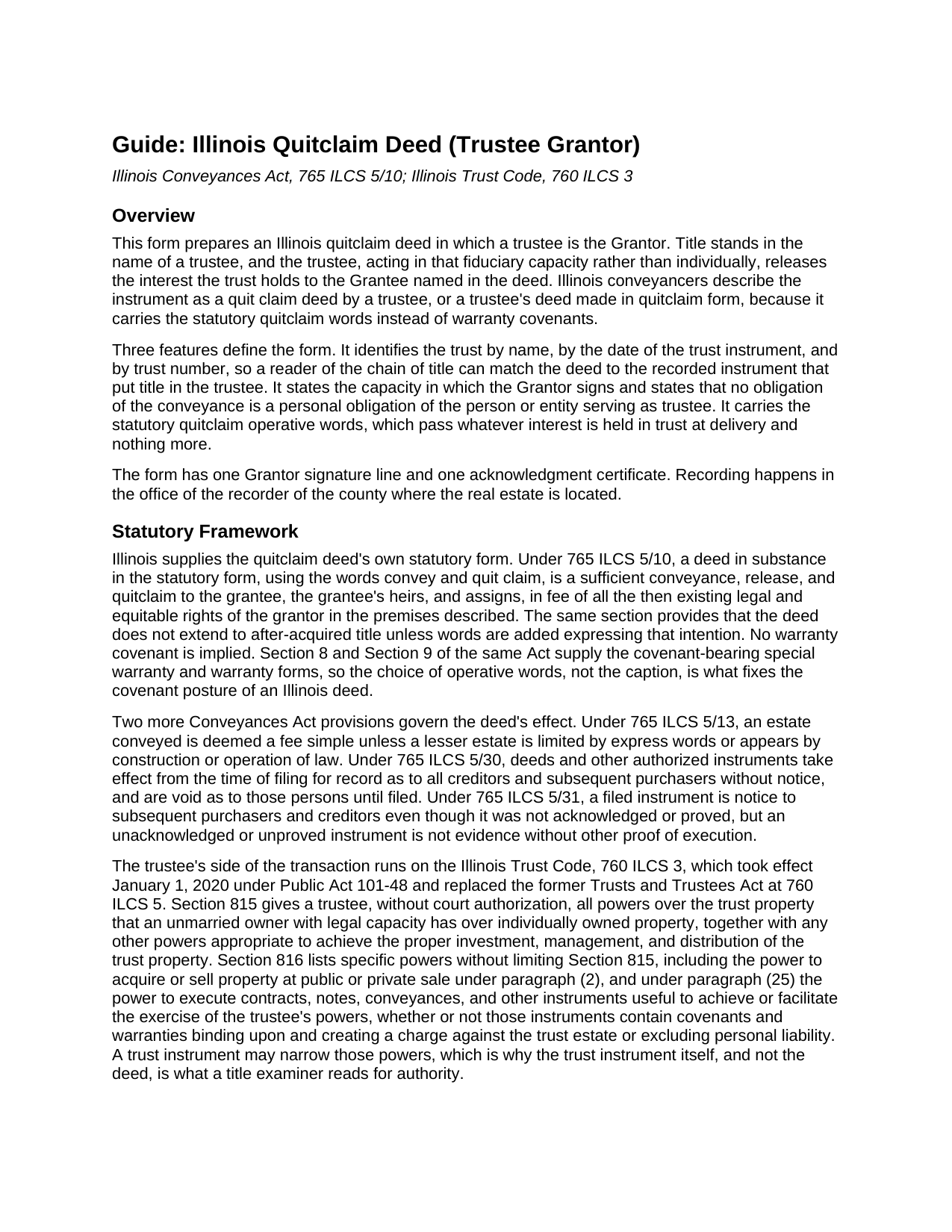
Hancock County Quitclaim Deed (Trustee Grantor) Guide
Line by line guide explaining every blank on the Quitclaim Deed (Trustee Grantor) form.
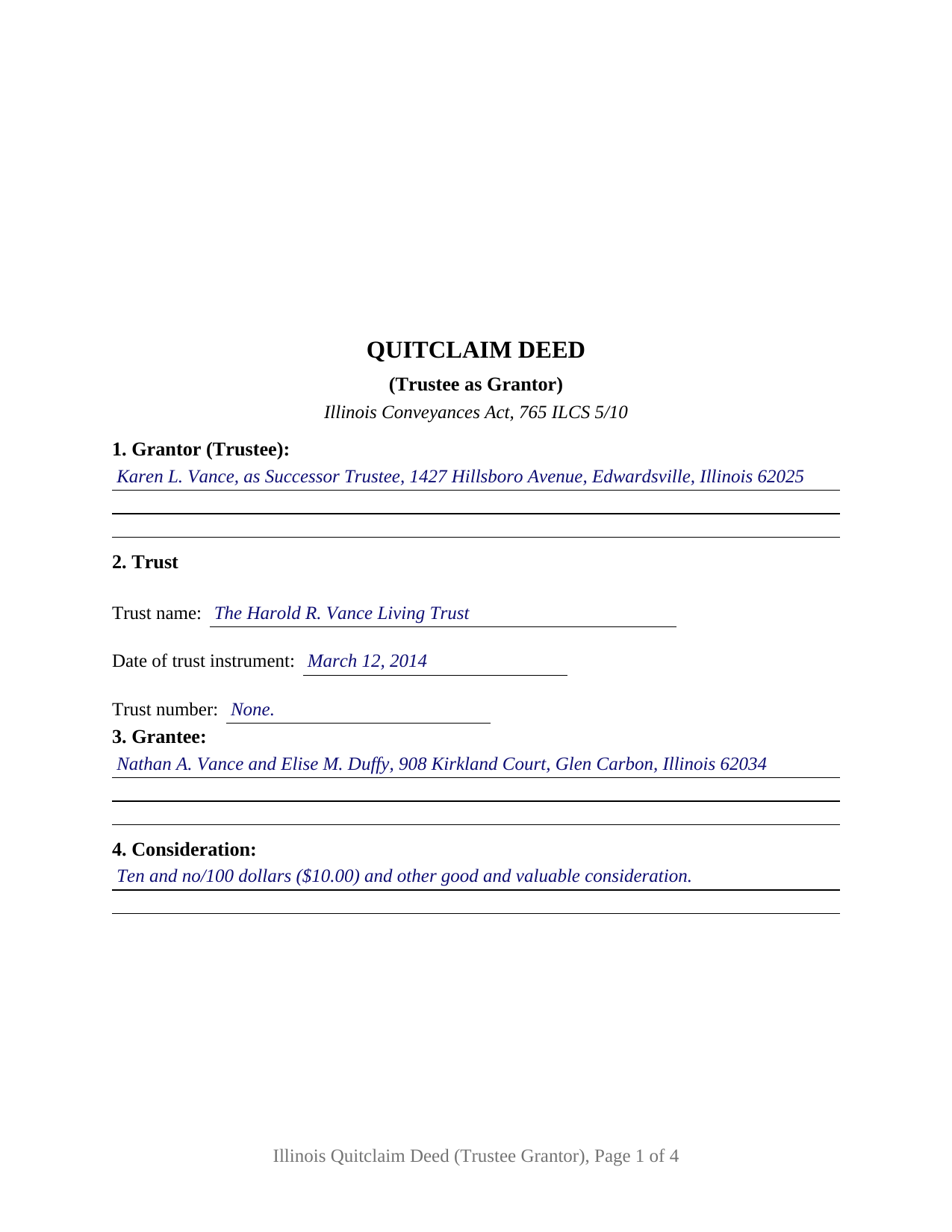
Hancock County Completed Example of the Quitclaim Deed (Trustee Grantor) Document
Example of a properly completed Illinois Quitclaim Deed (Trustee Grantor) document for reference.
All 3 documents above included • One-time purchase • No recurring fees
Immediate Download • Secure Checkout
Additional Illinois and Hancock County documents included at no extra charge:
Where to Record Your Documents
Hancock County Clerk & Recorder
Carthage, Illinois 62321
Hours: 8:00 to 4:00 Monday through Friday
Phone: (217) 357-3911
Recording Tips for Hancock County:
- Bring your driver's license or state-issued photo ID
- Ensure all signatures are in blue or black ink
- Ask about their eRecording option for future transactions
- Avoid the last business day of the month when possible
- Both spouses typically need to sign if property is jointly owned
Cities and Jurisdictions in Hancock County
Properties in any of these areas use Hancock County forms:
- Augusta
- Basco
- Bowen
- Carthage
- Colusa
- Dallas City
- Elvaston
- Ferris
- Hamilton
- La Harpe
- Nauvoo
- Niota
- Plymouth
- Sutter
- Warsaw
- West Point
Hours, fees, requirements, and more for Hancock County
How do I get my forms?
Forms are available for immediate download after payment. The Hancock County forms will be in your account ready to download to your computer. An account is created for you during checkout if you don't have one. Forms are NOT emailed.
Are these forms guaranteed to be recordable in Hancock County?
Yes. Our form blanks are guaranteed to meet or exceed the applicable formatting requirements used for recording in Hancock County, including margin requirements, font requirements, and other layout standards. This guarantee applies to formatting, not to the legal sufficiency of information entered by the user or the suitability of a form for a particular transaction.
Can I reuse these forms?
Yes. You can reuse the forms for your personal use. For example, if you have multiple properties in Hancock County you only need to order once.
What do I need to use these forms?
The forms are PDFs that you fill out on your computer. The free Adobe Acrobat Reader is recommended, and most PDF apps also work. You do NOT enter your property information online - you download the blank forms and complete them privately on your own computer.
Are there any recurring fees?
No. This is a one-time purchase. Nothing to cancel, no memberships, no recurring fees.
How much does it cost to record in Hancock County?
Recording fees in Hancock County vary. Contact the recorder's office at (217) 357-3911 for current fees.
Questions answered? Let's get started!
A trust cannot hold a pen. When Illinois real estate stands in a trustee's name and the time comes to move it back out, the deed is signed by whoever occupies that office, in the capacity the office carries. This quitclaim deed is arranged for exactly that conveyance: one trustee as the sole Grantor, with the trust identified by name, date, and number.
The office signs, not the trust
Section 1 names the person or entity serving as trustee, and Section 12 gives that signer a single signature line, because the power to convey belongs to the office. 760 ILCS 3/815 gives a trustee, without court authorization, all powers over trust property that an unmarried owner with legal capacity has over individually owned property, and 760 ILCS 3/816 adds specific powers, among them sale and the execution of conveyances. A successor trustee named years later conveys under that same authority. What narrows it is the trust instrument, which is why this deed identifies the trust instead of reprinting its terms, and why underwriters read the instrument or a certification of trust under 760 ILCS 3/1013, prepared separately and not included here.
Capacity stated, personal liability disclaimed
The operative section says the Grantor acts as trustee and not individually, and adds that no obligation arising from the conveyance is personal to the person or entity serving as trustee. That answers 760 ILCS 3/1010(a): a trustee escapes personal liability on a contract properly entered into in the fiduciary capacity where that capacity was disclosed. The other side of the relationship is 760 ILCS 3/1012, which protects someone dealing with a trustee in good faith and for value, without knowledge that the trustee is exceeding its powers.
Express trust or land trust, on the grantor side
Illinois keeps two title-holding regimes, and the trust entries accept either. A revocable or irrevocable trust is an express trust under the Illinois Trust Code, in force since January 1, 2020. A land trust sits outside that Code by the terms of 760 ILCS 3/102, leaving the trust agreement and Illinois common law to govern the land trustee, whose beneficiaries hold personal property under In re Estate of Alpert. The difference shows on the grantor side: a land trustee ordinarily conveys at its beneficiaries' written direction, and the trust number blank is how a numbered land trust is recognized in a chain of title.
What the trustee grantor configuration carries
The form recites one Grantor block, three trust entries, one signature line whose printed name states the capacity, and one acknowledgment certificate tracking the substance of 765 ILCS 5/26. Patterns presenting this configuration include a successor trustee distributing a parcel to the beneficiaries once a revocable trust turns distributive, a trustee releasing a fractional interest to the co-owner buying it out, and a land trustee closing a numbered trust. The form is not set up for two cotrustees signing together, and it is not the receiving side of the relationship, where a grantee clause runs to a trustee and to successors in trust. Homestead property carrying the entirety statement 765 ILCS 1005/1c permits inside a revocable trust is its own case, because that section makes a deed effective only on both tenants' signatures.
Only what the trust held
765 ILCS 5/10 makes a deed in quitclaim form a release in fee of the legal and equitable rights the grantor holds at delivery, carrying no covenant of title, and after-acquired title stays outside unless words are added reaching it. Mortgages, judgments, tax liens, easements, and plat restrictions of record follow the parcel into the Grantee's hands.
At the recorder's counter
The deed gathers the face-of-document items Illinois conditions recording on, then settles transfer tax either way. A taxable trustee's deed travels with the PTAX-203 declaration or its MyDec electronic equivalent and the revenue stamps; an exempt one records on the signed and dated notation the form prints, with a blank for the paragraph of 35 ILCS 200/31-45 relied on. Page geometry follows the statewide format standards, so the printed deed lands in the standard class.
Three files arrive with the purchase: the fillable trustee quitclaim deed, an example completed from the trust entries through the notary's commission date for a Madison County distribution, and a guide walking every numbered section, the trust and homestead questions, notarization, and recording. None of this is legal advice; it describes Illinois law in general terms, and a question about one particular trust or title belongs with an Illinois attorney.
Important: Your property must be located in Hancock County to use these forms. Documents should be recorded at the county recording office listed above.
This Quitclaim Deed (Trustee Grantor) meets all recording requirements specific to Hancock County.
Our Promise
The documents you receive here are guaranteed to meet or exceed the applicable Hancock County recording format requirements. If there is a rejection caused by our formatting, we will correct the issue or refund your payment. This guarantee applies to document formatting only and does not extend to information entered by the user, the selection of the form, or the legal effect of the completed document.
Save Time and Money
Get your Hancock County Quitclaim Deed (Trustee Grantor) form done right the first time with Deeds.com Uniform Conveyancing Blanks. At Deeds.com, we understand that your time and money are valuable resources, and we don't want you to face a penalty fee or rejection imposed by a county recorder for submitting nonstandard documents. We constantly review and update our forms to meet rapidly changing state and county recording requirements for roughly 3,500 counties and local jurisdictions.
4.8 out of 5 - ( 4,828 Reviews )
Christine K. 5 out of 5 stars
This site was fast and easy to use. I would highly recommend using them. Thank you Deeds.com!!!!
We appreciate your business and value your feedback. Thank you. Have a wonderful day!
Vanessa W. 5 out of 5 stars
This site is very useful and reasonable. Comes in handy when you need a deed in other states.
We appreciate your business and value your feedback. Thank you. Have a wonderful day!
cynthia k. 5 out of 5 stars
Very easy thank you
Thank you!
Paula S. 5 out of 5 stars
I highly recommend this website. It was quick and easy with very helpful guides and examples! I am so very thankful that I stumbled across the Deed website! Definitely worth every penny spent!
We appreciate your business and value your feedback. Thank you. Have a wonderful day!
Barbara A. 5 out of 5 stars
Much easier than going to the courthouse!
Thank you for your feedback. We really appreciate it. Have a great day!
JoAnn T. 5 out of 5 stars
Very happy! This was a very easy to use web site, the form came with directions and an example, both were very helpful. I will absolutely use Deeds.com in the future.
Thank you for your feedback. We really appreciate it. Have a great day!
Mary Ann G. 2 out of 5 stars
Couldn't find the deed form that I needed. Needs to have a short summary to determine the correct form.
Sorry to hear that Mary Ann, we appreciate your feedback.
Will O. 5 out of 5 stars
Saved me so much time and $!!
Thank you!
DENISE E. 5 out of 5 stars
I just submitted a beneficiary deed and it was accepted immediate and then recorded the next day! I like that I receive email messages notifying me of the process. The process was super easy and seamless. It's saved me so much time that I did not have to drive to downtown Phoenix to have this document record it. I love Deeds.com.
Thank you for your feedback. We really appreciate it. Have a great day!
Joanne W. 5 out of 5 stars
I was very pleased to find this service, as (another website) charges about $40 for the same service, so yours was a bargain.
Thank you!
Ellen O K. 5 out of 5 stars
Good experience. Easy peasy. :)
Thank you Ellen, have a wonderful day!
Vicki L. 5 out of 5 stars
Quick results with accurate information and thorough information.
Thank you!
shelley m. 5 out of 5 stars
I thought the service was good
Thank you Shelley. Have a fantastic day!
Tonya B. 5 out of 5 stars
Easy and fast. I will definitely use this service again.
Thank you for your feedback. We really appreciate it. Have a great day!
Michael D. 5 out of 5 stars
Quick and easy!
Thank you!