Illinois Quitclaim Deed (Trustee Grantor)
County Specific Legal Forms Validated as recently as September 11, 2026 by our Forms Development Team
About the Illinois Quitclaim Deed (Trustee Grantor)
How to Use This Form
- Select your county from the list
- Download the county-specific form
- Fill in the required information
- Have the document notarized if required
- Record with your county recorder's office
What Others Like You Are Saying
"I love how you can get information you need online great program ,outstanding just love it...."
"Was able to sell a property with the information obtained from your website without using an attorne…"
"The form was incompatible with my son's new computer. I do not have a printer. We did use your form …"
"Did not like that the lines aren't lining up smoothly to make the document look more professional."
"This site was easy to use."
4.8/5 from 4,828 reviews. Read all
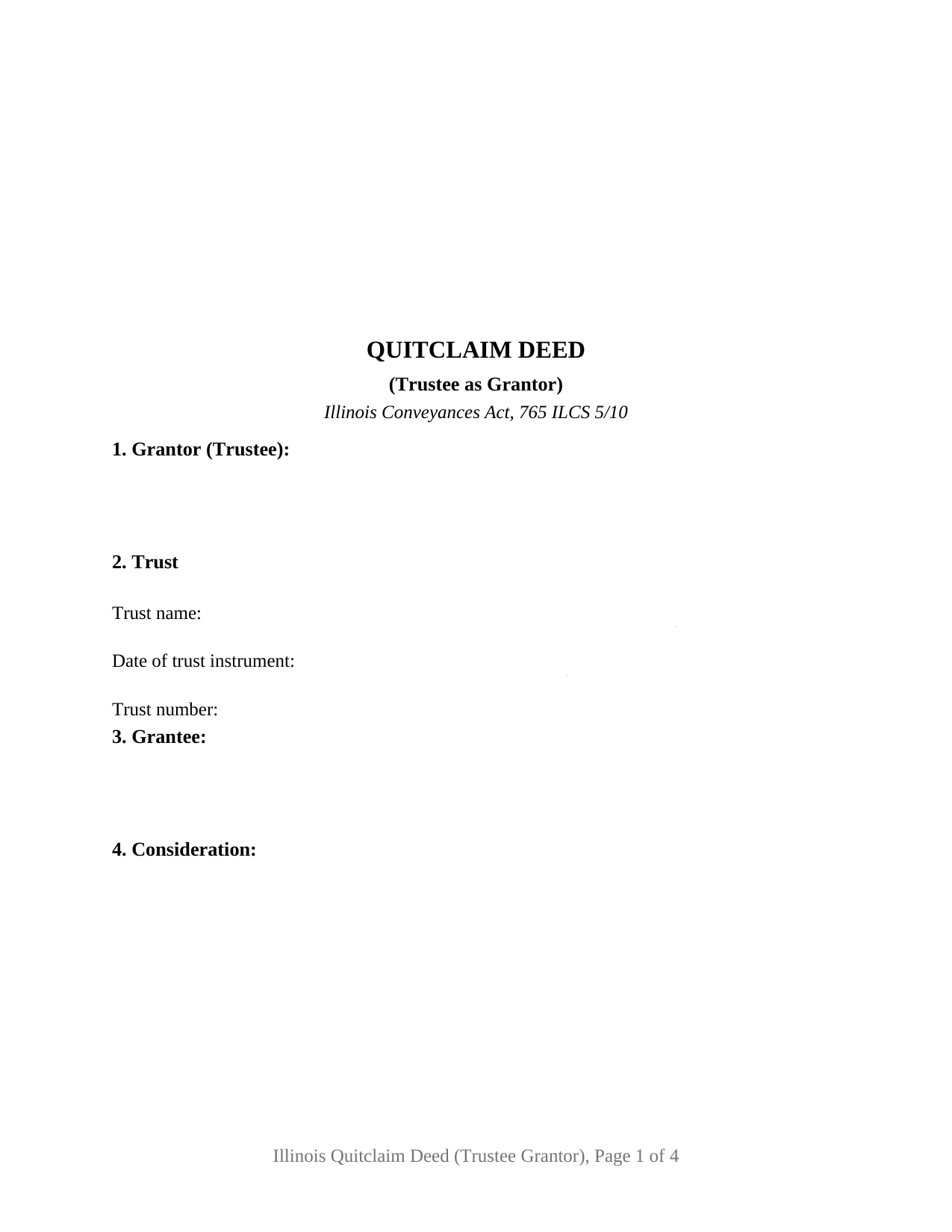
A trust cannot hold a pen. When Illinois real estate stands in a trustee's name and the time comes to move it back out, the deed is signed by whoever occupies that office, in the capacity the office carries. This quitclaim deed is arranged for exactly that conveyance: one trustee as the sole Grantor, with the trust identified by name, date, and number.
The office signs, not the trust
Section 1 names the person or entity serving as trustee, and Section 12 gives that signer a single signature line, because the power to convey belongs to the office. 760 ILCS 3/815 gives a trustee, without court authorization, all powers over trust property that an unmarried owner with legal capacity has over individually owned property, and 760 ILCS 3/816 adds specific powers, among them sale and the execution of conveyances. A successor trustee named years later conveys under that same authority. What narrows it is the trust instrument, which is why this deed identifies the trust instead of reprinting its terms, and why underwriters read the instrument or a certification of trust under 760 ILCS 3/1013, prepared separately and not included here.
Capacity stated, personal liability disclaimed
The operative section says the Grantor acts as trustee and not individually, and adds that no obligation arising from the conveyance is personal to the person or entity serving as trustee. That answers 760 ILCS 3/1010(a): a trustee escapes personal liability on a contract properly entered into in the fiduciary capacity where that capacity was disclosed. The other side of the relationship is 760 ILCS 3/1012, which protects someone dealing with a trustee in good faith and for value, without knowledge that the trustee is exceeding its powers.
Express trust or land trust, on the grantor side
Illinois keeps two title-holding regimes, and the trust entries accept either. A revocable or irrevocable trust is an express trust under the Illinois Trust Code, in force since January 1, 2020. A land trust sits outside that Code by the terms of 760 ILCS 3/102, leaving the trust agreement and Illinois common law to govern the land trustee, whose beneficiaries hold personal property under In re Estate of Alpert. The difference shows on the grantor side: a land trustee ordinarily conveys at its beneficiaries' written direction, and the trust number blank is how a numbered land trust is recognized in a chain of title.
What the trustee grantor configuration carries
The form recites one Grantor block, three trust entries, one signature line whose printed name states the capacity, and one acknowledgment certificate tracking the substance of 765 ILCS 5/26. Patterns presenting this configuration include a successor trustee distributing a parcel to the beneficiaries once a revocable trust turns distributive, a trustee releasing a fractional interest to the co-owner buying it out, and a land trustee closing a numbered trust. The form is not set up for two cotrustees signing together, and it is not the receiving side of the relationship, where a grantee clause runs to a trustee and to successors in trust. Homestead property carrying the entirety statement 765 ILCS 1005/1c permits inside a revocable trust is its own case, because that section makes a deed effective only on both tenants' signatures.
Only what the trust held
765 ILCS 5/10 makes a deed in quitclaim form a release in fee of the legal and equitable rights the grantor holds at delivery, carrying no covenant of title, and after-acquired title stays outside unless words are added reaching it. Mortgages, judgments, tax liens, easements, and plat restrictions of record follow the parcel into the Grantee's hands.
At the recorder's counter
The deed gathers the face-of-document items Illinois conditions recording on, then settles transfer tax either way. A taxable trustee's deed travels with the PTAX-203 declaration or its MyDec electronic equivalent and the revenue stamps; an exempt one records on the signed and dated notation the form prints, with a blank for the paragraph of 35 ILCS 200/31-45 relied on. Page geometry follows the statewide format standards, so the printed deed lands in the standard class.
Three files arrive with the purchase: the fillable trustee quitclaim deed, an example completed from the trust entries through the notary's commission date for a Madison County distribution, and a guide walking every numbered section, the trust and homestead questions, notarization, and recording. None of this is legal advice; it describes Illinois law in general terms, and a question about one particular trust or title belongs with an Illinois attorney.
Important: County-Specific Forms
Our quitclaim deed (trustee grantor) forms are specifically formatted for each of the 102 counties in Illinois.
After selecting your county, you'll receive forms that meet all local recording requirements, ensuring your documents will be accepted without delays or rejection fees.