Illinois Quitclaim Deed
County Specific Legal Forms Validated as recently as October 5, 2026 by our Forms Development Team
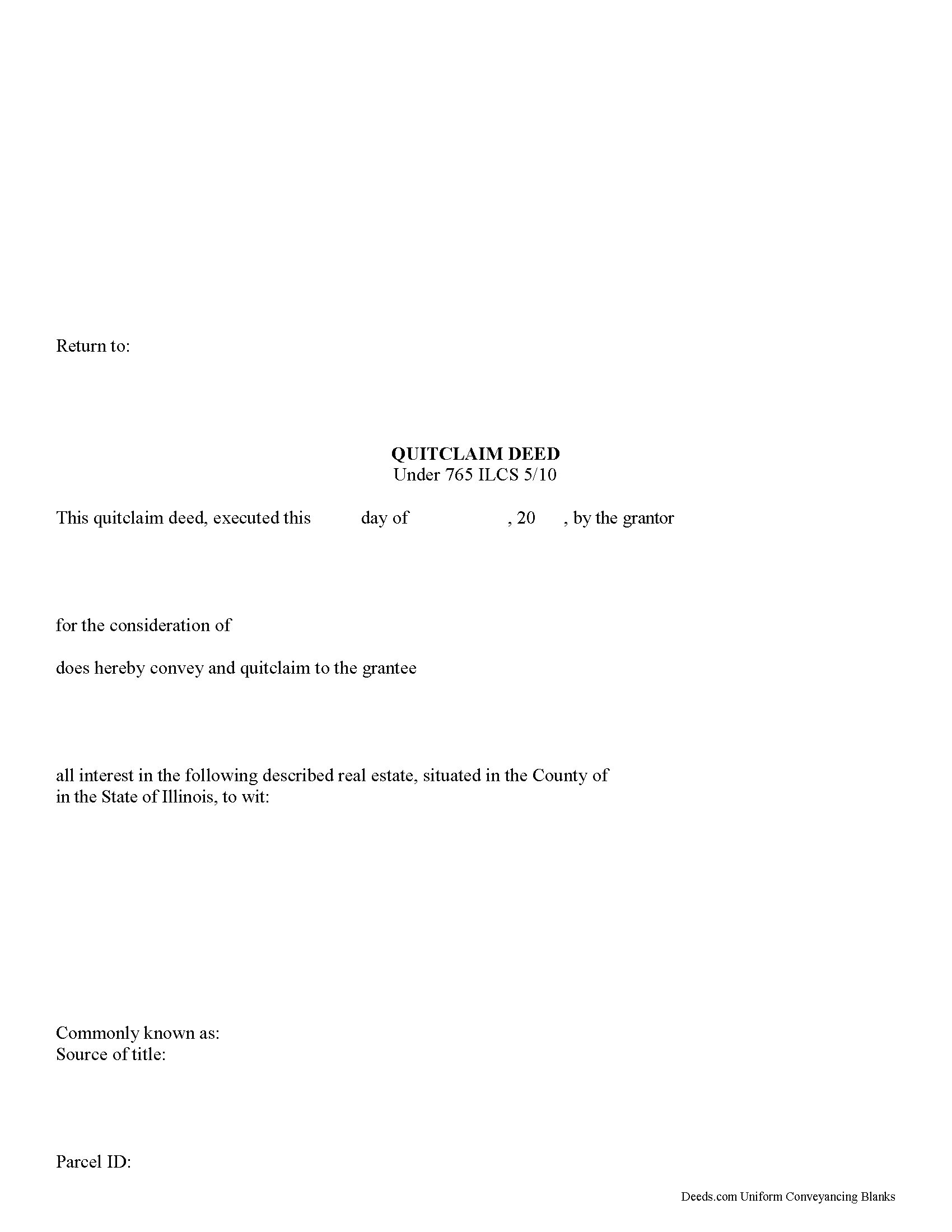
About the Illinois Quitclaim Deed
How to Use This Form
- Select your county from the list
- Download the county-specific form
- Fill in the required information
- Have the document notarized if required
- Record with your county recorder's office
What Others Like You Are Saying
"I found the site to be useful,informative and very accessable. Thank You"
"Purchased the Warranty Deed package for $19.95 which included all the forms I needed including instr…"
"Excellent service! Questions were answered promptly, and the entire process was easy and fast. Thank…"
"Very easy. Very helpful."
"Worked great....WV accepted this document and made the whole process easy...thanks"
4.8/5 from 4,820 reviews. Read all
A quitclaim deed measures what it moves at a single moment. Under 765 ILCS 5/10 the words convey and quit claim release the rights a grantor holds in the premises described when the deed is delivered, and the statute stops there: title arriving afterward stays with the grantor unless the deed adds words expressing that intention. This Illinois form prints those statutory words above party blocks that stay open, one or two individuals on either side.
Released at delivery, and no further
A deed in substance in the statutory form is a good and sufficient conveyance, release, and quitclaim in fee of the grantor's then existing rights, and it promises nothing about what those rights are worth. No covenant of seisin, none against encumbrances, no defense of the title afterward: that is the distance between this instrument and the conveys and warrants form of 765 ILCS 5/9. What the Act does supply sits a few sections over, in 765 ILCS 5/13: absent express words of limitation, whatever the grantor holds passes in fee simple.
Party blocks the form leaves open
Sections 1 and 2 take one or two individuals each, with the residence, status, or co-ownership wording the parties themselves supply, and nothing marital, capacity, or vesting related is printed in advance. Four count patterns run through the one instrument: one grantor to one grantee, one to two, two to one, and two to two. Below them sit two signature blocks headed GRANTOR and SECOND GRANTOR (if applicable), each with an acknowledgment certificate carrying the substance of 765 ILCS 5/26, so two signers may appear before different notaries on different days; a conveyance by one grantor leaves the second block and its certificate empty. Where two grantees are named, the wording in Section 2 fixes how they take, and 765 ILCS 1005/1 answers a clause silent on the point by leaving them as tenants in common. A deed executed for a company, a corporation, a partnership, a trustee, or an agent under a power of attorney recites authority these blocks do not collect, and three or more owners on a side exceed their two-party capacity.
Homestead, stated and never assumed
The homestead estate moves on express words alone. 765 ILCS 5/27 construes no instrument as releasing or waiving that right unless a clause expressly does so, which is why the operative sentence here carries the statutory phrase releasing and waiving all rights under and by virtue of the homestead exemption laws of this State. Signatures are the second half of the question, and they answer to the statute: on an occupied residence 735 ILCS 5/12-904 measures a valid release of the exempt estate by a writing the owner and the owner's spouse have both signed, a signature the second block carries.
What a recorder reads before taking the deed
Illinois conditions recording on content printed on the face of the instrument, and each item occupies a numbered section: the grantee's name and address under 55 ILCS 5/3-5026, the tax bill endorsement of 765 ILCS 5/35c, the return entry and the prior document number under 55 ILCS 5/3-5020.5, and the preparer statement 55 ILCS 5/3-5022 makes a condition of recording. Geometry answers 55 ILCS 5/3-5018.2 and 55 ILCS 5/4-12002.3, down to the blank 3 by 5 inch space at the upper right corner of page one. One rule is this instrument's own: in a county of 3,000,000 or more inhabitants, 55 ILCS 5/3-5046 has the recorder mail notice to the owners of record whenever a quitclaim deed is filed.
One of two transfer tax routes
State tax under 35 ILCS 200/31-10 runs at 50 cents for each $500 of value, a county board may add up to 25 cents, and a municipality that has certified a home rule ordinance to the recorder stops the filing until its own tax is shown paid. A taxable transfer reaches the counter with the PTAX-203 declaration or its MyDec equivalent and the stamps. An exempt transfer instead carries the signed and dated notation Section 12 prints, naming the paragraph of 35 ILCS 200/31-45 the transfer rests on.
The download holds three files: the fillable Illinois quit claim deed form, a completed example filled in for a DuPage County transfer through the notary's commission expiration date, and a guide covering each numbered section along with signing, homestead, notarization, and county recording. These pages describe Illinois law in general terms and are not legal advice; an Illinois attorney or title company can speak to one particular title.
Important: County-Specific Forms
Our quitclaim deed forms are specifically formatted for each of the 102 counties in Illinois.
After selecting your county, you'll receive forms that meet all local recording requirements, ensuring your documents will be accepted without delays or rejection fees.